Table of Contents
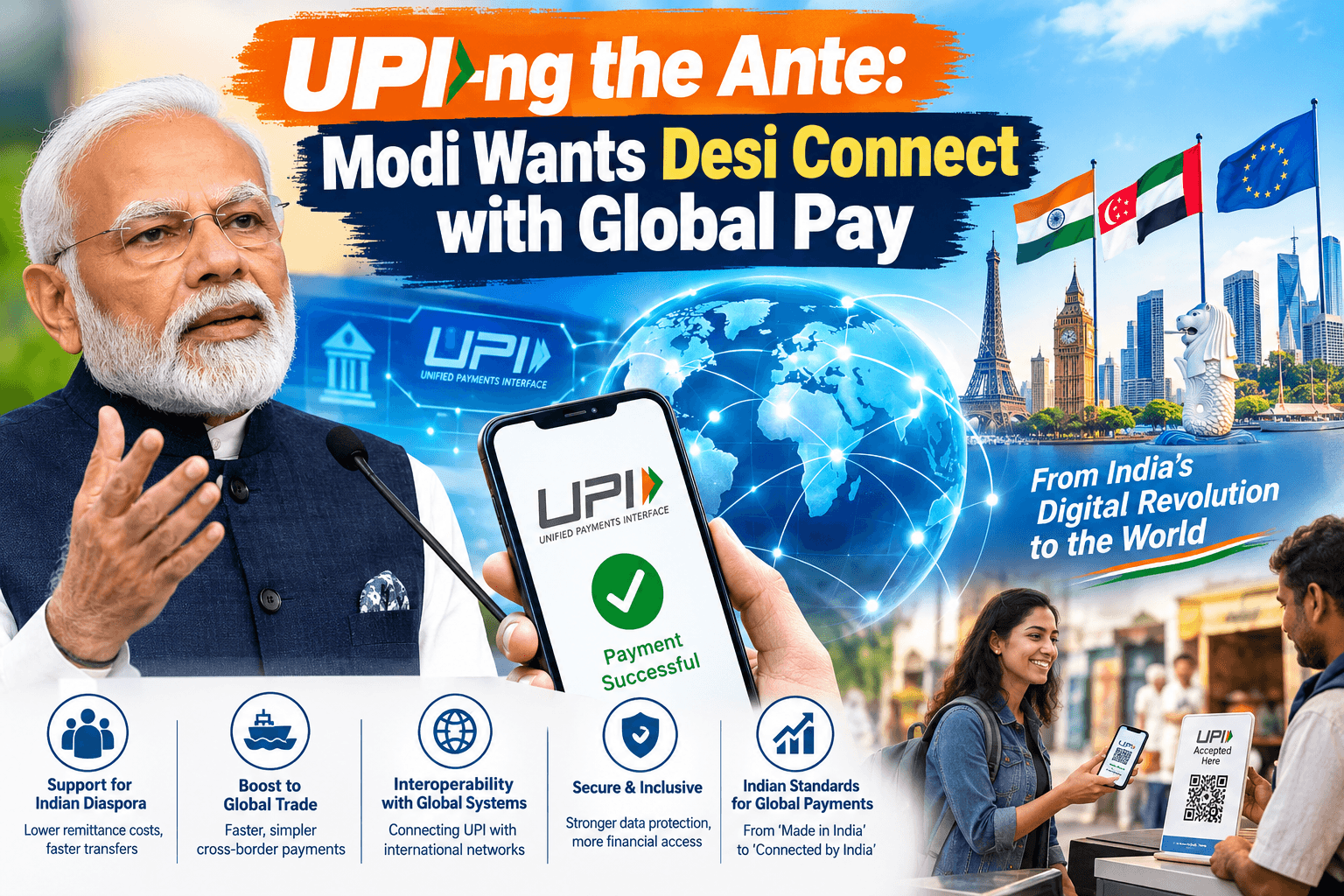
India’s digital payments revolution is entering a new phase. After transforming the way millions of Indians pay for everything from groceries and transport to utility bills and online purchases, the Unified Payments Interface (UPI) is now being positioned as a global payment bridge.
.
Inroduction
Prime Minister Narendra Modi has called for India to go beyond simply making UPI available in other countries. The next objective, he said, should be to connect UPI directly with the local payment systems of other nations.
Speaking at the Global Fintech Fest 2026 in Mumbai, Modi argued that countries with large Indian diaspora populations, significant trade with India, or a willingness to collaborate on digital payments should be prioritised for such integration.
The message is significant: India does not merely want UPI to be accepted abroad. It wants its home-grown digital payment infrastructure to become part of the architecture of global payments.
From Indian Innovation to Global Infrastructure
UPI was launched in 2016 with a relatively simple proposition: make bank-to-bank payments instant, convenient and interoperable.
A decade later, it has become one of the defining components of India’s digital economy.
According to the government, UPI processed more than 24 billion transactions in August 2026 alone. The platform is now live in 11 foreign countries, demonstrating that the technology has moved well beyond India’s borders.
The scale of domestic adoption has created an opportunity for India to export not just a payment application, but an entire digital-payment model.
Modi’s latest proposal takes that ambition a step further.
Instead of treating UPI as an isolated Indian system that happens to work in certain foreign markets, India wants to establish interoperability between UPI and other national fast-payment networks.
Singapore provides an important example.
India’s UPI has already been linked with Singapore’s PayNow system. This enables faster cross-border transfers between the two countries and demonstrates what interoperability between national payment systems can look like.
Now, the government wants similar connections with more countries.
What Does “Global UPI” Actually Mean?
There is an important distinction between UPI acceptance abroad and UPI interoperability.
At present, Indian users can use UPI at participating merchants in several countries. NPCI’s international UPI service enables users to scan eligible QR codes and pay directly from linked Indian bank accounts.
But connecting two national payment systems is a bigger proposition.
Imagine an Indian worker in another country sending money home without depending on a complicated chain of intermediaries. Or an Indian traveller paying a local merchant abroad using the same familiar payment interface used at home.
Similarly, businesses involved in India-linked trade could potentially benefit from faster and more efficient settlement mechanisms.
That is the broader vision behind Modi’s push.
Indian Diaspora Could Be a Major Beneficiary
One of the strongest arguments for expanding UPI internationally is India’s enormous overseas community.
Millions of Indians work and live outside the country, and large sums of money are sent back to families in India every year.
Cross-border remittances can involve fees, currency conversion costs and multiple intermediaries. Even a relatively small reduction in transaction costs can make a meaningful difference when the total volume of remittances is enormous.
Modi argued that wider UPI integration could help reduce these costs and allow money to reach Indian families more quickly.
This makes the globalisation of UPI more than a technology story.
It is also a financial-inclusion story.
For an Indian worker abroad, a faster and cheaper way of sending money home could directly increase the amount ultimately received by a family in India.
Trade Could Get a Digital Boost
The second major area of opportunity is international trade.
India’s trade relationships span Asia, Europe, the Middle East, Africa and other regions. As cross-border commerce becomes increasingly digital, payment infrastructure is becoming an important part of economic competitiveness.
Modi has therefore suggested prioritising countries where India has substantial trade volumes.
If national payment systems can communicate with each other efficiently, businesses could potentially benefit from faster payments and fewer intermediaries.
This could be particularly valuable for smaller businesses.
Large multinational companies already have access to sophisticated banking and payment infrastructure. Small exporters, freelancers, merchants and service providers often face greater friction when receiving international payments.
A more interoperable payment ecosystem could help narrow that gap.
India Wants Its Own Standards
Perhaps the most ambitious element of Modi’s message is not simply the expansion of UPI itself, but the creation of Indian standards and protocols for international payments.
For decades, global card-payment infrastructure has relied heavily on standards and networks developed outside India.
India’s digital-payment revolution has demonstrated that a large economy can build a different model.
UPI was designed around interoperability, bank connectivity and real-time transactions rather than traditional card-centric infrastructure.
Modi argued that India now has the capability to develop its own rules and standards and connect them with the wider world.
That represents a major shift in India’s technological ambitions.
The goal is no longer simply to adopt global technology.
The goal is increasingly to create technology and standards that can become globally relevant.
UPI’s International Footprint Is Already Growing
The global expansion of UPI is not merely a future proposal.
According to the Indian government, UPI is already operational in 11 foreign countries for acceptance and/or cross-border remittances. Recent additions include Cambodia, Greece and the Maldives.
The government has also highlighted UPI’s presence in countries including Bhutan, Nepal, Singapore, the UAE, France, Sri Lanka, Mauritius and Qatar.
This footprint gives India a foundation on which to build.
The next challenge is making these connections deeper and more interoperable.
Why Singapore Matters
Singapore is arguably the clearest example of the model India wants to replicate.
The linkage between UPI and PayNow allows users in the two countries to transfer money through connected digital payment systems.
Modi specifically referred to the India-Singapore connection as an example of how payments can become almost as seamless across borders as they are within a country.
Replicating that model elsewhere could significantly increase the usefulness of UPI.
Instead of having separate systems that simply accept each other’s payments, countries could create interconnected digital-payment rails.
That could eventually become an important layer of global financial infrastructure.
The “Desi” Advantage
The phrase “desi connect” captures an important part of India’s strategy.
UPI’s success is closely tied to India’s domestic digital ecosystem.
Affordable smartphones, widespread mobile connectivity, bank-account penetration, QR-code payments and a large technology industry created favourable conditions for rapid adoption.
But UPI’s appeal abroad will depend on whether those advantages can translate into different economic and regulatory environments.
Every country has its own banking regulations, privacy rules, currency controls and financial infrastructure.
Therefore, global expansion will require partnerships rather than simple replication.
India will have to work with regulators, central banks, commercial banks and payment networks in other countries.
Security and Data Protection Will Be Critical
Global payment expansion also brings serious challenges.
The more international a payment network becomes, the more important cybersecurity, fraud prevention, consumer protection and data governance become.
Recent developments underline this point.
A proposed connection involving Alipay+ and UPI has faced scrutiny in India over security and data concerns, demonstrating that cross-border payment integration can involve sensitive questions about technology, ownership and national security.
For UPI to become a trusted international platform, India will need to maintain strong standards for data protection and cybersecurity.
Convenience cannot come at the cost of consumer security.
Competition in the Global Payments Market
India is not entering an empty market.
International payments are already dominated by established card networks, banks, fintech companies and digital-wallet platforms.
UPI’s biggest advantage is its proven scale.
India has already demonstrated that instant, low-friction digital payments can work for a population of more than a billion people.
The challenge is proving that the model can work across borders.
If UPI can establish successful links with a growing number of national payment systems, India could become an important standard-setter in the global digital-payments ecosystem.
From Payments to a Larger Fintech Ecosystem
Modi’s message also comes at a time when India’s fintech industry is looking beyond basic payments.
The first phase of India’s fintech revolution was largely about moving money digitally.
The next phase could involve lending, insurance, wealth management, cybersecurity, artificial intelligence and other financial services.
UPI provides a foundation on which many of these services can be built.
Its massive transaction network generates an ecosystem in which banks, fintech firms and merchants can develop new products.
That makes UPI strategically important beyond the QR code visible at a neighbourhood shop.
What Global UPI Could Mean for Travellers
For ordinary Indians travelling overseas, international UPI integration could make payments simpler.
Instead of carrying large amounts of foreign currency or relying entirely on cards, travellers could potentially use familiar UPI applications wherever participating payment systems are connected.
NPCI already operates UPI Global Acceptance for eligible international merchant transactions, allowing users to scan supported QR codes and pay through participating UPI applications.
For tourists, simplicity is a major advantage.
For merchants, accepting payments from international customers through familiar digital infrastructure could also make transactions easier.
A Potential Boost for Small Businesses
One of the most interesting long-term effects could be on small businesses.
India’s digital-payment revolution brought street vendors, small shops and micro-businesses into the formal digital economy.
The same philosophy could eventually extend to international commerce.
A small Indian exporter or service provider may benefit if cross-border payments become easier, faster and less expensive.
That could help democratise international trade.
Instead of global payments being primarily the domain of large companies, digital payment interoperability could make cross-border commerce more accessible to smaller players.
India’s Digital Public Infrastructure Story
UPI is part of a larger Indian approach often described as Digital Public Infrastructure.
The philosophy is that digital systems should be designed to be interoperable and capable of supporting broad participation.
UPI is perhaps the most visible example because of the sheer number of daily transactions.
But India’s broader digital infrastructure also includes systems for digital identity, document access and other public services.
The international success of UPI could therefore strengthen India’s argument that its digital-public-infrastructure model has relevance beyond its borders.
The Road Ahead
Modi’s latest push signals that India considers the first decade of UPI to be only the beginning.
The domestic revolution has already happened.
Now comes the harder challenge: making the system interoperable internationally.
That will require diplomatic negotiations, regulatory cooperation, technical integration and strong cybersecurity frameworks.
Not every country will adopt the same model.
Some nations may prefer bilateral connections. Others may want regional payment networks. Some may have competing domestic systems.
India will therefore need a flexible strategy.
The objective should not necessarily be to make UPI the only global payment network.
Rather, it could be to make UPI one of the major interoperable payment systems connecting national digital economies.
Conclusion: From “Made in India” to “Connected by India”
The story of UPI has already gone far beyond a mobile payment app.
It represents India’s ability to build large-scale digital infrastructure and deploy it across a diverse population.
Now Prime Minister Narendra Modi wants to take that achievement onto the global stage.
The immediate priorities are clear: connect UPI with payment systems in countries with large Indian populations, strengthen links with major trading partners, reduce remittance costs and develop Indian standards that can connect seamlessly with international networks.
If successful, the result could be significant.
A technology created to make everyday payments easier for Indians could evolve into an important component of international financial connectivity.
The next decade may therefore determine whether UPI remains primarily India’s digital payment success story or becomes something much larger: a global payment bridge with an unmistakably Indian foundation.
For now, the message from New Delhi is clear.
India does not want to simply participate in the future of digital payments.
It wants to help shape it.
Editor’s Note
India’s digital payments story is no longer limited to the convenience of paying for a cup of tea with a smartphone. Over the past decade, the Unified Payments Interface, better known as UPI, has transformed the way Indians send and receive money. What began as an ambitious domestic digital-payment initiative has now emerged as one of the most closely watched developments in the global fintech landscape.
The idea of taking UPI beyond India’s borders therefore deserves attention not merely as a technology story, but as a larger economic and strategic development.
Prime Minister Narendra Modi’s push for deeper integration between UPI and payment systems in other countries reflects an important shift in India’s digital ambitions. The objective is not simply to allow Indian travellers to scan QR codes abroad. A more interconnected payment ecosystem could potentially make cross-border transactions easier for tourists, workers, students, businesses and the millions of members of the Indian diaspora living around the world.
For ordinary users, the biggest attraction is simplicity. People are accustomed to instant payments at home, and naturally expect similar convenience when they travel or conduct business internationally. If payment systems can communicate with one another securely and efficiently, cross-border transactions could become faster, more transparent and potentially less expensive.
The opportunity for small businesses is equally significant. International payments have traditionally involved banks, card networks and other intermediaries, often creating additional costs and complexity. Greater interoperability could help smaller merchants, exporters, freelancers and service providers participate more easily in the global digital economy.
However, the internationalisation of UPI should not be viewed as a guaranteed success. Payment systems operate within different regulatory, legal and financial environments. Countries have their own rules regarding data protection, cybersecurity, consumer rights, currency management and financial supervision. Any international expansion will therefore require careful cooperation between governments, central banks, financial institutions and technology companies.
Security must remain at the heart of this expansion. The convenience of instant payments can only deliver lasting value if users have confidence that their money and personal information are protected. As UPI becomes more connected internationally, the importance of fraud prevention, authentication, privacy and resilient digital infrastructure will grow substantially.
There is also a larger question about India’s place in the global digital economy. For years, India has been known primarily as a major technology-services destination. UPI represents something different: an example of infrastructure developed at enormous scale for the domestic market and now being considered for international use.
The success of this effort could strengthen India’s position as a creator of digital infrastructure and standards rather than simply a consumer of technology developed elsewhere.
Our view is that the global expansion of UPI should be judged by one central question: can India make cross-border payments as accessible, secure and seamless as domestic digital payments?
If the answer eventually proves to be yes, UPI could become much more than an Indian payment platform. It could become a bridge connecting India’s digital economy with the wider world.
That possibility makes the global UPI story one worth watching closely.