Table of Contents
Updated September 24, 2026
The meeting between U.S. President Donald Trump and Chinese President Xi Jinping in Washington is being watched as one of the most consequential encounters in the relationship between the world’s two largest economies.
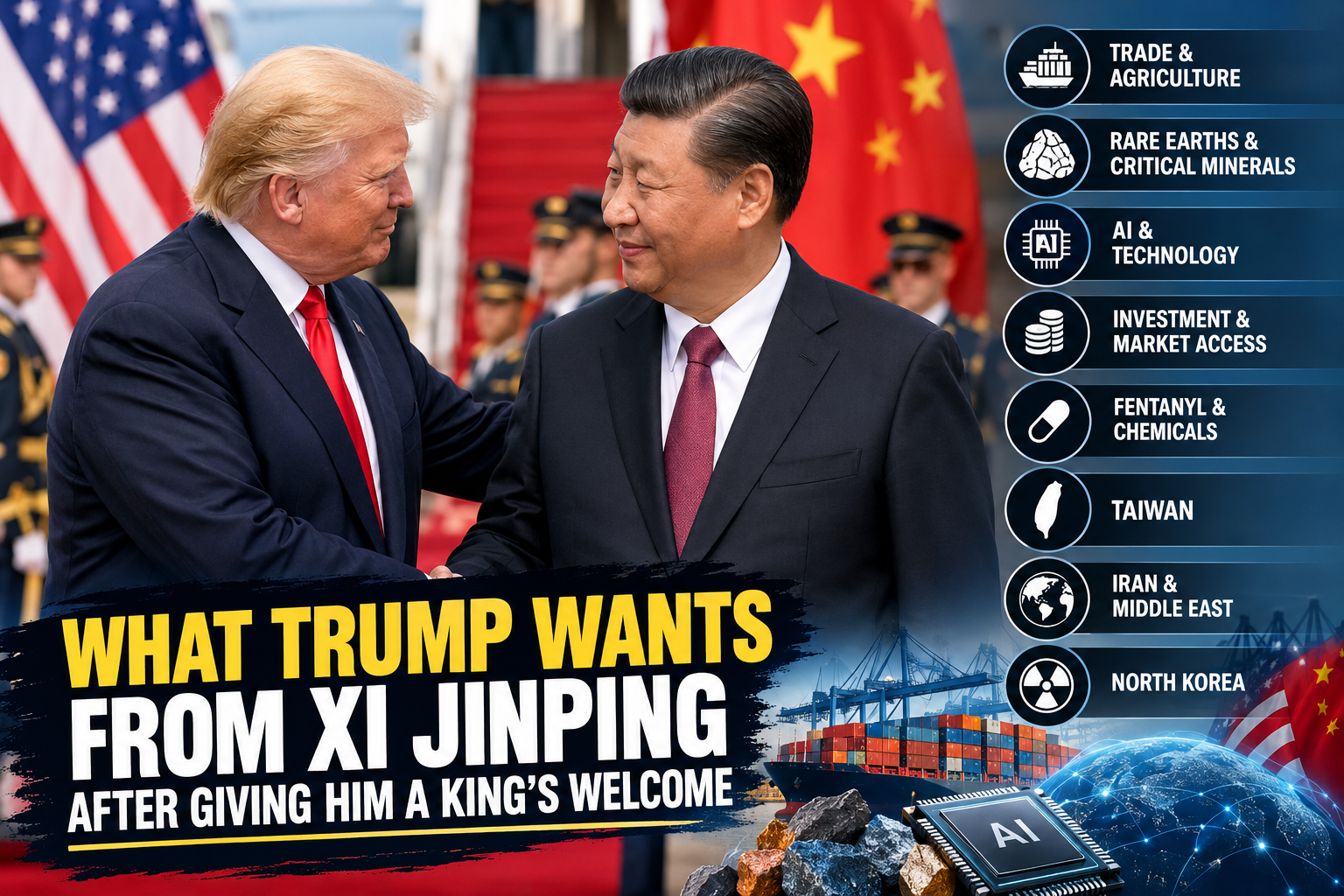
The symbolism is striking. Xi Jinping has received an unusually elaborate welcome, including a personal greeting from Trump at Joint Base Andrews, a formal state arrival ceremony and a White House reception involving hundreds of U.S. military personnel. The visit is Xi’s first trip to Washington in more than a decade.
But behind the pageantry is a long list of difficult negotiations.
Trump is not simply hosting Xi for diplomatic spectacle. Washington is seeking concrete outcomes on trade, rare-earth supplies, technology, artificial intelligence, agricultural purchases, investment, fentanyl-related chemicals and broader geopolitical issues. At the same time, China has its own demands, including greater stability in the relationship, continued access to markets and technology, and discussions over Taiwan.
The central question is therefore not simply why Trump is giving Xi such a grand welcome.
It is what the U.S. president hopes to get from Beijing after giving its leader such an extraordinary diplomatic reception.
A Welcome Designed to Send a Message
Xi’s arrival in Washington comes at an important moment in U.S.-China relations.
The two governments have spent years moving between confrontation and negotiations. Tariffs, semiconductor restrictions, rare-earth controls, technology competition and disputes over Taiwan have repeatedly threatened to push the relationship toward a deeper economic and strategic split.
Yet the Trump administration has also been trying to establish what it calls a more stable relationship with Beijing.
At their May 2026 summit in Beijing, Trump and Xi agreed on a framework described by Washington as a “constructive relationship of strategic stability,” with an emphasis on fairness and reciprocity. The two sides also created new mechanisms for managing trade and investment relations.
That makes the September meeting less about starting negotiations from zero and more about testing whether the emerging détente can survive difficult issues.
The elaborate welcome for Xi is therefore both diplomatic theater and political signaling.
The White House has made clear that this is a major state visit. The official program includes a state arrival ceremony, military honors, national anthems and a large military presence.
But symbolism does not eliminate bargaining.
In fact, the more spectacular the welcome, the more closely observers will examine what comes afterward.
1. Trump Wants Trade Stability
Trade remains at the center of the Trump-Xi relationship.
Trump has long treated tariffs and market access as major instruments of U.S. economic policy. China, meanwhile, remains one of America’s largest trading partners and a crucial part of global manufacturing and supply chains.
The two countries have already reached agreements aimed at reducing some of the pressure.
The May agreement included Chinese commitments involving American agricultural products, Boeing aircraft and critical minerals. The White House said China would purchase at least $17 billion per year of U.S. agricultural products in 2026, 2027 and 2028, while also committing to an initial purchase of 200 Boeing aircraft.
Trump now has an interest in making those commitments durable.
The reason is straightforward: a trade agreement that exists only on paper does little to reassure American businesses, farmers and manufacturers.
Reuters reported that Trump is looking for an economic win that he can present to Americans facing concerns about prices, while the two governments seek to preserve a fragile trade détente.
For Washington, therefore, one of the key questions is whether China will continue buying American goods at the scale previously discussed.
That includes agricultural commodities.
American farmers are particularly exposed to changes in Chinese demand because China has historically been a major buyer of U.S. agricultural products.
More purchases could provide an important political and economic benefit for the Trump administration.
2. Rare Earths Are One of Washington’s Biggest Concerns
Few issues illustrate the strategic nature of U.S.-China economic relations better than rare-earth minerals.
Rare earths are used in electronics, electric vehicles, renewable-energy technologies, advanced manufacturing and military equipment.
China has a dominant position in parts of the global rare-earth supply chain, particularly processing.
That gives Beijing considerable leverage.
During previous periods of tension, Chinese restrictions on rare-earth exports created concern in Washington and among American manufacturers.
The May 2026 agreement attempted to address some of those concerns.
The White House said China would address U.S. concerns related to shortages of rare earths and other critical minerals, including yttrium, scandium, neodymium and indium. It also said Beijing would address restrictions involving rare-earth production and processing equipment and technologies.
But implementation is the real challenge.
Reuters and other reporting ahead of the September summit indicate that critical minerals remain a major issue for Washington.
Trump is therefore expected to seek greater certainty.
American companies want to know whether supplies will continue arriving even when Washington and Beijing disagree on other issues.
For the United States, this is about more than today’s prices.
It is about reducing the vulnerability of strategic industries to decisions made in Beijing.
3. The Technology Battle Is Moving Toward AI
The next major battlefield is artificial intelligence.
The United States and China are competing aggressively in AI, advanced computing, semiconductors and related technologies.
Washington wants to maintain its technological advantage, while Beijing wants to prevent American export restrictions from limiting China’s development.
This creates an unusually complicated negotiating environment.
The United States can use technology controls as leverage, but overly broad restrictions can also encourage China to develop independent alternatives.
At the same time, American companies want access to the enormous Chinese market.
Ahead of the summit, AI risk management and technology were expected to be among the subjects discussed by Trump and Xi.
The two countries therefore face a difficult balancing act.
They must compete without allowing competition to become uncontrollable.
For Trump, the objective appears to involve maintaining U.S. technological advantages while finding areas where cooperation remains possible.
That is particularly relevant to AI safety.
China has been advocating dialogue over AI risks while resisting U.S. efforts to constrain Chinese technological development.
This means the AI discussion is unlikely to be simply about whether the two countries cooperate.
The more difficult question is where competition ends and cooperation begins.
4. Trump Has Another Major Concern: Chinese Investment
Trade is not the only economic issue on the table.
Investment is also becoming important.
The United States wants to attract capital, factories and employment while strengthening domestic production.
The May agreement established a U.S.-China Board of Investment to provide a government-to-government forum for investment-related issues.
Washington may want Chinese companies to invest more in the United States, particularly in areas that create jobs and support domestic manufacturing.
That fits into Trump’s broader economic strategy.
Instead of simply importing goods from China, the administration has an interest in encouraging production and investment inside America.
However, investment comes with security concerns.
The United States is increasingly cautious about foreign ownership or investment involving sensitive technologies, data, communications infrastructure and strategically important industries.
This creates a contradiction.
Washington wants Chinese capital in some areas while restricting Chinese involvement in others.
The summit could help define where that line is drawn.
5. Fentanyl and Chemical Exports
Another issue Trump has repeatedly raised with Beijing involves precursor chemicals used in the production of synthetic drugs.
The United States has identified China as a significant source of chemicals that can be used in manufacturing fentanyl and methamphetamine.
China has taken steps to tighten export controls.
Just before the summit, Beijing announced export-permit requirements covering two additional precursor chemicals shipped to the United States, Mexico and Canada, bringing the number of controlled substances to 18.
That move illustrates how economic and law-enforcement issues have become intertwined.
Washington wants China to do more to prevent chemical suppliers from supporting illegal drug production.
Beijing, meanwhile, has criticized the use of tariffs as a response and has emphasized its own actions against illicit drug trafficking.
Trump will therefore be looking for measurable cooperation.
The administration has an obvious domestic interest in demonstrating that engagement with Beijing produces practical results rather than simply diplomatic photographs.
6. Taiwan Will Remain the Most Sensitive Issue
Economic negotiations may dominate headlines, but Taiwan remains one of the most sensitive subjects in the relationship.
China regards Taiwan as part of its territory and opposes moves toward formal independence.
The United States does not recognize Taiwan as an independent country but maintains extensive unofficial relations with Taipei and supplies it with weapons.
The issue has become one of the biggest potential flashpoints between Washington and Beijing.
During the May summit, Taiwan was already a significant concern.
Reporting at the time indicated that Beijing expected Trump to discuss the issue, while Trump’s approach to U.S. military support for Taiwan attracted attention.
Xi’s position is likely to remain focused on preventing what Beijing sees as moves toward Taiwanese independence and limiting U.S. military support for the island.
Trump, meanwhile, has to balance several considerations.
Any major shift in U.S. policy could affect America’s relationships with Taiwan and other allies in the Indo-Pacific.
At the same time, Trump has repeatedly emphasized negotiation and deal-making rather than allowing disputes to automatically escalate.
The September meeting could therefore provide clues about how the administration intends to manage the Taiwan question.
However, major breakthroughs would be difficult.
Taiwan is not simply another trade negotiation.
It is tied to China’s national-security policy, American strategic commitments and broader questions about military power in East Asia.
7. Trump Also Wants China to Help on Iran
The geopolitical agenda extends beyond East Asia.
The war involving Iran has become another factor in the U.S.-China relationship.
Both Washington and Beijing have interests in Middle Eastern stability, particularly because disruptions around the Strait of Hormuz can affect global energy markets.
The White House said in May that Trump and Xi agreed that Iran should not obtain a nuclear weapon and supported reopening the Strait of Hormuz.
China has also been involved diplomatically in discussions concerning Iran.
Ahead of the Washington summit, Chinese Foreign Minister Wang Yi discussed the Middle East situation with U.S. Secretary of State Marco Rubio. Beijing advocated restraint and a return to diplomatic consultations.
For Trump, Chinese diplomatic influence could be useful.
Beijing has economic and diplomatic relationships that Washington does not possess.
The question is whether China is prepared to use that influence in ways that align with U.S. objectives.
This is one area where the summit could expand beyond the traditional U.S.-China agenda.
8. North Korea Is Another Shared Concern
North Korea is another issue where Washington and Beijing have overlapping interests, even though their approaches differ.
China remains an important economic and diplomatic partner for North Korea.
The White House said Trump and Xi had confirmed a shared goal of denuclearizing North Korea during their May meeting.
That does not mean the two countries automatically agree on how to achieve it.
Beijing’s priorities include avoiding instability on its border and preventing a major refugee crisis.
Washington is primarily concerned with North Korea’s nuclear and missile capabilities and the security of U.S. allies in the region.
Still, cooperation between the two powers could potentially influence the broader Korean Peninsula situation.
That makes North Korea another area where Trump may want Xi’s assistance.
Why the Welcome Matters
The unusually personal nature of Trump’s welcome has generated considerable attention.
A U.S. president personally greeting a foreign leader at Joint Base Andrews is unusual. The White House’s planned state ceremony is also highly formal, involving hundreds of military personnel and extensive ceremonial arrangements.
Why make such a show?
One explanation is diplomacy.
Personal relationships matter at the highest level of international politics.
Trump has frequently emphasized his ability to negotiate directly with other leaders. A warm welcome can create an atmosphere in which difficult negotiations become easier.
But there is another dimension.
The symbolism also communicates that Washington does not want uncontrolled confrontation with Beijing.
The United States and China can be strategic competitors while still maintaining communication.
That distinction is increasingly important.
China Is Not Arriving as a Weak Negotiating Partner
It would be a mistake to interpret Trump’s hospitality as evidence that Xi is entering the meeting from a position of weakness.
China remains an enormous economic power.
Its exports have continued to perform strongly, and Beijing possesses leverage over critical minerals, manufacturing and supply chains.
The Associated Press reported that China’s expanding capabilities have given Beijing greater ability to respond to U.S. pressure.
This changes the nature of the negotiation.
Trump can impose tariffs and export restrictions.
Xi can respond through trade, industrial policy, rare-earth controls and diplomatic relationships.
Neither side can easily dictate terms to the other.
That is why the summit is being described by analysts as an effort to stabilize the relationship rather than completely transform it.
What Xi Wants in Return
Understanding Trump’s objectives requires looking at Beijing’s interests as well.
Xi is likely seeking continued trade stability.
China benefits from access to the American market, while Chinese manufacturers also want predictable rules for international commerce.
Beijing is also interested in technology access.
Restrictions on advanced chips and related technologies remain a major concern for China’s technology sector.
AI is another area where China wants dialogue without accepting restrictions that it believes could slow its development.
Taiwan is perhaps even more important.
Xi has a strong interest in preventing additional U.S. military support for Taiwan and avoiding language or policies that Beijing interprets as supporting Taiwanese independence.
In addition, Beijing wants a stable overall relationship.
The Chinese government has emphasized equality, mutual respect and reciprocity in describing its preferred framework for relations with Washington.
That means both sides are looking for stability—but their definitions of stability are not identical.
The Bigger Economic Picture
The stakes go far beyond the United States and China.
Together, the two countries have enormous influence over global manufacturing, technology, energy markets, shipping and investment.
A prolonged confrontation can raise costs for businesses around the world.
Companies may need to redesign supply chains.
Manufacturers may seek alternative suppliers.
Technology companies may have to create separate systems for different markets.
Consumers can eventually face higher prices.
That is why investors and governments across the world are watching the Trump-Xi meeting carefully.
The World Economic Forum described the summit as an attempt to stabilize a fragile trade détente rather than produce a complete reset in relations.
That distinction is important.
The objective may not be friendship.
It may simply be preventing rivalry from becoming an economic crisis.
Why India Is Watching Closely
For India, the Trump-Xi relationship has significant implications.
One of the major consequences of U.S.-China tensions in recent years has been the growth of the “China+1” strategy.
Companies looking to diversify manufacturing away from China have considered India, Vietnam and other economies.
If Washington and Beijing achieve greater economic stability, some companies may reconsider how quickly they need to diversify.
At the same time, reduced tensions could improve global trade conditions.
India also has strategic interests in the Indo-Pacific.
Changes in U.S.-China relations could affect America’s approach to alliances and partnerships in the region.
Rare earths, semiconductor supply chains, artificial intelligence and critical minerals are also increasingly important for Indian industry.
So the outcome of the summit will matter in New Delhi even though India is not sitting at the negotiating table.
A Deal Is Easier to Announce Than to Implement
This may ultimately be the biggest test of the Trump-Xi meeting.
Both governments have demonstrated that they can announce agreements.
The harder part is implementation.
Rare-earth shipments must actually move.
Agricultural purchases must actually occur.
Technology restrictions must be clearly defined.
Chemical export controls must be enforced.
Investment agreements must translate into real projects.
And communication channels must remain open when the next disagreement occurs.
This is particularly important because the U.S.-China relationship has repeatedly gone through cycles of cooperation followed by confrontation.
A successful summit, therefore, should not necessarily be measured by the number of announcements made on one day.
The more meaningful test will be what happens during the months afterward.
What the Trump-Xi Meeting Could Mean for the Future
The meeting is unlikely to eliminate the fundamental rivalry between the United States and China.
Both countries want technological leadership.
Both are competing for influence.
Both are strengthening strategic capabilities.
And both have fundamentally different views on issues such as Taiwan and the international order.
But rivalry does not automatically require permanent escalation.
The two governments can compete while maintaining economic relationships and diplomatic communication.
That appears to be the central idea behind the current period of “strategic stability.”
For Trump, the immediate objectives are practical: trade, agricultural purchases, rare earths, investment, technology, drug-precursor controls and cooperation on selected international crises.
For Xi, the priorities include economic stability, technology access, Taiwan and a relationship with Washington that does not continually threaten China’s development.
The interests overlap in some areas and sharply diverge in others.
The Real Test Comes After the Red Carpet
The images from Washington will inevitably dominate the first headlines.
Trump greeting Xi at the airport.
The red carpet.
Military honors.
The White House ceremony.
The state dinner.
The handshakes.
But diplomacy is ultimately measured by what happens after the cameras leave.
Trump has offered Xi a highly symbolic welcome at a time when Washington and Beijing are attempting to stabilize a relationship defined by competition.
In return, the Trump administration appears to want concrete economic and strategic commitments from China.
Those include reliable access to critical minerals, continued purchases of American goods, cooperation on drug-related chemical controls, investment, dialogue over artificial intelligence and progress on wider geopolitical concerns.
China, meanwhile, will seek its own concessions and assurances.
That makes the Washington summit less a celebration of friendship than a high-level negotiation wrapped in ceremony.
The central question is not whether Trump and Xi can appear cordial.
They clearly can.
The more difficult question is whether that cordiality can produce agreements that survive the next dispute over tariffs, technology, Taiwan, rare earths or global security.
The answer will not come from the welcome ceremony.
It will come from the details of the deals—and, most importantly, from whether Washington and Beijing actually follow through on them.
https://thehommyblogger.com/market-sell-off/news/daily-news/09/2026/
Xi
[…] https://thehommyblogger.com/xi-jinping/news/daily-news/09/2026/ […]