Table of Contents
New Delhi: A tragic cylinder blast in Delhi’s Okhla Phase-I area has left one person dead and four others injured, triggering an emergency response and a police investigation into the circumstances surrounding the explosion.
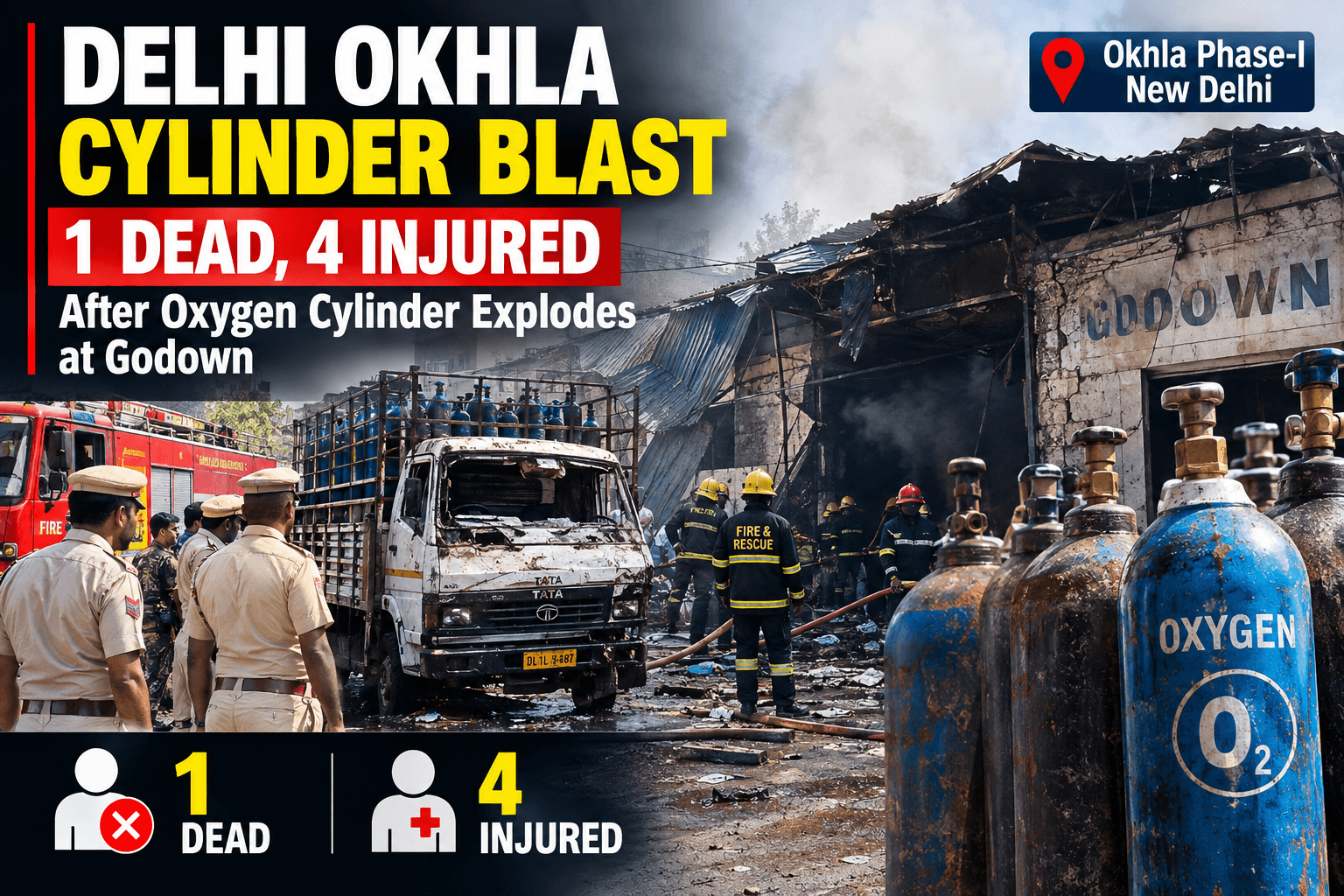
The incident took place at a godown in the industrial area of Okhla Phase-I, where commercial oxygen cylinders were reportedly being handled. According to preliminary information, an oxygen cylinder exploded while a vehicle carrying cylinders was present at the premises.
The blast resulted in a fatality and injuries to four people. Emergency personnel were rushed to the location after information about the incident was received. The injured were taken for medical treatment, while authorities secured the area and began examining the site.
The exact reason why the cylinder exploded has not yet been conclusively established. Investigators are expected to examine the condition of the cylinder, its handling and storage, transportation procedures and the safety arrangements at the premises.
The incident has once again raised concerns about safety standards in industrial and commercial establishments where pressurised cylinders and other potentially hazardous materials are stored or transported.
What Happened in Okhla?
The explosion occurred at a godown in D-23, Okhla Phase-I, an area known for its industrial and commercial establishments.
Preliminary reports indicate that commercial oxygen cylinders were being handled at the premises. A Tata 407 carrying oxygen cylinders was reportedly present when one of the cylinders exploded.
The blast created an emergency situation at the location. People nearby were alerted by the explosion, and emergency services were informed.
Officials responded to the incident and began rescue and relief operations. One person was reported dead, while four others sustained injuries.
The injured victims were moved to a hospital where they could receive medical attention. Authorities are expected to provide further information about their condition as the investigation continues.
At present, the precise sequence of events leading to the explosion remains under investigation.
One Person Dies, Four Injured
The most serious consequence of the Okhla explosion was the death of one person.
Four other people were injured in the incident. Their injuries reportedly occurred as a result of the explosion and its immediate impact.
For the victims’ families, the incident has been a sudden and devastating event. Authorities are working to establish the identities and circumstances of everyone involved.
The condition of the injured remains an important part of the developing investigation. Medical teams are treating those who suffered injuries, while officials are expected to release further details when they are formally confirmed.
The loss of life has also raised questions about whether adequate precautions were in place at the premises where the cylinders were being handled.
Emergency Response After the Blast
Following the explosion, emergency services were quickly mobilised.
Fire service personnel were sent to the area, while other emergency responders assisted at the scene. The priority was to ensure that the situation was brought under control and that injured people could be moved to safety.
In incidents involving oxygen cylinders, emergency responders must also consider the possibility of additional hazards.
Although oxygen itself is not a combustible fuel, it supports combustion. A high concentration of oxygen can cause fires to burn more intensely and rapidly. Cylinders also contain gas under high pressure, making physical damage or failure potentially dangerous.
Emergency teams therefore need to secure the surrounding area and make sure that other cylinders at the site do not create additional risks.
Police Begin Investigation
Delhi Police have started an investigation into the blast.
The first task for investigators is to determine what happened immediately before the explosion.
Investigators are likely to examine the cylinder that exploded, the vehicle involved in transporting the cylinders and the location where the cylinders were being stored.
They may also examine whether the cylinders were properly secured during transportation and whether they were being unloaded or handled according to required safety procedures.
Other factors that could be examined include:
- The condition and age of the cylinder
- Whether the cylinder had undergone required inspection
- How the cylinders were stored
- Whether the cylinders were exposed to excessive heat
- How the cylinders were transported
- Whether trained personnel were handling them
- Whether safety equipment was available
- Whether emergency procedures were in place
- Whether the premises complied with applicable regulations
However, it is important not to assume negligence until authorities complete their investigation.
Exact Cause of Explosion Yet to Be Established
One of the most important unanswered questions is why the cylinder exploded.
A pressurised cylinder can become hazardous if it is damaged, improperly handled or exposed to extreme conditions. Mechanical damage, valve problems, excessive heat and other factors can contribute to dangerous failures.
However, there is currently no confirmed evidence establishing a specific cause in the Okhla case.
Authorities will need to examine physical evidence from the site before determining what caused the explosion.
Forensic and technical examination can help investigators understand whether the cylinder itself failed or whether an external factor contributed to the incident.
The investigation may also determine whether the explosion happened during unloading, storage or another stage of cylinder handling.
Why Oxygen Cylinders Require Strict Safety Measures
Oxygen cylinders are used extensively in hospitals, clinics, industrial units and other facilities.
They are essential for medical care and numerous industrial processes. However, because they contain compressed gas, they require careful handling.
Cylinders need to be protected against falling, impact and physical damage. They should generally be kept in appropriate storage areas and secured so that they cannot easily tip over.
Transportation also requires caution.
A cylinder that is dropped, struck or mishandled can become dangerous. The valve is particularly important because damage to it can cause the gas to escape rapidly.
Oxygen also increases the intensity of combustion. Materials that might burn slowly under ordinary atmospheric conditions can burn much more aggressively in oxygen-rich surroundings.
This is why smoking, open flames and other ignition sources must be kept away from oxygen-storage areas.
Industrial Safety Concerns in Delhi
The Okhla incident has highlighted broader concerns about safety in Delhi’s industrial areas.
Industrial and commercial zones often contain businesses that store chemicals, gases, machinery and other materials requiring specialised safety procedures.
At the same time, many industrial areas operate within densely populated parts of the city.
An accident inside one premises can therefore have consequences beyond the immediate workplace.
A cylinder explosion, fire or chemical accident can potentially affect neighbouring businesses, workers, pedestrians and residents.
Regular inspections and enforcement of safety regulations are therefore critical.
Businesses handling hazardous or pressurised materials must ensure that their employees understand the risks associated with the materials they handle.
Importance of Proper Cylinder Storage
One of the most important aspects of cylinder safety is proper storage.
Cylinders should be kept in designated areas where they are protected from physical damage and excessive heat.
They should also be secured properly so that they cannot fall or roll.
Storage areas should have adequate ventilation and should be kept away from potential ignition sources.
Where multiple cylinders are stored together, businesses need to maintain appropriate separation and organisation.
Poor storage practices can increase the risk of accidents, particularly when cylinders are moved frequently.
Investigators examining the Okhla blast will likely look closely at how the cylinders were positioned and handled at the godown.
Transportation of Cylinders Also Matters
The transportation of oxygen cylinders presents its own safety challenges.
Cylinders need to be secured during transportation to prevent them from moving, falling or colliding with one another.
Workers involved in loading and unloading must also know how to handle cylinders safely.
A vehicle carrying pressurised cylinders should be operated with appropriate precautions, and cylinders should not be treated like ordinary cargo.
The presence of a Tata 407 carrying commercial oxygen cylinders at the Okhla premises is therefore an important part of the investigation.
Authorities will need to establish what stage of the transportation or handling process was underway when the explosion occurred.
Could the Blast Have Been Prevented?
It is too early to say whether the Okhla blast could have been prevented.
That question can only be answered after investigators determine the cause of the explosion and assess the safety conditions at the site.
If the investigation finds that the cylinder failed despite being properly maintained and handled, the incident could represent an accidental equipment failure.
If investigators find evidence of improper storage, transportation, inspection or handling, however, regulatory authorities may examine whether safety violations contributed to the accident.
The distinction is important because determining the root cause can help prevent similar incidents in the future.
Need for Regular Safety Inspections
Industrial establishments handling pressurised cylinders should undergo regular safety checks.
These inspections can help identify damaged cylinders, unsafe storage practices and other potential hazards before they result in an accident.
Workers should also receive regular training.
Safety training should cover cylinder handling, emergency procedures, fire prevention and the correct response to leaks or other dangerous situations.
Businesses should ensure that employees understand not only what they are supposed to do but also what they must avoid.
Small safety violations can sometimes create serious consequences when pressurised gases are involved.
Role of Emergency Preparedness
Every industrial establishment dealing with hazardous materials should have an emergency response plan.
Employees should know how to raise an alarm and contact emergency services.
Fire extinguishers and other appropriate safety equipment should be accessible.
Emergency exits should remain clear, and workers should know where to assemble if evacuation becomes necessary.
Businesses should also maintain accurate information about the materials stored on their premises so emergency responders can assess the risks quickly.
The response to the Okhla incident demonstrates why rapid communication between workers, businesses, police, fire services and medical teams is essential.
Impact on the Local Area
The blast also caused concern among people in the surrounding Okhla industrial area.
An explosion involving a pressurised cylinder can be alarming, particularly when it happens in a busy commercial zone.
People nearby may initially have limited information about what has happened, creating fear and confusion.
Emergency responders must therefore not only address the immediate physical danger but also ensure that surrounding areas remain safe.
Police and emergency agencies may restrict access to the affected premises while investigators examine the site.
Such measures can temporarily affect traffic and nearby businesses, but they are necessary when there is a possibility of additional hazards.
Families Await Answers
For the families of those involved, the most immediate concern is the condition of the injured and the circumstances surrounding the death.
Families often face uncertainty in the immediate aftermath of industrial accidents.
Authorities therefore have an important responsibility to communicate verified information as the investigation progresses.
The identity of the deceased and injured victims should be confirmed through official channels before being widely circulated.
Similarly, speculation about the cause of the explosion should be avoided until investigators establish the facts.
What Investigators Will Look For
Investigators examining the Okhla cylinder explosion are likely to focus on several key questions.
1. What caused the cylinder to explode?
This is the central question. Technical examination of the cylinder and surrounding evidence may help establish the cause.
2. Was the cylinder properly maintained?
Investigators may examine whether the cylinder had undergone required inspection and whether it showed signs of damage or deterioration.
3. How was it transported?
The vehicle and loading arrangements may be examined to determine whether the cylinder was properly secured.
4. How was it stored?
Authorities may inspect the godown to determine whether appropriate storage procedures were being followed.
5. Who was handling the cylinders?
Investigators may establish whether workers had appropriate training and experience.
6. Were safety procedures being followed?
The investigation may examine whether the business had appropriate safety equipment and emergency arrangements.
7. Were regulatory requirements met?
If necessary, authorities may inspect licences, records and other documentation related to the operation.
Importance of Waiting for Official Findings
In the aftermath of an accident, rumours can spread rapidly.
Claims about negligence, equipment failure or other causes may circulate before investigators have completed their work.
It is important to distinguish between preliminary information and confirmed findings.
The early stages of an investigation often provide only a partial picture.
Authorities may initially know where the explosion occurred and how many people were affected, but the technical reason for the explosion can take longer to determine.
Therefore, conclusions about responsibility should be based on official findings rather than speculation.
Broader Lesson for Businesses
The Okhla blast is a reminder to businesses across Delhi and other cities that safety cannot be treated as an administrative formality.
Where pressurised cylinders are involved, every part of the process matters—from procurement and inspection to transportation, storage and handling.
Businesses should regularly review their safety procedures.
They should also make sure that employees have the necessary training and that safety equipment is available and functional.
A strong safety culture can help reduce risks and protect workers, customers, neighbouring businesses and the wider community.
What the Public Should Know About Oxygen Cylinder Safety
People who encounter oxygen cylinders should avoid attempting to move or tamper with them unnecessarily.
If a cylinder appears damaged, is leaking or has been exposed to fire or excessive heat, people should move away and contact emergency services.
Open flames and smoking should never be permitted around oxygen cylinders.
Members of the public should also avoid gathering close to an industrial accident. Emergency responders need clear access to reach the scene and transport injured people.
The Road Ahead
The immediate focus following the Okhla blast is on the injured victims, the deceased person’s family and the investigation.
Authorities will need to establish exactly what happened and whether any safety failures contributed to the incident.
If violations are discovered, appropriate action may follow.
The findings could also provide an opportunity for authorities and businesses to review safety practices at industrial facilities where pressurised cylinders are stored or transported.
Preventing future accidents requires more than responding after something goes wrong. It requires continuous inspection, employee training, equipment maintenance and strict adherence to safety standards.
Conclusion
The Delhi Okhla cylinder blast, which left one person dead and four injured, has once again brought workplace and industrial safety into focus.
The explosion occurred at a godown in Okhla Phase-I where commercial oxygen cylinders were reportedly being handled. A vehicle carrying cylinders was present at the premises when one cylinder exploded.
Emergency services responded to the incident, and the injured were taken for treatment. Delhi Police have begun investigating the circumstances surrounding the blast.
The exact cause of the explosion remains to be established.
Investigators are expected to examine the cylinder, the transportation vehicle, storage arrangements, handling procedures and safety measures at the premises.
For now, the tragedy is a reminder of the risks associated with compressed-gas cylinders and the importance of strict safety practices.
As the investigation progresses, more details are expected to emerge about what caused the explosion and whether any safety lapses played a role.
The incident also underlines a larger responsibility shared by businesses, workers and regulatory authorities: industrial safety must remain a priority at every stage, because a single failure involving a pressurised cylinder can have devastating consequences.
FAQs
What happened in Okhla, Delhi?
An oxygen cylinder reportedly exploded at a godown in Okhla Phase-I, resulting in one death and injuries to four people.
How many people were injured in the Okhla blast?
Four people were reported injured in the cylinder explosion.
Was anyone killed in the incident?
Yes. One person was reported dead following the explosion.
Where did the cylinder blast take place?
The incident was reported at a godown in the D-23 area of Okhla Phase-I, Delhi.
What type of cylinder was involved?
Preliminary reports identified the cylinder as a commercial oxygen cylinder.
What caused the cylinder to explode?
The exact cause has not yet been conclusively established. Authorities are investigating the incident.
Has Delhi Police started an investigation?
Yes. Police have begun investigating the circumstances surrounding the explosion.
Why are oxygen cylinders dangerous?
Oxygen cylinders contain gas under high pressure, while oxygen itself strongly supports combustion. Improper handling, damage or exposure to unsuitable conditions can create serious risks.
What safety precautions are important when handling oxygen cylinders?
Cylinders should be properly inspected, secured, transported and stored in suitable areas away from heat, flames and other potential hazards.
Is the investigation still ongoing?
Yes. Further details are expected as authorities complete their examination of the blast site and circumstances surrounding the incident.