Table of Contents
Monthly Budget Plan
Managing money can sometimes feel complicated. Bills arrive, daily expenses keep increasing, and before you realise it, most of your monthly income has already been spent. Many people want to save more money but do not know where their money is actually going.
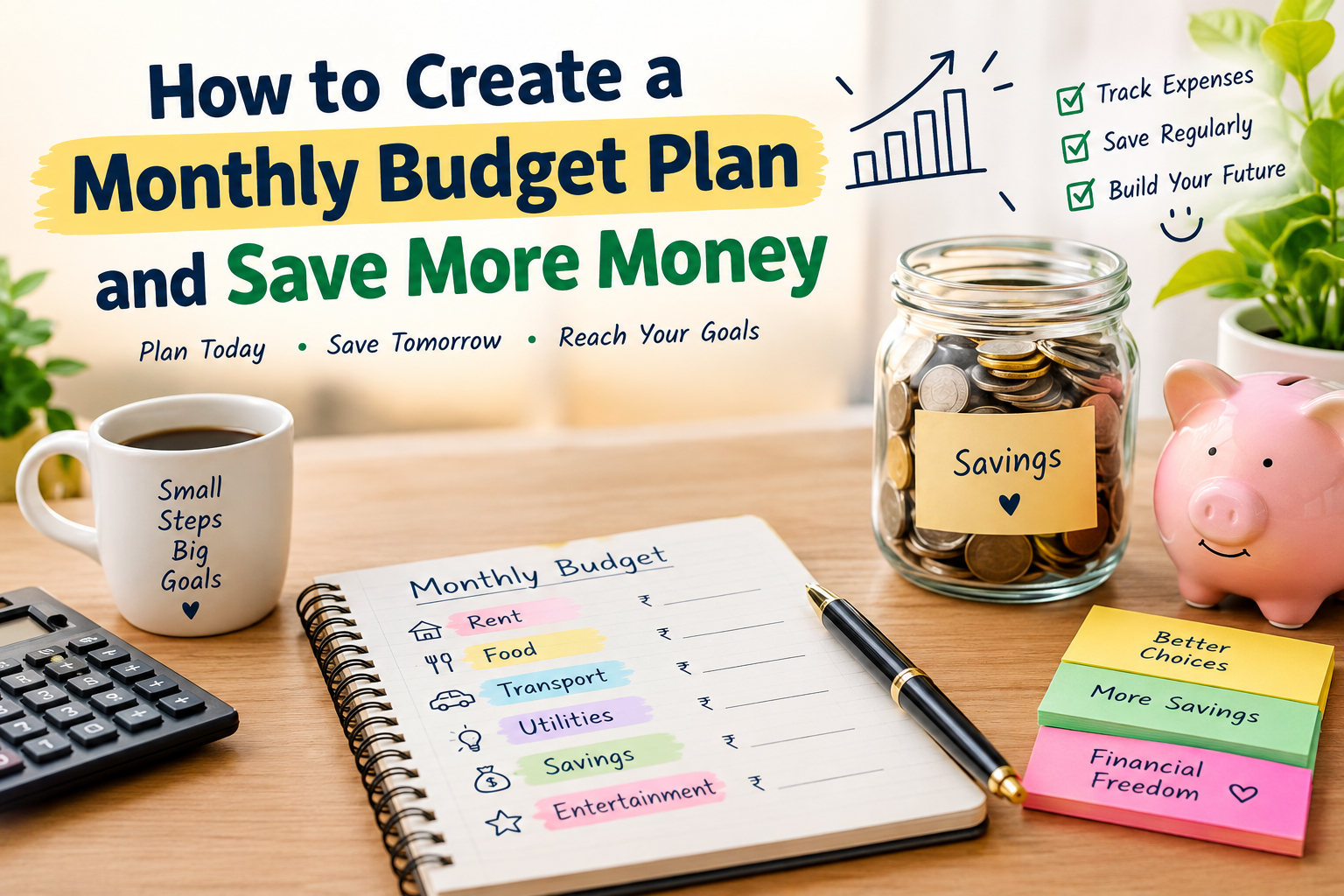
The good news is that creating a monthly budget does not have to be difficult. A budget is simply a plan for how you will use your money during the month. It helps you understand your income, control your expenses, increase your savings, and work toward your financial goals.
You do not need to be an expert in finance to create a budget. You only need to know how much money comes in, how much goes out, and what you want your money to achieve.
This guide explains how to create a monthly budget step by step, how to reduce unnecessary spending, how to build better saving habits, and how to stay consistent.
What Is a Monthly Budget?
A monthly budget is a simple plan that divides your monthly income among different expenses, savings and financial goals.
For example, suppose you earn ₹50,000 per month. Instead of spending money whenever you need something, you can create a plan such as:
- ₹15,000 for rent
- ₹8,000 for food and groceries
- ₹5,000 for transportation
- ₹4,000 for bills and utilities
- ₹5,000 for investments
- ₹5,000 for savings
- ₹3,000 for entertainment
- ₹5,000 for other expenses
The exact numbers will be different for every person. The purpose of a budget is not to stop you from spending money. It is to make sure your spending matches your income and priorities.
Why Is a Monthly Budget Important?
Without a budget, it is easy to spend money without noticing how quickly small purchases add up.
A coffee, food delivery, online subscription or impulsive shopping purchase may seem insignificant individually. But several small expenses can become a large amount by the end of the month.
A monthly budget can help you:
- Understand where your money goes
- Reduce unnecessary expenses
- Save money regularly
- Avoid overspending
- Prepare for emergencies
- Pay off debt
- Plan major purchases
- Invest for the future
- Reduce financial stress
- Reach long-term financial goals
The most important benefit is awareness. Once you know where your money is going, you can make better decisions about it.
Step 1: Calculate Your Monthly Income
The first step in creating a budget is knowing exactly how much money you receive each month.
If you have a fixed salary, this is relatively easy. Look at your monthly take-home pay rather than your gross salary because the amount you actually receive is what you can use for your budget.
For example:
Monthly take-home income: ₹60,000
If you have multiple sources of income, include them separately.
For example:
- Salary: ₹50,000
- Freelance income: ₹8,000
- Other income: ₹2,000
Total monthly income: ₹60,000
If your income changes every month, such as when you work as a freelancer or run a business, use a conservative estimate. It may be safer to create your regular budget around your lower expected income.
This prevents you from depending on income that may not arrive.
Step 2: List All Your Monthly Expenses
Once you know your income, write down your expenses.
Do not rely on memory. Check your bank statements, credit card statements, UPI transactions, receipts, and other payment records.
Divide your expenses into categories.
Fixed Expenses
Fixed expenses are costs that usually remain similar every month.
Examples include:
- Rent
- Home loan EMI
- Insurance premiums
- School fees
- Certain subscriptions
- Loan payments
For example:
| Expense | Monthly Amount |
|---|---|
| Rent | ₹15,000 |
| Loan EMI | ₹6,000 |
| Insurance | ₹2,000 |
| Internet | ₹1,000 |
| Total | ₹24,000 |
These expenses should be included first because they are usually difficult to change immediately.
Variable Expenses
Variable expenses can change from month to month.
Examples include:
- Groceries
- Electricity
- Transportation
- Eating out
- Shopping
- Entertainment
- Medical expenses
- Personal care
For example, you might spend ₹6,000 on groceries one month and ₹7,000 the next month.
Tracking these expenses helps you understand where you have room to save.
Step 3: Separate Needs From Wants
One of the most useful budgeting habits is learning the difference between needs and wants.
Needs are things you generally require for everyday life.
Examples include:
- Food
- Housing
- Basic clothing
- Transportation
- Electricity
- Essential healthcare
- Basic communication
Wants are things that make life more enjoyable but are not essential.
Examples include:
- Restaurant meals
- Expensive gadgets
- Premium subscriptions
- Designer clothing
- Frequent shopping
- Entertainment purchases
This does not mean you should eliminate wants completely.
Instead, create a reasonable amount of money for them.
A budget should be realistic. If you completely remove every enjoyable expense, you may find the budget difficult to follow.
Step 4: Set a Savings Target
Saving whatever money is left at the end of the month may not work very well.
A better approach is to treat saving as an important part of your budget.
For example, if you earn ₹50,000, you could decide to save ₹5,000 every month.
When your salary arrives, move the savings amount into a separate savings or investment account.
This approach is often called paying yourself first.
Instead of saying:
“I will save whatever is left.”
you say:
“I will save first and spend what remains.”
This simple change can make saving more consistent.
Step 5: Try the 50/30/20 Rule
One popular budgeting method is the 50/30/20 rule.
Under this approach:
- 50% of income goes toward needs
- 30% goes toward wants
- 20% goes toward savings and financial goals
For an income of ₹50,000, the basic structure would look like:
- Needs: ₹25,000
- Wants: ₹15,000
- Savings and goals: ₹10,000
However, this is a guideline, not a strict rule.
If you live in an expensive city, your rent may consume more than 50% of your income. If you have significant debt, you may need to allocate more money toward debt repayment.
The best budget is one that fits your actual financial situation.
Step 6: Track Every Expense
Creating a budget is only the beginning.
You also need to track your spending.
You can use:
- A notebook
- A spreadsheet
- A budgeting app
- Your banking app
- A simple notes application
Record your expenses throughout the month.
For example:
Monday
- Breakfast: ₹80
- Transport: ₹100
- Lunch: ₹180
Tuesday
- Transport: ₹100
- Lunch: ₹150
- Online purchase: ₹500
At the end of the week, you may discover that you spent more on food or shopping than expected.
Tracking gives you the information needed to make adjustments.
Step 7: Find Your Money Leaks
Money leaks are small expenses that happen repeatedly without receiving much attention.
For example, imagine you spend:
- ₹150 on snacks three times a week
- ₹200 on food delivery twice a week
- ₹300 on unnecessary online purchases each week
Individually, these expenses may not look serious.
But over a month, they can add up significantly.
Look through your previous month’s transactions and ask:
“Would I still buy this if I had to think about it carefully?”
You may find subscriptions you no longer use, frequent delivery orders or purchases you made impulsively.
You do not have to eliminate everything. Even reducing a few unnecessary expenses can improve your monthly savings.
Step 8: Create Separate Categories for Your Money
A useful budgeting technique is to give every amount of money a purpose.
For example, divide your monthly income into:
- Household expenses
- Food
- Transportation
- Savings
- Investments
- Emergency fund
- Entertainment
- Personal spending
You can do this using separate bank accounts, savings goals or simply categories in a spreadsheet.
When a category reaches its monthly limit, you know you should be careful before spending more.
Step 9: Build an Emergency Fund
An emergency fund is money kept aside for unexpected situations.
Examples include:
- Medical expenses
- Job loss
- Emergency travel
- Major home repairs
- Vehicle repairs
- Unexpected bills
Without an emergency fund, you may have to rely on credit cards or loans when something unexpected happens.
Start small if necessary.
For example, your first goal could be ₹10,000.
Then gradually increase it.
Over time, many people aim to build enough emergency savings to cover several months of essential expenses.
The exact amount depends on your income, job stability, family responsibilities and expenses.
Keep emergency money somewhere relatively accessible rather than placing all of it in investments that may be difficult to access quickly.
Step 10: Reduce Unnecessary Subscriptions
Subscriptions can quietly consume a significant amount of money.
Check your monthly payments for:
- Streaming services
- Music services
- Apps
- Cloud storage
- Gaming subscriptions
- News services
- Fitness memberships
Ask yourself how often you actually use each service.
If you are paying ₹500 every month for something you rarely use, cancelling it could save ₹6,000 a year.
The goal is not to cancel everything.
Keep the subscriptions that provide real value and remove the ones you no longer need.
Step 11: Plan Your Grocery Shopping
Food is an important part of every budget.
One effective way to control grocery expenses is to create a shopping list before going to the store.
Check what you already have at home.
Then buy only what you need.
Planning meals in advance can also reduce food waste and unnecessary purchases.
For example, instead of deciding what to eat every evening, plan several meals for the week.
You may also compare prices and choose products based on value rather than simply choosing the most expensive option.
Step 12: Control Impulse Purchases
Impulse buying can make budgeting difficult.
You see something you like and immediately buy it.
A simple strategy is to use a waiting period.
For non-essential purchases, wait 24 hours before buying.
For expensive purchases, consider waiting several days or even a few weeks.
During the waiting period, ask:
- Do I really need it?
- Do I already own something similar?
- Can I afford it without affecting my savings?
- Will I still want it next week?
- Does it support one of my financial goals?
Sometimes you will discover that you do not actually need the item.
Step 13: Use Automatic Savings
Automation can make saving easier because you do not have to remember to move money every month.
For example, if your salary arrives at the beginning of the month, you could arrange for a predetermined amount to move into your savings account shortly afterward.
This creates a system where saving happens automatically.
Even ₹2,000 or ₹3,000 per month can become meaningful over time.
The important thing is consistency.
Step 14: Pay Down High-Cost Debt
Debt can make it difficult to build wealth because part of your income goes toward interest and repayments.
If you have expensive debt, consider making debt repayment an important part of your budget.
List your debts along with:
- Outstanding balance
- Interest rate
- Minimum payment
- Due date
Avoid missing required payments.
You can then create a strategy for paying down debt while continuing to maintain basic savings.
For personalized debt decisions, consider your interest rates, cash flow and financial goals rather than following a single strategy blindly.
Step 15: Set Specific Financial Goals
Saving money becomes easier when you know what you are saving for.
Instead of saying:
“I want to save more.”
set a specific goal.
For example:
“I want to save ₹60,000 for an emergency fund within 12 months.”
This gives you a target of ₹5,000 per month.
Other goals could include:
- Buying a car
- Making a home down payment
- Paying education expenses
- Taking a vacation
- Building retirement savings
- Starting a business
- Creating an emergency fund
Specific goals make budgeting more meaningful.
Step 16: Review Your Budget Every Month
Your budget does not need to remain exactly the same.
Your income and expenses can change.
At the end of every month, review:
- How much did I earn?
- How much did I spend?
- How much did I save?
- Which category went over budget?
- Where did I spend less than expected?
- What unnecessary expenses can I reduce?
- What should I change next month?
For example, you may discover that your transportation expenses were much higher than expected.
You can then adjust the transportation category for the next month.
Budgeting is a process, not a one-time activity.
A Simple Monthly Budget Example
Suppose someone earns ₹60,000 per month.
A possible budget could look like this:
| Category | Amount |
|---|---|
| Rent | ₹15,000 |
| Groceries | ₹7,000 |
| Transportation | ₹4,000 |
| Utilities and phone | ₹3,000 |
| Loan repayment | ₹5,000 |
| Savings | ₹8,000 |
| Investments | ₹5,000 |
| Entertainment | ₹3,000 |
| Personal expenses | ₹3,000 |
| Miscellaneous | ₹2,000 |
| Emergency fund | ₹5,000 |
| Total | ₹60,000 |
This is only an example.
Your own budget should be based on your actual income, living costs, responsibilities and financial goals.
How to Save More Money Without Feeling Miserable
Saving money does not mean that you have to stop enjoying your life.
Instead of making extreme cuts, look for sustainable changes.
For example:
- Cook at home more frequently.
- Reduce unnecessary delivery orders.
- Cancel unused subscriptions.
- Compare prices before major purchases.
- Use a shopping list.
- Set a monthly entertainment limit.
- Avoid unnecessary debt.
- Automate savings.
- Review recurring payments.
- Wait before making expensive purchases.
Small changes repeated every month can have a larger effect than extreme changes that you cannot maintain.
Common Budgeting Mistakes to Avoid
1. Creating an unrealistic budget
If your budget is too restrictive, you may abandon it quickly.
Make your budget realistic.
2. Forgetting irregular expenses
Some expenses happen only once or a few times a year.
Examples include:
- Insurance premiums
- Annual subscriptions
- Festivals
- School expenses
- Vehicle maintenance
- Gifts
Set aside money throughout the year for these expenses.
3. Not tracking spending
A budget without tracking is difficult to evaluate.
You need to know whether your actual spending matches your plan.
4. Ignoring small purchases
Small expenses can become significant when repeated frequently.
5. Using savings for everyday spending
Try to keep your savings separate from your regular spending money.
6. Giving up after one bad month
Overspending one month does not mean your entire financial plan has failed.
Review what happened, make adjustments and continue.
How to Make Budgeting a Habit
The easiest way to maintain a budget is to make it part of your routine.
Choose one day every month for a financial review.
For example, on the last Sunday of every month:
- Check your bank accounts.
- Review your expenses.
- Check your savings.
- Review your debt.
- Update your budget.
- Set goals for the next month.
This process may take only 20–30 minutes.
Over time, it can become a normal part of managing your money.
Frequently Asked Questions
How much of my income should I save each month?
There is no single percentage that works for everyone. Some people may start with 5% or 10%, while others may be able to save 20% or more. Start with an amount you can maintain consistently and increase it when your income allows.
What if I cannot save money every month?
Start small. Even a modest amount can help establish the habit. First focus on understanding your expenses and reducing unnecessary spending.
Is the 50/30/20 rule mandatory?
No. It is simply a budgeting guideline. Your actual budget should reflect your income, housing costs, debt, family responsibilities and financial goals.
Should I save or pay off debt first?
It depends on the type and cost of the debt, your emergency savings and your financial circumstances. Maintaining some emergency savings can help prevent unexpected expenses from creating additional debt.
How can I stop overspending?
Track your expenses, create spending limits, avoid unnecessary impulse purchases and review your budget regularly. Making purchases after a waiting period can also reduce impulse spending.
Should I use a budgeting app?
You can use an app if it makes tracking easier. However, you do not need a special app. A spreadsheet, notebook or simple list can work just as well.
How long does it take to create a budget?
Your first budget may take 30–60 minutes because you need to collect your income and expense information. After that, monthly reviews can become much quicker.
Final Thoughts
Creating a monthly budget is one of the simplest ways to gain better control over your money.
You do not need a high income to start budgeting. You simply need to understand how much money you receive, where it goes and what you want to achieve financially.
Start by calculating your income. Then list your fixed and variable expenses. Separate needs from wants, set a savings target and track your spending.
Look for small expenses that can be reduced without making your lifestyle uncomfortable. Automate your savings where possible and create an emergency fund for unexpected situations.
Most importantly, remember that budgeting is not about restricting your life. It is about giving your money a purpose.
A good budget allows you to spend on the things that matter while making sure you are also preparing for the future.
You do not have to create the perfect budget on your first attempt. Start with a simple plan, review it at the end of each month and improve it gradually.
The earlier you develop the habit of budgeting, the easier it can become to save money, manage expenses and work toward your financial goals.
https://thehommyblogger.com/indian-stock-market/news/daily-news/09/2026/
Monthly Budget Plan
Monthly Budget Plan Monthly Budget Plan Monthly Budget Plan Monthly Budget Plan Monthly Budget Plan Monthly Budget Plan Monthly Budget Plan
Monthly Budget Plan Monthly Budget Planv Monthly Budget Plan Monthly Budget Plan Monthly Budget Plan Monthly Budget Plan Monthly Budget Plan Monthly Budget Plan Monthly Budget Plan Monthly Budget Plan Monthly Budget Plan Monthly Budget Plan Monthly Budget Plan Monthly Budget Plan Monthly Budget Plan Monthly Budget Plan Monthly Budget Plan Monthly Budget Plan vMonthly Budget Plan Monthly Budget Plan