Table of Contents
Introduction
The Unified Payments Interface, better known as UPI, has become one of the most widely used digital payment systems in India. From buying groceries and paying restaurant bills to transferring money to family members, UPI has made instant bank-to-bank payments a routine part of everyday life.
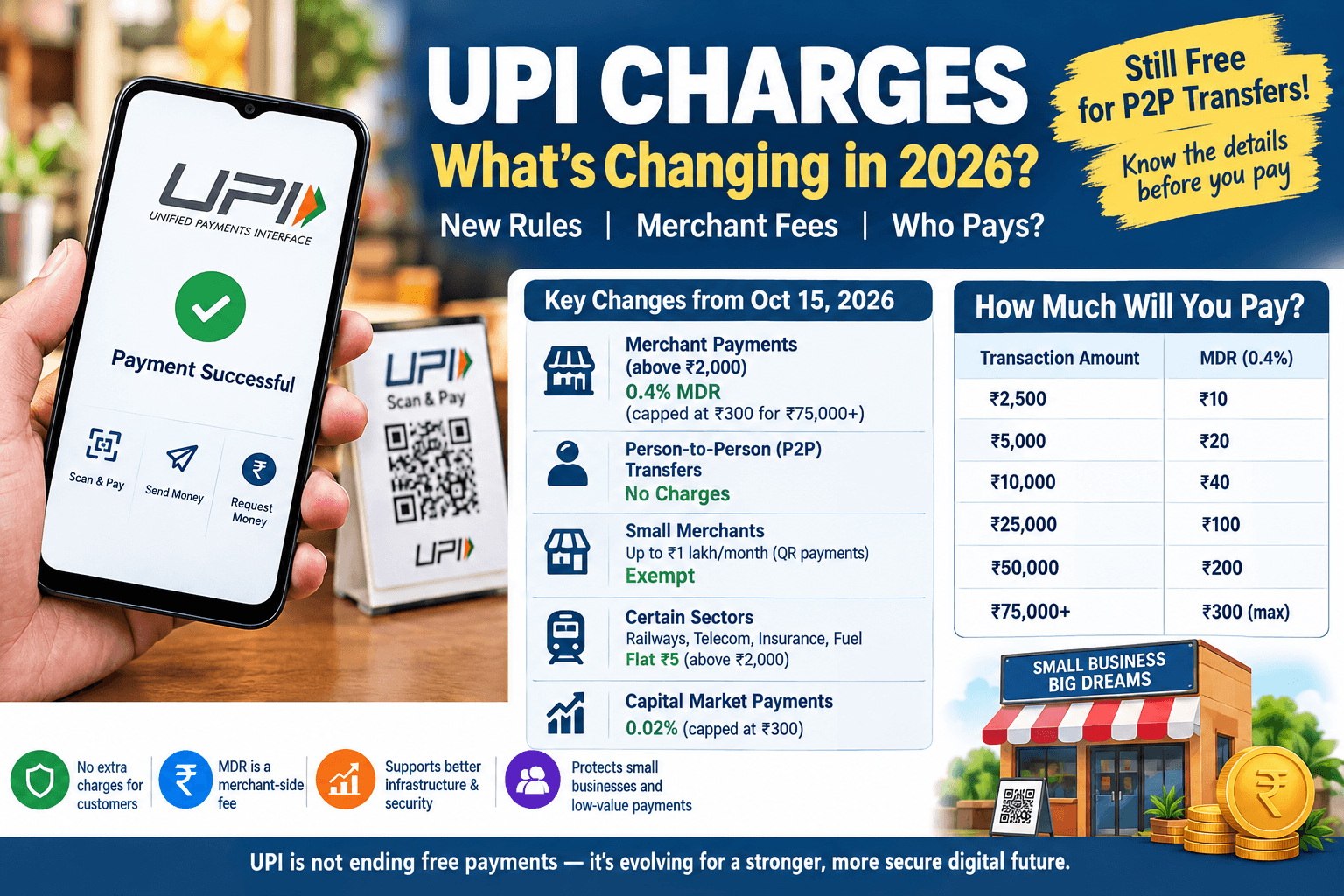
For years, one of the biggest attractions of UPI has been its low-cost structure for users. However, the UPI fee framework is now changing.
On September 15, 2026, the National Payments Corporation of India (NPCI) announced a new Merchant Discount Rate (MDR) framework for certain UPI payments. From October 15, 2026, a 0.4% MDR will apply to eligible person-to-merchant UPI transactions above ₹2,000. The MDR will be capped at ₹300 for transactions of ₹75,000 and above. Importantly, the announced charge is a merchant-side fee, while person-to-person UPI transfers remain free.
The announcement has raised an important question among millions of UPI users:
Will customers now have to pay a charge every time they make a UPI payment?
The answer, under the announced framework, is no. The MDR is imposed on eligible merchant transactions and is not supposed to be passed directly to consumers.
This article explains the new UPI charges, when they apply, who pays them, what happens to small merchants, and what consumers should know before October 15.
What Is UPI?
UPI stands for Unified Payments Interface. It is an instant payment system that allows users to transfer money between bank accounts using a smartphone.
Instead of entering a bank account number and IFSC code for every payment, users can generally make payments through:
- UPI IDs
- QR codes
- Mobile numbers
- Bank-linked UPI applications
- Other supported payment identifiers
UPI has transformed retail payments because it allows payments to happen almost instantly.
Popular apps supporting UPI include bank applications as well as third-party payment apps such as Google Pay, PhonePe and Paytm.
The system is operated by NPCI, which manages India’s retail payment infrastructure.
What Are the New UPI Charges From October 15, 2026?
The most important change is the introduction of an MDR of 0.4% on eligible person-to-merchant UPI transactions above ₹2,000.
The new framework is scheduled to take effect on October 15, 2026.
The basic structure is:
| Transaction type | New charge |
|---|---|
| Person-to-person UPI | No MDR |
| Merchant payment up to ₹2,000 | No MDR |
| Eligible merchant payment above ₹2,000 | 0.4% MDR |
| Eligible transaction ₹75,000 or more | Maximum ₹300 MDR |
| Certain specified sectors | Flat ₹5 MDR |
| Eligible capital-market payments | 0.02%, capped at ₹300 |
The exact treatment depends on the transaction category and merchant type.
What Does MDR Mean?
MDR stands for Merchant Discount Rate.
It is a fee associated with processing a merchant payment. In a conventional card-payment ecosystem, merchants may pay MDR when customers use debit or credit cards.
Under the new UPI framework, MDR will similarly apply to specified merchant-side UPI transactions.
For example, suppose an eligible customer makes a merchant payment of ₹10,000.
At an MDR rate of 0.4%:
₹10,000 × 0.4% = ₹40
Therefore, the applicable MDR would be ₹40.
However, this does not mean that the customer should automatically see an additional ₹40 added to the bill.
The announced framework says the MDR is a merchant-side charge and providers are not supposed to pass it on to consumers.
Will Customers Have to Pay UPI Charges?
This is probably the biggest question surrounding the new rules.
For ordinary consumers, person-to-person UPI transfers remain free.
For example, if you send:
- ₹500 to a friend
- ₹5,000 to a family member
- ₹20,000 to another individual’s bank account
these P2P transactions remain outside the new MDR framework.
The new MDR is primarily relevant to person-to-merchant payments.
The government has also stated that UPI providers and banks should not transfer the MDR to customers through additional platform fees or hidden charges.
That distinction is important.
P2P vs P2M
P2P — Person to Person
You send money to another individual.
P2M — Person to Merchant
You pay a business, shop, service provider or other merchant.
The new MDR primarily concerns the second category.
What Happens to UPI Payments Below ₹2,000?
Payments to merchants up to ₹2,000 remain outside the new 0.4% MDR.
This means that a customer buying something worth:
- ₹200
- ₹500
- ₹1,000
- ₹1,999
- ₹2,000
would not attract the new MDR.
The threshold becomes relevant when an eligible merchant transaction is above ₹2,000.
This distinction is particularly important for small-value retail transactions, where UPI is heavily used.
How Much Is the UPI Charge Above ₹2,000?
For eligible merchant transactions above ₹2,000, the standard MDR is 0.4%.
Here are some examples:
| Payment amount | 0.4% calculation |
|---|---|
| ₹2,500 | ₹10 |
| ₹5,000 | ₹20 |
| ₹10,000 | ₹40 |
| ₹25,000 | ₹100 |
| ₹50,000 | ₹200 |
| ₹75,000 | ₹300 |
| ₹1,00,000 | ₹400, but capped at ₹300 |
For transactions of ₹75,000 and above, the MDR is capped at ₹300 per transaction under the announced framework.
Again, these calculations describe the merchant-side MDR and should not be interpreted as a direct consumer surcharge.
Why Is India Introducing UPI MDR?
UPI has expanded dramatically, but running a nationwide real-time payment infrastructure requires continuous investment.
Payment networks have costs associated with:
- Technology infrastructure
- Cybersecurity
- Fraud prevention
- System reliability
- Customer support
- Payment processing
- Banking infrastructure
- Digital-payment innovation
NPCI has said the new MDR framework is intended to support investment in infrastructure resilience, innovation, cybersecurity and customer service.
The policy therefore represents a change in how some parts of the UPI ecosystem are financed.
What Will Happen to Small Merchants?
Small businesses are an important part of India’s UPI ecosystem.
Street vendors, local shops, small restaurants and neighbourhood businesses frequently rely on QR-code payments.
The new framework includes an exemption for small merchants receiving up to ₹1 lakh per month through QR-code UPI payments.
The government has also said that a dedicated fund will be created to encourage UPI adoption among small merchants, with 5% of MDR collections earmarked for this purpose.
This means the policy is not simply about introducing a fee. It also contains provisions intended to protect smaller businesses and encourage continued digital-payment adoption.
Special ₹5 Charge for Certain Services
Not every eligible transaction will necessarily use the standard 0.4% calculation.
Certain specified sectors will have a flat ₹5 MDR for applicable transactions above ₹2,000.
These include sectors such as:
- Railways
- Telecom
- Insurance
- Fuel
The reported framework identifies these categories as receiving special treatment.
This structure means consumers should not assume that every UPI merchant payment above ₹2,000 will generate the same percentage-based merchant cost.
What About UPI and Capital-Market Payments?
The announced framework also provides a separate rate for certain capital-market payments.
Payments related to areas such as:
- Mutual fund investments
- Stock investments
- Other specified capital-market transactions
will attract a 0.02% fee, subject to a maximum of ₹300, according to NPCI’s announced framework.
The separate treatment is intended to keep digital payment costs relatively limited in this category.
Will the New Rule Affect Person-to-Person Transfers?
No.
One of the clearest parts of the announcement is that P2P transactions remain outside the MDR charge.
So if you use UPI to transfer money directly to another person’s bank account, the new merchant MDR does not apply.
This means common activities such as:
- Sending rent to an individual
- Sending pocket money
- Paying a friend back
- Transferring money to parents
- Sending money to another personal bank account
remain unaffected by the new merchant MDR framework, assuming the transaction is genuinely P2P.
Does This Mean UPI Is No Longer Free?
The answer depends on what is meant by “free.”
For consumers, ordinary UPI usage remains free under the announced framework.
But at the ecosystem level, certain merchant transactions will now carry an MDR.
So it would be more accurate to say:
UPI is not becoming a universally charged consumer service. Instead, a merchant-side fee is being introduced for specified higher-value merchant transactions.
That distinction is essential because headlines about “UPI charges” can otherwise create confusion.
UPI Charges and RuPay Credit Cards
Another area that often causes confusion is the use of RuPay credit cards through UPI.
UPI can be used with eligible RuPay credit cards for supported merchant payments. NPCI provides information on linking and using RuPay credit cards on UPI.
Credit-card-on-UPI transactions have their own interchange and fee arrangements. These should not automatically be treated as identical to ordinary bank-account-to-bank-account UPI transactions.
In 2026, NPCI also revised certain fees associated with consumer-facing UPI apps for RuPay credit-card transactions. Reports said the fee for the non-industry category was reduced from 8 basis points to 6 basis points, while the industry category moved from 4 basis points to 3 basis points.
For consumers, the important point is that a fee within the payment ecosystem does not necessarily mean the customer will be separately billed for making a UPI payment.
Why the ₹2,000 Threshold Matters
The ₹2,000 threshold is significant because it separates routine small-value payments from higher-value merchant transactions.
A large number of everyday UPI payments are small.
For example:
- Tea and snacks
- Groceries
- Local transport
- Small retail purchases
- Restaurant bills
- Household services
often involve relatively low transaction values.
Keeping transactions up to ₹2,000 outside the MDR structure is therefore designed to limit the impact on small-value digital payments.
At the same time, higher-value merchant payments become part of the new fee framework.
What Does the Change Mean for Businesses?
The direct financial impact will depend on:
- Transaction size
- Monthly UPI volume
- Merchant classification
- Sector
- Whether the merchant qualifies for an exemption
- Whether transactions fall into a special category
For a business processing many high-value UPI transactions, the MDR could become a new operating cost.
For a small QR-code merchant below the specified monthly threshold, the exemption may mean little or no direct impact from the new MDR.
The structure therefore does not affect every merchant in the same way.
Can a Shopkeeper Add a UPI Surcharge?
The announced framework says providers and banks should prevent the MDR from being passed directly to consumers.
The government has stated that UPI app providers are prohibited from imposing platform fees or hidden charges and that banks have been advised to ensure merchants do not pass MDR costs to customers.
Consumers should therefore distinguish between:
MDR: A merchant-side payment-processing charge.
Customer surcharge: An additional amount explicitly demanded from the consumer.
They are not the same thing.
If a merchant displays a separate UPI surcharge, customers should check the bill and the applicable rules rather than assuming that the surcharge is automatically authorised by the new MDR framework.
How Will the MDR Money Be Distributed?
The MDR collected from eligible transactions is expected to be distributed among different participants in the payment ecosystem.
According to reporting on NPCI’s announcement, the largest portion will go to the bank of the person making the payment, while other shares will go to the merchant’s acquiring bank, payment app and payment service providers.
This reflects the fact that a UPI payment involves several participants behind the scenes.
Even though the customer may simply scan a QR code, the transaction depends on multiple banking and technology systems.
What Should UPI Users Do Now?
For most consumers, there is no need to change everyday UPI habits solely because of the new MDR announcement.
However, users should understand the difference between:
- P2P payments
- Merchant payments
- Bank-account UPI
- RuPay credit-card-on-UPI payments
- Other payment instruments such as wallets
Before making a large merchant payment, users should also check the final amount shown by the merchant.
Most importantly, consumers should not assume that a headline saying “UPI charges from October 15” means every UPI transaction will suddenly become chargeable.
That interpretation would be inaccurate under the announced rules.
Frequently Asked Questions About UPI Charges
1. Are UPI payments completely free from October 15, 2026?
Not in every sense. Eligible merchant transactions above ₹2,000 will attract a merchant-side MDR of 0.4% from October 15, 2026. P2P payments remain free.
2. Will I be charged when sending ₹10,000 to a friend?
No. A genuine person-to-person UPI transfer remains outside the new MDR framework.
3. Will I pay extra when buying something worth ₹5,000 using UPI?
The announced MDR applies to the merchant, not directly to the consumer. Providers and banks have been instructed not to pass the charge to consumers.
4. What is the new UPI MDR rate?
The standard MDR for eligible merchant transactions above ₹2,000 is 0.4%.
5. Is there a maximum MDR?
Yes. For eligible transactions of ₹75,000 and above, the MDR is capped at ₹300 per transaction.
6. Are small merchants exempt?
Small merchants receiving up to ₹1 lakh per month through QR-code UPI payments are reported to be exempt from MDR.
7. Are payments below ₹2,000 charged?
The new MDR does not apply to merchant payments up to ₹2,000.
8. Is there a special fee for railway and fuel payments?
Certain specified sectors, including railways, telecom, insurance and fuel, have a reported flat MDR of ₹5 for applicable transactions above ₹2,000.
9. When do the new charges begin?
The new MDR framework is scheduled to begin on October 15, 2026.
10. Does this mean UPI will become expensive for ordinary users?
The announced framework does not impose a general consumer transaction fee. Its primary change is the introduction of MDR for specified merchant payments.
Conclusion
The UPI ecosystem is entering a new phase in 2026.
For years, UPI’s appeal has been closely associated with convenience, speed and low-cost digital payments. The new MDR framework introduces a different approach for certain higher-value merchant transactions while keeping person-to-person transfers free.
From October 15, 2026, eligible merchant UPI payments above ₹2,000 will attract a 0.4% MDR, with a maximum of ₹300 for transactions of ₹75,000 and above. Certain sectors will have separate flat charges, while small merchants meeting the specified QR-payment threshold will be exempt.
For consumers, the most important takeaway is simple: the new MDR is a merchant-side charge, not a blanket fee on every UPI user.
As UPI continues to expand, the balance between keeping digital payments affordable and funding the infrastructure behind them will remain an important part of India’s payments story. The new rules are therefore significant not because every UPI payment is becoming chargeable, but because they mark a change in the way certain parts of the UPI ecosystem are financed.
In short: UPI is not simply “ending free payments.” Instead, India is introducing a targeted merchant-fee structure for specified higher-value transactions while retaining free P2P transfers and protecting certain small-value and small-merchant payments.
z zgz zns ss d d d e e w ne en ene e h h h u u 567 58ku 5 j ny ny6 n6u n n v v v v v v v v v v v v v
[…] https://thehommyblogger.com/upi-charges-2026/news/daily-news/09/2026/ […]