Table of Contents
Introduction
A maritime incident involving Indian and Pakistani naval vessels in the North Arabian Sea has triggered a fresh diplomatic exchange between the two neighbouring countries.
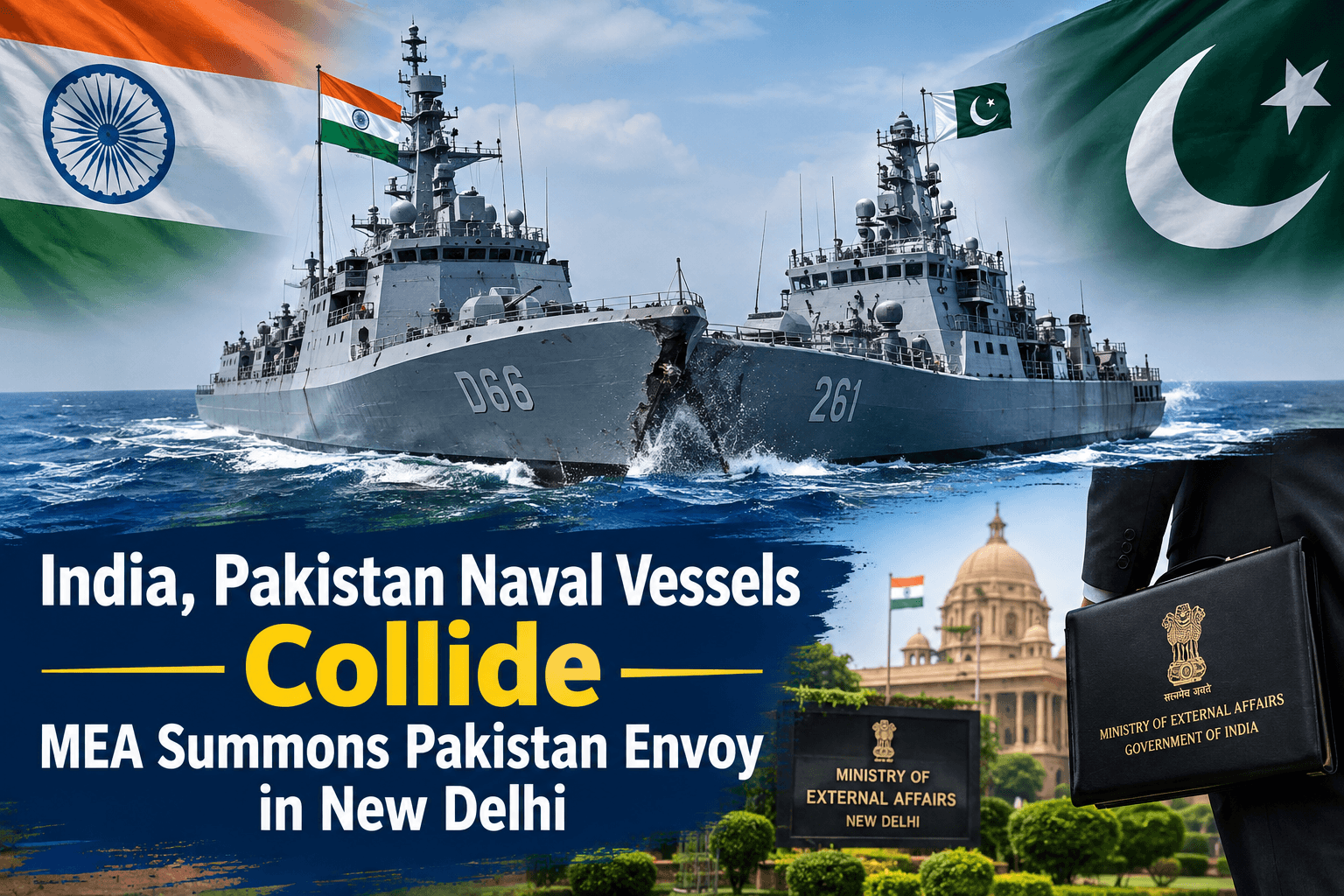
On September 16, 2026, India summoned Pakistan’s Charge d’Affaires in New Delhi and lodged a strong protest following a collision involving naval units of the two countries in international waters. India’s Ministry of External Affairs described the conduct of the Pakistani naval units as “unacceptable and unprofessional.”
According to Indian officials, the incident did not cause major damage to the Indian Navy vessel. However, New Delhi has treated the episode seriously because it involved military vessels operating in a sensitive maritime environment and because India says the circumstances amounted to a violation of commitments under a bilateral military agreement.
The incident is significant not simply because two naval vessels came into contact at sea. Naval encounters between the armed forces of countries with a long and complicated relationship can carry diplomatic consequences far beyond the physical damage caused by a collision.
The episode also highlights the importance of communication, navigational discipline and established military protocols when armed forces operate in proximity.
This article examines what is known about the incident, India’s diplomatic response, the agreement cited by New Delhi, the wider strategic importance of the Arabian Sea and the possible implications for India-Pakistan relations.
What Happened Between the Indian and Pakistani Naval Vessels?
The incident occurred in international waters in the North Arabian Sea, according to India’s Ministry of External Affairs.
Indian authorities said a Pakistani naval vessel came into contact with an Indian Navy unit. India subsequently raised the matter through diplomatic channels, describing the conduct involved as unsafe and unprofessional.
Reports indicate that the Indian vessel was operating in the area as part of its maritime duties when the encounter occurred.
Importantly, the available information indicates that the incident did not result in major damage to the Indian naval vessel.
That detail is significant. A collision between two military ships can potentially result in casualties, structural damage or even a larger maritime emergency. In this case, the immediate physical consequences appear to have been limited.
Nevertheless, the incident became a diplomatic issue because of the circumstances surrounding the encounter and the fact that the vessels belonged to two countries whose military relationship remains highly sensitive.
Why Did India Summon Pakistan’s Diplomat?
Following the incident, India’s Ministry of External Affairs summoned Pakistan’s Charge d’Affaires in New Delhi.
A Charge d’Affaires is the senior diplomatic representative responsible for a country’s mission when an ambassador is not serving in that capacity. Summoning such a representative is a formal diplomatic mechanism through which one government communicates its objection or concern to another.
India used the meeting to lodge a strong protest over what it described as the conduct of Pakistani naval units.
Reuters reported that India’s foreign ministry characterised the conduct as “unacceptable and unprofessional” and said it had resulted in a collision with an Indian naval unit.
The move demonstrates that New Delhi does not view the episode simply as an ordinary navigational accident.
At the same time, a diplomatic protest does not automatically mean that the two countries are moving toward a military confrontation. Governments frequently use diplomatic channels to communicate objections, demand clarification and reinforce existing agreements after incidents involving their armed forces.
India Cites the 1991 Bilateral Military Agreement
One of the most important elements of India’s response is its reference to the 1991 Agreement between India and Pakistan on Advance Notice on Military Exercises, Manoeuvres and Troops Movements.
India has said that the conduct surrounding the naval incident was in direct contravention of Article 10 of that agreement.
The agreement was designed to establish mechanisms intended to reduce the possibility of misunderstandings arising from military activity.
Such arrangements are particularly important between neighbouring countries with large armed forces. Military exercises, troop movements and naval operations can sometimes be misinterpreted, especially when forces operate near one another.
The broader principle behind confidence-building agreements is straightforward: greater transparency can reduce the possibility that a military movement is mistaken for hostile preparation.
India’s reference to the agreement therefore gives the diplomatic protest a wider context.
The issue is not only the physical contact between ships. New Delhi is also pointing to the importance of established rules governing military activity.
Why Are Naval Encounters Particularly Sensitive?
Naval vessels operate in an environment that is fundamentally different from roads or ordinary commercial shipping lanes.
Large warships have considerable momentum and require significant distances to change direction or stop. Their movements can also be affected by visibility, weather, sea conditions, traffic density and the operational requirements of military missions.
More importantly, warships are military platforms.
When two military vessels belonging to countries with strained relations come close to one another, their crews must consider not only navigational safety but also the possibility that the encounter could be interpreted strategically.
A manoeuvre that might be routine in another context can appear more serious when the ships belong to rival states.
This is why communication procedures, navigation rules and professional conduct are important during encounters at sea.
The India-Pakistan incident demonstrates how a relatively limited physical event can quickly become a diplomatic matter.
International Waters Do Not Mean an Absence of Rules
The fact that the collision occurred in international waters is another important part of the story.
International waters are not an area where ships can operate without obligations.
Maritime navigation is governed by international rules and conventions. Ships are expected to maintain safe navigation, avoid collisions and exercise appropriate caution.
Military vessels also operate under national rules and established procedures.
For India and Pakistan, bilateral agreements can add another layer of obligations concerning military activities.
Consequently, the location of the incident does not eliminate the diplomatic or legal significance of the encounter.
The challenge in any maritime collision investigation is determining exactly what happened: the positions of the vessels, their speeds, their courses, communications between crews, manoeuvres undertaken before the collision and the environmental conditions at the time.
Those details are essential for establishing responsibility.
Why the Arabian Sea Matters
The Arabian Sea is strategically important to both India and Pakistan.
It connects the western coast of the Indian subcontinent with major international shipping routes extending toward the Persian Gulf, Gulf of Oman, Red Sea and wider Indian Ocean.
Commercial vessels carrying energy supplies, manufactured goods and other cargo routinely pass through the broader region.
The sea is also important for naval operations.
India has a large coastline along the Arabian Sea and maintains naval assets in the western maritime region. Pakistan’s principal naval facilities are also concentrated along its Arabian Sea coastline.
This geographical reality means that Indian and Pakistani naval forces operate within the same broad maritime environment.
The proximity creates opportunities for encounters, but it also makes operational discipline particularly important.
A Diplomatic Incident in an Already Sensitive Relationship
India and Pakistan have a history of military confrontations, diplomatic disputes and periodic attempts at confidence-building.
Their relationship has frequently been affected by disagreements over security, terrorism, borders and military activity.
Against that backdrop, even an apparently limited incident involving naval vessels can attract considerable attention.
The latest collision comes at a time when maritime security itself is an increasingly important international issue.
The Arabian Sea and wider Indian Ocean region are crucial to global trade. Naval forces from several countries operate in the broader region for different purposes, including maritime security, anti-piracy missions, surveillance and protection of commercial shipping.
Any incident involving military vessels therefore has the potential to attract regional attention.
India’s Diplomatic Message
India’s response appears to have contained several distinct messages.
First, New Delhi formally objected to the conduct that it says led to the collision.
Second, it emphasised the importance of established bilateral agreements.
Third, India called for military forces to exercise appropriate care and follow relevant protocols to avoid similar incidents in the future.
India also directed its Charge d’Affaires in Islamabad to lodge a corresponding protest with Pakistan’s Ministry of Foreign Affairs, according to reports.
This shows that the issue was being handled through formal diplomatic channels rather than solely through military communication.
What Is Known About Damage?
One of the key facts available so far is that the Indian vessel did not suffer major damage.
Multiple reports citing the MEA state that the collision in international waters did not cause major damage.
However, detailed technical information about the condition of both vessels has not been publicly established in the initial reports.
There is also limited publicly available information about precisely how the vessels manoeuvred immediately before contact.
That distinction matters.
Early reports following maritime incidents can contain incomplete information. A full understanding generally requires navigational data, communications records, photographs, video evidence and statements from the personnel involved.
Therefore, claims about precisely how the collision occurred should be treated cautiously until additional official information becomes available.
Why Rules of Engagement and Communication Matter at Sea
Naval forces routinely develop procedures for communicating with other vessels.
These can include radio communication, signalling, visual identification and navigational manoeuvres.
When military ships encounter one another, these procedures become particularly important.
A misunderstanding at sea can escalate rapidly because large warships cannot change direction instantly.
The risks become even greater when ships are travelling at high speed.
This is why professional naval forces place substantial emphasis on navigation training, bridge-team coordination and situational awareness.
The diplomatic dispute following the latest India-Pakistan incident reinforces that point.
Even without major physical damage, a dangerous manoeuvre can create risks for personnel and military assets.
Could the Incident Affect India-Pakistan Relations?
The immediate diplomatic impact is clear: India has formally protested to Pakistan.
The longer-term consequences will depend on what happens next.
If both sides keep the matter within diplomatic and military communication channels, the episode could remain a contained bilateral incident.
If competing narratives emerge, however, the dispute could become part of the broader political and security tensions between the two countries.
Much will depend on whether Pakistan accepts India’s description of the incident, offers a different account or seeks further clarification.
At the time of writing, the available reports primarily document India’s response. More information from the Pakistani side would be important for establishing a complete picture.
The Importance of Avoiding Miscalculation
Perhaps the most significant lesson from the incident is the importance of avoiding miscalculation.
Military encounters do not always begin with an intention to escalate.
A navigational error, communication failure or misunderstanding can create an unexpected confrontation.
When the countries involved already have a history of military tensions, the margin for error becomes smaller.
This is why confidence-building measures and communication channels matter.
The 1991 India-Pakistan agreement represents one such mechanism.
Its broader purpose is to provide predictability around military activity and reduce opportunities for misunderstanding.
The latest incident has therefore brought attention back to the continuing importance of such arrangements.
Maritime Security Goes Beyond India and Pakistan
The incident also has relevance beyond bilateral relations.
The Arabian Sea is part of the wider Indian Ocean maritime system, which is vital to global commerce.
Any disruption involving naval forces can raise concerns about maritime stability.
The region includes important commercial routes connecting Asia, the Middle East, Africa and Europe.
India’s location gives it a major role in Indian Ocean security, while Pakistan’s geography places its navy close to some of the same maritime spaces.
This means that professional conduct between naval units is not merely a bilateral concern.
It can also contribute to the wider stability of regional shipping.
What Happens Next?
Several developments could follow the diplomatic protest.
1. Further diplomatic communication
India and Pakistan may exchange additional diplomatic notes or hold further discussions about the incident.
2. Internal military review
Both navies may examine operational records to determine how the collision occurred.
3. Technical assessment
Investigators could assess the extent of damage and review navigation data.
4. Clarification of procedures
The incident may lead to renewed emphasis on protocols governing encounters between naval vessels.
5. Possible Pakistani response
Pakistan could provide its own account of the incident through diplomatic or military channels.
A complete understanding will require consideration of information from both sides.
Why the Incident Has Attracted Attention
The collision has attracted attention because India and Pakistan are not ordinary maritime neighbours.
Both countries possess substantial military capabilities, including naval forces that operate in the Arabian Sea.
Their political relationship has repeatedly experienced periods of tension.
As a result, an event that might be treated as a routine maritime accident elsewhere can become a matter of national security and diplomacy in the India-Pakistan context.
The fact that India chose to summon Pakistan’s Charge d’Affaires shows the diplomatic importance New Delhi attaches to the episode.
However, the fact that the matter is currently being addressed through formal diplomatic channels is also significant.
Diplomatic mechanisms exist precisely to allow governments to register objections without automatically turning every military incident into a larger confrontation.
Lessons for Future Naval Operations
The episode offers several broader lessons for military forces operating in contested or sensitive maritime environments.
Clear communication
Ships operating near one another need reliable communication procedures.
Situational awareness
Bridge teams must continuously monitor nearby vessels and anticipate their movements.
Respect for maritime rules
International navigation standards are intended to reduce collisions and protect lives.
Military confidence-building
Bilateral agreements can help reduce misunderstandings between neighbouring armed forces.
Crisis communication
When an incident occurs, direct communication between governments can prevent speculation from overtaking verified information.
These principles apply not only to India and Pakistan but to naval forces worldwide.
India-Pakistan Maritime Relations: A Longer History
The latest incident is not the first time Indian and Pakistani naval vessels have had a contentious encounter.
In 2011, for example, India and Pakistan exchanged protests after Pakistani naval ship PNS Babur came into contact with Indian warship INS Godavari during an anti-piracy operation. India’s official account said the Pakistani vessel approached at high speed and touched the Indian warship, causing minor damage.
That earlier episode illustrates that naval interactions between the two countries have previously produced diplomatic disputes.
However, each incident has its own circumstances and should not automatically be treated as identical.
The current episode will need to be assessed on the basis of the evidence surrounding the September 2026 encounter.
What the Incident Does Not Establish
It is important not to draw conclusions beyond the available evidence.
The collision, by itself, does not establish that either government intended a military escalation.
It also does not establish the precise cause of the collision without a detailed investigation.
Similarly, the diplomatic protest does not necessarily mean that India and Pakistan are entering a new military crisis.
What is established is that a collision occurred, India protested, Pakistan’s diplomatic representative was summoned, and New Delhi described the conduct of the Pakistani naval units as unacceptable and unprofessional.
The next phase will depend on additional information and the responses from both governments.
Conclusion
The collision between Indian and Pakistani naval vessels in the North Arabian Sea has created a fresh diplomatic issue between the two countries.
Although reports indicate that the Indian vessel did not suffer major damage, India has treated the incident seriously because it involved military units operating in international waters and, according to New Delhi, conduct inconsistent with established bilateral commitments.
The decision to summon Pakistan’s Charge d’Affaires demonstrates the importance India attaches to maritime safety and military protocols.
At the centre of the dispute is also the 1991 bilateral agreement concerning advance notice of military exercises, manoeuvres and troop movements. India’s reference to Article 10 underlines its position that military activities between the two countries need to be conducted with appropriate care and predictability.
The Arabian Sea’s strategic importance makes responsible naval behaviour particularly important. It is a major maritime environment connecting South Asia with the Middle East and wider Indian Ocean.
For now, the incident remains primarily a diplomatic and maritime-security matter. The full picture will become clearer as more information emerges from both sides.
The immediate priority for both countries is likely to be preventing a limited naval encounter from becoming a larger source of misunderstanding. Clear communication, adherence to established agreements and professional conduct at sea remain central to avoiding similar incidents in the future.
FAQs
Q1. Where did the India-Pakistan naval collision occur?
The collision occurred in international waters in the North Arabian Sea, according to India’s Ministry of External Affairs.
Q2. Did the Indian Navy vessel suffer major damage?
Indian officials said the incident did not cause major damage to the Indian naval vessel.
Q3. Why was Pakistan’s diplomat summoned?
India summoned Pakistan’s Charge d’Affaires in New Delhi to lodge a strong diplomatic protest over what it described as unacceptable and unprofessional conduct by Pakistani naval units.
Q4. Which agreement did India refer to?
India referred to the 1991 Agreement on Advance Notice on Military Exercises, Manoeuvres and Troops Movements, specifically Article 10.
Q5. Is the collision likely to lead to military conflict?
The available reporting establishes a diplomatic protest but does not establish that the incident will lead to military escalation. Further developments will depend on official investigations and responses from both countries.
Q6. Why is the Arabian Sea strategically important?
The Arabian Sea is an important maritime region connecting South Asia with the Persian Gulf, Middle East and wider Indian Ocean trade routes. It is also an operating area for the Indian and Pakistani navies.
Q7. What happens next?
Further diplomatic communication, military assessments and clarification of the circumstances surrounding the collision are possible next steps. More information from both governments will be needed for a complete account.
[…] https://thehommyblogger.com/indian-and-pakistani-2026/news/daily-news/09/2026/ […]