Table of Contents
Introduction
The Eiffel Tower, one of the most famous landmarks in the world and a powerful symbol of France, has found itself at the centre of an unexpected controversy after female employees were reportedly asked to step aside during a private visit by a Hindu religious delegation.
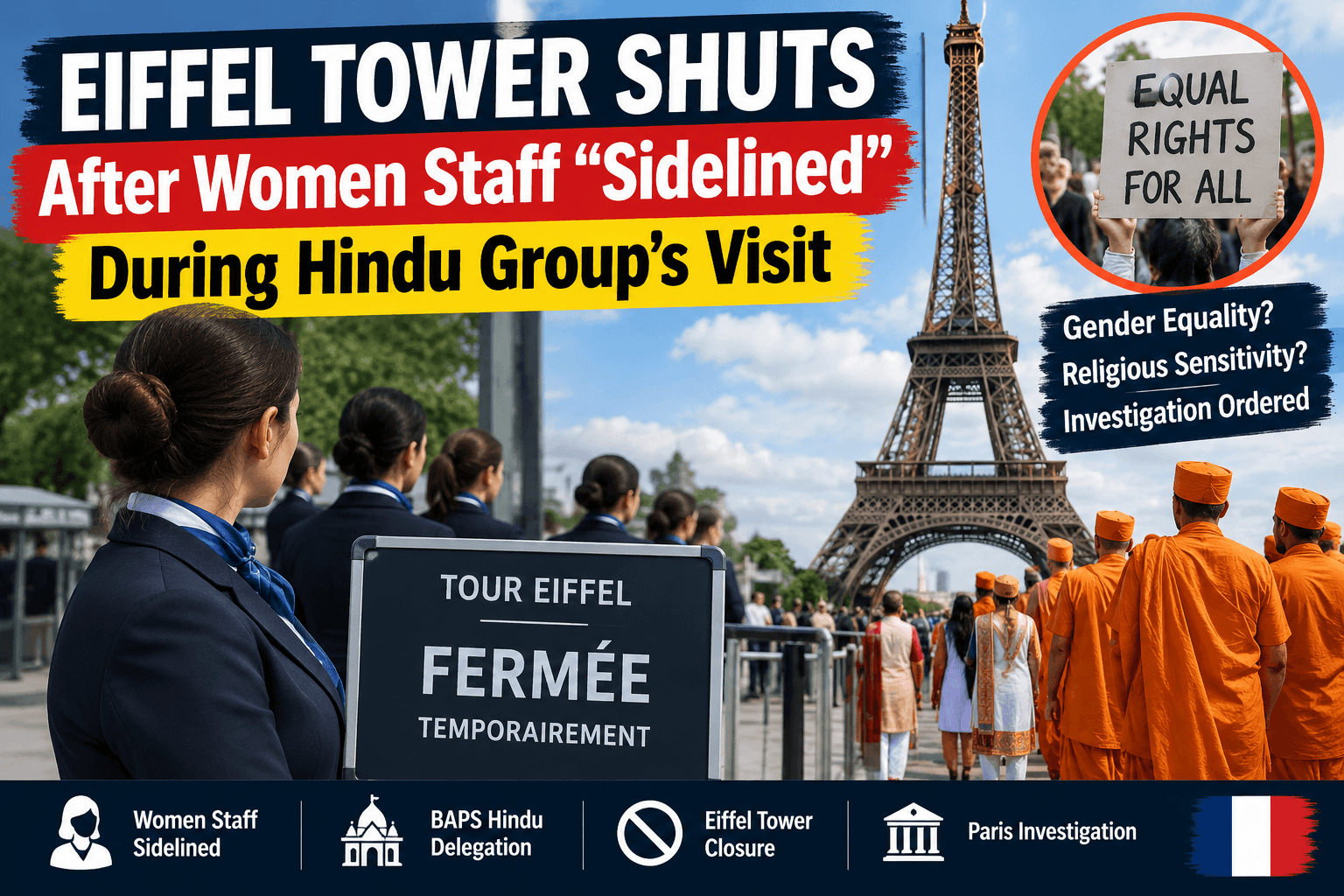
The incident has sparked a debate involving gender equality, religious accommodation, workplace rights and France’s commitment to secularism. The controversy also resulted in a temporary closure of the Eiffel Tower after employees protested over the reported treatment of female staff.
The delegation was associated with BAPS, the Bochasanwasi Akshar Purushottam Swaminarayan Sanstha, a Hindu religious organisation with a large international presence. The group was visiting France around the time of the inauguration of a major Hindu temple near Paris.
While the exact circumstances surrounding the incident are being investigated, the controversy has already attracted significant political and public attention.
At the heart of the dispute is a simple but sensitive question: Can religious or cultural preferences be accommodated when doing so appears to affect the equal treatment of employees?
Eiffel Tower Controversy: What Happened?
The controversy centres on a private visit to the Eiffel Tower by a large Hindu delegation.
According to reports, members of the delegation visited the monument on September 5, 2026. During preparations for the visit, arrangements were allegedly made that resulted in some female Eiffel Tower employees being moved away from positions where they could interact with members of the delegation.
Union representatives reportedly objected to the decision, arguing that female workers had effectively been “sidelined” because of their gender.
Reports suggested that male employees were placed in certain positions instead.
The allegation immediately raised concerns among staff because the issue was not simply about changing work schedules or managing a private event. Employees viewed the reported arrangement as a situation in which women were treated differently from their male colleagues.
The Eiffel Tower’s operator, Société d’Exploitation de la Tour Eiffel (SETE), later acknowledged that arrangements had been made in connection with a request from the visiting group but said that such conditions should not have been accepted.
That admission helped turn what might otherwise have remained an internal workplace disagreement into a major public controversy.
Why Did the Eiffel Tower Close?
The Eiffel Tower was temporarily closed to visitors following a protest by employees.
Workers gathered to express their concerns about what they described as unacceptable treatment of female colleagues.
The closure caused disruption at one of Paris’s busiest tourist attractions, with visitors unable to access the landmark as normal.
The Eiffel Tower receives millions of visitors each year, making even a short closure a significant event for tourists, businesses and the city.
However, employees argued that the protest was necessary to draw attention to an issue they believed involved fundamental workplace principles.
For the workers, the central concern was not the identity of the visiting group but the reported decision to separate or replace female staff.
The protest consequently became a wider discussion about whether an employer can accommodate a visitor’s religious or cultural preference if that accommodation results in employees being treated differently.
Who Is BAPS?
The Hindu organisation at the centre of the controversy is commonly known as BAPS, or Bochasanwasi Akshar Purushottam Swaminarayan Sanstha.
BAPS is an international Hindu religious and cultural organisation with temples and communities in numerous countries.
The organisation has a significant presence in Europe, North America, India and other parts of the world.
Its activities include religious services, cultural programmes, community service, education and charitable initiatives.
The organisation has recently attracted additional attention in France because of the opening of a major Hindu temple near Paris.
The Eiffel Tower visit reportedly formed part of activities surrounding the group’s presence in France.
Importantly, the current controversy concerns the arrangements made during the Eiffel Tower visit and should not automatically be interpreted as representing the beliefs or behaviour of every BAPS member or Hindu visitor.
The precise circumstances remain a matter for investigation.
What Did BAPS Say?
BAPS has responded to the controversy and expressed regret over the situation.
The organisation said the visit had been coordinated with Eiffel Tower management beforehand.
According to the organisation, arrangements were intended to manage the large delegation and minimise disruption during the visit.
BAPS has also said that it was not aware of anyone being prevented from entering the Eiffel Tower.
The organisation expressed regret that the situation had caused concern and said it takes the issues raised by employees seriously.
This response is significant because it highlights a difference between the allegations and the organisation’s understanding of the visit.
The employees and their representatives have focused on the treatment of female workers, while BAPS has indicated that the arrangements were part of logistical planning for a large private group.
The investigation will therefore be important in determining exactly what happened and who made the decisions regarding staff deployment.
What Did Eiffel Tower Management Say?
The Eiffel Tower’s operator, SETE, has acknowledged that conditions were arranged in connection with the delegation’s visit.
However, management reportedly said that accepting a request that resulted in female employees being treated differently was inappropriate.
This is one of the most important aspects of the controversy.
If management itself accepts that the arrangement should not have been made, questions naturally arise about how the decision was reached and whether proper workplace policies were followed.
The operator has also apologised to employees and indicated that an investigation would examine the circumstances.
The controversy therefore involves not only questions about the visiting delegation but also questions about the responsibilities of the Eiffel Tower’s management.
An employer is responsible for protecting its employees from discriminatory treatment, even when dealing with important guests or private groups.
Paris Authorities Launch Investigation
The controversy has also reached Paris’s political leadership.
Authorities have announced an investigation into the circumstances surrounding the visit and the treatment of staff.
The investigation is expected to examine questions such as:
- Who requested the changes to staff arrangements?
- What exactly were female employees asked to do?
- Was gender a factor in the decision?
- Who approved the arrangements?
- Did management violate workplace equality principles?
- Were employees informed beforehand?
- Were alternative arrangements available?
- Did the visiting delegation explicitly request the removal of female staff?
Finding clear answers to these questions will be essential.
At present, public discussion has moved faster than the formal investigation.
That makes it especially important to distinguish between reported allegations, statements from employees, management’s response and facts that are ultimately established by investigators.
Gender Equality at the Centre of the Debate
The strongest reaction to the incident has focused on gender equality.
France has long placed considerable importance on equality between men and women.
In workplaces, employees are generally expected to receive equal treatment regardless of gender.
This principle becomes particularly sensitive when an employer changes working arrangements because of a third party’s preference.
Critics argue that allowing a visitor to request that female employees be removed from certain positions could establish a troubling precedent.
For example, if a private group could request male-only or female-only staff based on religious or cultural preferences, employers could face difficult questions about where to draw the line.
Supporters of accommodation may argue that reasonable arrangements should be possible when they do not cause significant harm.
Opponents respond that workplace equality should not become negotiable.
This is why the Eiffel Tower dispute has become much larger than a disagreement over one private visit.
Religion and Cultural Sensitivity
The other major dimension of the story is religion.
France is known for its strong commitment to laïcité, or secularism.
The principle has played a major role in French public life and in the country’s approach to religion.
At the same time, France is a diverse society with communities representing many different religious and cultural traditions.
Tourist attractions, hotels, airports, restaurants and other public-facing institutions regularly interact with visitors who have different religious practices.
The challenge is finding a balance between respecting those practices and maintaining universal workplace standards.
Religious accommodation can sometimes be relatively simple.
For example, an institution might provide a suitable space for prayer, make reasonable scheduling adjustments or accommodate dietary requirements.
But the situation becomes more controversial when accommodation involves another person’s employment conditions or equal treatment.
That appears to be the central issue in the Eiffel Tower controversy.
Is a Visitor’s Religious Request Enough to Change Staff Roles?
This is perhaps the biggest question emerging from the incident.
Suppose a visiting group says it would prefer to interact only with male employees.
Should a venue agree?
There are several competing considerations.
On one hand, businesses may want to make visitors feel comfortable and respected. Large private groups can also require special logistical arrangements.
On the other hand, employees have their own rights.
A workplace cannot necessarily agree to every request made by a customer, guest or private organisation.
If the request directly conflicts with equality policies, management may have to reject it.
The Eiffel Tower controversy illustrates why these decisions should ideally be addressed before an event takes place, rather than after employees are affected.
Clear policies can help organisations determine which requests are reasonable and which cross a line.
Why the Eiffel Tower Makes the Story More Sensitive
The location itself has added enormous attention to the controversy.
The Eiffel Tower is not an ordinary workplace.
It is one of the most recognisable monuments on Earth and a symbol of Paris and France.
Millions of tourists from different countries visit it every year.
As a result, an incident involving its employees can quickly become an international story.
The tower also represents ideals that France often associates with its national identity, including liberty, equality and openness.
That makes allegations involving gender discrimination particularly sensitive.
The controversy therefore has symbolic importance beyond the immediate dispute.
The Impact on Tourists
The employee protest also affected tourists.
Visitors who had planned trips to the Eiffel Tower were faced with delays or temporary closure.
For international tourists, such disruption can be particularly frustrating because visits to the tower are often booked weeks or months in advance.
Hotels, tour operators and other tourism businesses can also be affected when major attractions close unexpectedly.
However, employee protests are an established part of labour relations in France, and workers can use industrial action to draw attention to workplace disputes.
In this case, employees evidently believed the issue was serious enough to justify disruption at one of the city’s most important tourist destinations.
Political Reactions
The controversy has generated political reactions because it touches on fundamental questions about equality.
French political figures have criticised the idea of female workers being removed or replaced because of a visitor’s preferences.
The argument is straightforward: religious freedom should not require discrimination against another person.
At the same time, political leaders must also avoid drawing conclusions before the investigation establishes the full facts.
That distinction is especially important in a case involving a religious organisation.
The issue should be about workplace conduct and institutional responsibility rather than about judging an entire religious community based on one disputed incident.
What the Incident Says About Workplace Policies
One lesson from the controversy is the importance of clear workplace policies.
Large venues often host private events involving diplomats, celebrities, religious groups, corporations and other organisations.
Special arrangements are sometimes necessary.
But employees need to know which requests management can accept and which requests must be rejected.
A strong workplace policy could state that:
- Employees must be treated equally.
- Customers cannot demand discriminatory treatment.
- Religious practices should be respected where reasonably possible.
- Accommodation cannot override employment rights.
- Management must consult employees when unusual arrangements affect their work.
- Complaints should be investigated promptly.
Such rules could prevent confusion and reduce the likelihood of similar controversies.
The Difference Between Respect and Discrimination
A particularly important point in this debate is the difference between respecting religious practices and discriminating against workers.
Respect can mean allowing someone to follow their faith where doing so does not interfere with another person’s rights.
Discrimination occurs when someone is treated less favourably because of a protected characteristic such as gender.
The difficult part is determining where an accommodation request crosses that boundary.
For example, a venue might reasonably accommodate a religious ceremony by adjusting access times.
But asking an employee to leave a position solely because the employee is a woman raises a very different question.
That distinction is likely to be central to the investigation.
Why the Investigation Matters
Public debate can become highly emotional when religion and discrimination are involved.
An official investigation can provide facts.
Investigators can establish what instructions were actually given, who gave them, what the delegation requested and whether employees were disadvantaged as a result.
It can also determine whether the situation was caused by:
- a misunderstanding;
- poor communication;
- an inappropriate decision by individual staff members;
- a management failure;
- an explicit request from visitors; or
- a combination of several factors.
The findings could determine whether disciplinary, organisational or policy changes are necessary.
Could This Happen Again?
The controversy may lead the Eiffel Tower and other French institutions to reconsider how they handle private visits by religious and cultural organisations.
Venues may become more cautious about accepting requests that affect employees based on gender.
They may also establish clearer rules for private tours.
This could ultimately become one of the more lasting consequences of the incident.
Rather than simply deciding who was right or wrong in this particular case, institutions could use the controversy as an opportunity to create clearer standards for future events.
A Broader Global Debate
The issues raised in Paris are not unique to France.
Around the world, workplaces frequently deal with competing expectations involving religion, culture, gender and customer preferences.
Airlines, hotels, hospitals, universities and government offices can all encounter similar questions.
How much accommodation is appropriate?
When does accommodation become discrimination?
Who should make the decision?
And what happens when the rights of one group appear to conflict with the rights of another?
There are rarely simple answers.
The Eiffel Tower controversy is therefore part of a much wider global conversation about how modern societies manage diversity.
What Should Be Avoided in the Debate?
Because the story involves a Hindu organisation, there is also a risk that the incident could be interpreted as a conflict between France and Hinduism.
That would oversimplify the situation.
The controversy concerns a specific visit and specific allegations regarding staff treatment.
It should not be used to stereotype Hindus, French people, religious organisations or women.
Likewise, criticism of the reported workplace arrangement should not automatically be interpreted as criticism of Hindu religious beliefs.
The most constructive approach is to focus on the facts.
If the investigation finds that women were indeed treated differently because of their gender, responsibility should be assigned to the people and institutions that made or approved that decision.
What Happens Next?
The immediate next step is the investigation into the incident.
Employees will likely seek assurances that similar arrangements will not be repeated.
Management may also review its policies for private events and religious delegations.
BAPS is expected to continue cooperating with authorities and maintaining its position that the visit was organised in consultation with Eiffel Tower management.
The final findings will be important because they could clarify whether the controversy resulted from an explicit request, an interpretation by staff or management, or a combination of circumstances.
Eiffel Tower Closure: Frequently Asked Questions
Why did the Eiffel Tower close?
The Eiffel Tower temporarily closed following a protest by employees concerning the reported treatment of female staff during a private visit by a Hindu delegation.
Which Hindu organisation was involved?
The delegation was associated with BAPS, the Bochasanwasi Akshar Purushottam Swaminarayan Sanstha.
Were women banned from the Eiffel Tower?
There is an important distinction between visitors and employees. The controversy concerns allegations that female staff members were asked to step aside or were replaced in certain positions during the delegation’s visit. BAPS has said it was not aware of anyone being prevented from entering the monument.
Why is the incident controversial?
The controversy centres on whether female employees were treated differently because of their gender in order to accommodate a visiting group’s preferences.
Has BAPS apologised?
BAPS has expressed regret over the controversy and said it takes the concerns raised seriously.
Has Eiffel Tower management responded?
Yes. The operator has acknowledged the arrangements surrounding the visit and said that accepting conditions that resulted in unequal treatment of female staff was inappropriate.
Is there an investigation?
Yes. Paris authorities have announced an investigation into the circumstances surrounding the incident.
What is the larger issue?
The dispute has raised questions about how institutions can respect religious and cultural practices while protecting workplace equality and employee rights.
Conclusion
The Eiffel Tower controversy is about much more than a temporary closure at a famous tourist attraction.
It has opened a difficult discussion about gender equality, religious accommodation, workplace rights and institutional responsibility.
The reported decision to sideline female employees during a private Hindu delegation’s visit has prompted strong reactions because gender equality is a fundamental principle in French public life.
At the same time, BAPS has said the visit was coordinated with management and has expressed regret over the controversy. The Eiffel Tower operator has also acknowledged that the conditions surrounding the visit should not have been accepted.
The investigation will ultimately need to establish what happened, who made the relevant decisions and whether employees were subjected to discriminatory treatment.
Until those findings are available, it is important to avoid turning allegations into established facts.
The broader lesson, however, is already clear: religious and cultural differences deserve respect, but that respect must be balanced with the equal treatment and dignity of workers.
For an institution as globally recognised as the Eiffel Tower, the controversy provides a powerful reminder that workplace policies matter—especially when the world’s cultures meet under one roof.
And as Paris investigates what happened, the outcome could influence how major public attractions across France handle similar situations in the future.