Table of Contents
Satya Niketan Building Collapse: A Tragedy That Has Shocked Delhi
A major building collapse in Satya Niketan, New Delhi, has once again raised serious questions about building safety, construction practices, structural inspections and the enforcement of civic regulations in the capital.
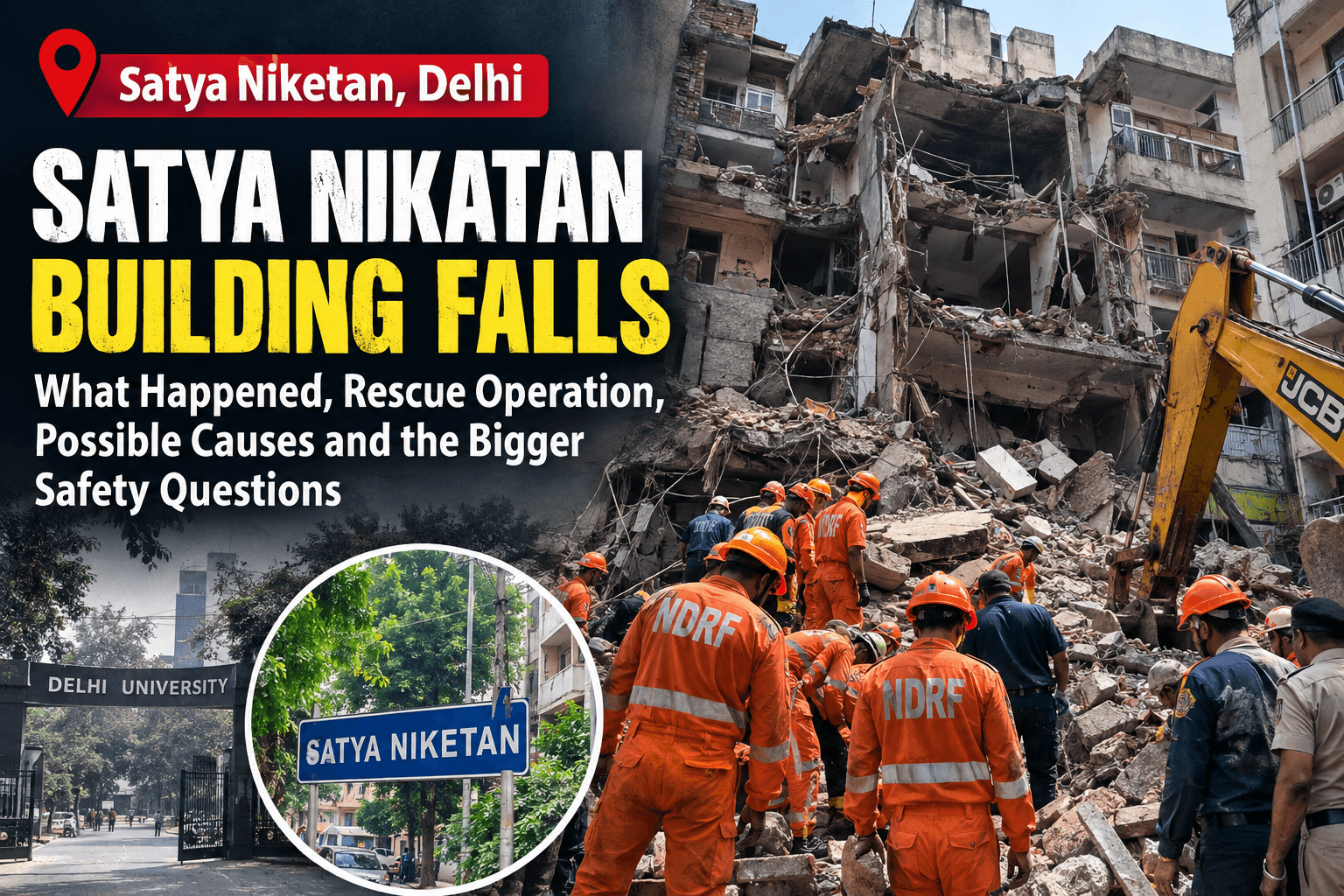
On Sunday, September 6, 2026, a multi-storey building being used as a student paying-guest accommodation collapsed in the Satya Niketan area near Delhi University’s South Campus. The incident triggered a large-scale rescue operation involving the Delhi Fire Services, police, disaster-response teams and other emergency personnel.
The building reportedly had a basement and five upper floors and was being used as accommodation for students. Initial reports said that dozens of people could have been inside when the structure came down. As rescue teams worked through the rubble, the death toll continued to rise. By September 7, reports placed the number of fatalities at at least seven, while several others were injured.
The tragedy has not only devastated families but has also renewed concerns about the safety of older buildings and student accommodations in densely populated parts of Delhi.
What Happened in Satya Niketan?
The building collapse took place at approximately 1:30 p.m. on Sunday, September 6, according to reports.
The structure was being used as a private PG or hostel accommodation. Satya Niketan is a densely populated locality popular among students because of its proximity to Delhi University’s South Campus. The neighbourhood has numerous PG accommodations, hostels, eateries, shops and residential properties packed into relatively narrow lanes.
According to police reports cited by news organisations, repair or construction work was underway in the building’s basement when the structure collapsed.
The building reportedly came down rapidly, trapping people beneath several layers of concrete, bricks, furniture and other debris.
The sudden nature of the collapse left residents, students, shopkeepers and passers-by scrambling for safety. Emergency services were called almost immediately, and rescue personnel began searching the debris for survivors.
At the time of the initial reports, authorities feared that a significant number of people could still be trapped inside.
A Building Full of Students
One of the most disturbing aspects of the tragedy is that the collapsed structure was being used as student accommodation.
Satya Niketan is known as a student-centric neighbourhood. Its location close to Delhi University makes it particularly attractive to students searching for relatively affordable accommodation.
Over the years, many residential properties in the area have reportedly been converted into PG accommodations and hostels.
The transformation of the locality has brought economic activity and housing opportunities, but it has also raised questions about whether old residential buildings are structurally suitable for accommodating larger numbers of people.
The Indian Express has reported that Satya Niketan developed over decades from a residential area into a major accommodation hub for students, with small plots and older structures being adapted for modern student housing needs.
That transformation makes structural safety especially important.
A building designed decades ago for a particular residential purpose may not necessarily have been designed to accommodate multiple floors, large numbers of occupants or extensive modifications.
Death Toll Rises as Rescue Operations Continue
The initial casualty reports changed rapidly as rescuers reached different sections of the collapsed structure.
Early reports spoke of one or two deaths, with several people critically injured and dozens feared trapped. Later updates reported a higher number of fatalities.
By Monday, September 7, reports from The Indian Express stated that at least seven people had died, with search and rescue operations continuing into a second day.
The changing numbers demonstrate the uncertainty that often surrounds major building-collapse incidents during the first several hours.
Rescue teams have to work extremely carefully because removing one section of rubble can potentially destabilise another part of a damaged structure.
Emergency personnel therefore face two simultaneous challenges: reaching people trapped underneath the debris and protecting rescuers from further structural failure.
How the Rescue Operation Unfolded
Following the collapse, emergency teams rushed to Satya Niketan.
The rescue effort involved multiple agencies and specialised equipment. Firefighters and disaster-response personnel worked alongside police and other emergency workers.
Earthmoving equipment was brought in to remove large quantities of debris. However, rescuers could not simply clear the rubble as quickly as possible.
When survivors may be trapped underneath a collapsed building, heavy machinery has to be used cautiously.
A careless movement can potentially cause additional debris to fall or injure someone trapped in a survivable pocket.
Reports described rescuers working through the night and into Monday as they searched for survivors.
One particularly hopeful development was the rescue of people who were found alive beneath the debris. Reports also highlighted how communication from trapped individuals helped rescuers identify possible locations where survivors might be located.
Why Did the Satya Niketan Building Collapse?
The exact cause of the collapse remains subject to investigation.
However, several possible factors have emerged from preliminary reports.
1. Ongoing Basement Work
One of the most frequently reported details is that construction or repair work was underway in the basement when the building collapsed.
According to Delhi Police reports cited by India Today, the structure was around 40 to 50 years old, and work was being carried out in the basement.
Basement construction or renovation can involve excavation, changes to foundations, removal of structural elements or other interventions.
If such work is undertaken without appropriate structural assessment and engineering supervision, it can potentially affect the stability of an older building.
That does not, by itself, establish that basement work caused this particular collapse. A detailed structural investigation will be necessary to determine the actual sequence of events.
2. Age of the Building
Reports have described the building as several decades old.
Age alone does not mean a building is unsafe. Many buildings remain structurally sound for decades when they are properly designed, maintained and inspected.
However, older buildings can become vulnerable when they are subjected to:
- Unauthorised additions
- Extra floors
- Structural alterations
- Water damage
- Foundation problems
- Poor-quality repairs
- Changes in building usage
- Overloading
- Lack of regular structural inspections
The combination of several such factors can create significant risks.
3. Unauthorised Construction and Structural Alterations
Another major concern emerging from the incident is the possibility of unauthorised construction.
Reports have raised questions about additional floors, structural modifications and repair work carried out over the years.
The Times of India reported allegations that the building had undergone modifications and that the structure lacked some important reinforcements. It also reported concerns about unauthorised repair work and water accumulation in the basement.
These reports are part of the developing investigation and should not be treated as a final determination of responsibility.
Nevertheless, they highlight a broader issue affecting many rapidly changing urban neighbourhoods.
When buildings are repeatedly modified without proper structural assessment, the original design assumptions may no longer apply.
The Waterlogging and Foundation Question
Another issue being examined is water accumulation in the basement.
Water can be particularly problematic for older structures when drainage is inadequate or when prolonged moisture affects soil, foundations, reinforcement, or masonry.
Delhi’s monsoon season can further complicate the situation.
However, it is important to distinguish between a possible contributing factor and a confirmed cause.
At this stage, only a professional structural investigation can determine whether waterlogging, foundation weakening or other factors played a decisive role in the Satya Niketan collapse.
Satya Niketan: Why the Location Matters
The incident has attracted enormous attention partly because of Satya Niketan’s importance to Delhi’s student community.
The neighbourhood is located close to Delhi University’s South Campus and has developed into a major student housing market.
Students often choose PG accommodation based on factors such as:
- Distance from college
- Monthly rent
- Food availability
- Transport connectivity
- Security
- Internet facilities
- Room size
- Availability of shared accommodation
Structural safety may not always be the first consideration.
This tragedy demonstrates why it should be.
A visually attractive room, convenient location or low rent cannot compensate for an unsafe building.
A Warning for Delhi’s PG and Hostel Market
The Satya Niketan incident has potentially significant implications for the city’s PG and hostel industry.
Thousands of students live in privately operated accommodations across Delhi.
Some properties were originally constructed as ordinary homes but were later converted into hostels or PGs.
When the number of occupants increases significantly, the building may experience changes in:
- Electrical load
- Water usage
- Plumbing requirements
- Fire-safety requirements
- Occupancy load
- Interior partitions
- Stairway usage
- Emergency evacuation requirements
If building permissions and safety requirements do not keep pace with these changes, residents can be exposed to unnecessary risks.
Authorities Announce Action
The incident has already prompted action from civic authorities.
India Today reported that the Municipal Corporation of Delhi ordered the immediate sealing of illegal constructions exceeding four floors following the collapse.
Authorities have also faced questions about whether existing regulations and inspection systems were sufficient to identify the risks before the collapse.
According to reports, officials have been suspended as part of the response to the incident. Investigators are also examining the building’s ownership, permissions, construction history and ongoing repair work.
The coming days are likely to bring more information about responsibility and possible regulatory violations.
The 2022 Satya Niketan Collapse
The latest incident is particularly disturbing because Satya Niketan has experienced another fatal building collapse in the past.
According to reports, in April 2022, a three-storey building in the same neighbourhood collapsed during renovation work. Two labourers died and several others were injured.
The Times of India reported that the structure had previously been declared dangerous by the municipal corporation and that authorities had sought to stop work before the collapse.
The fact that another major collapse has occurred in the same neighbourhood four years later has intensified calls for stronger enforcement.
The question is no longer simply about one building.
It is about whether similar risks exist in other ageing properties across Satya Niketan and other densely populated parts of Delhi.
What This Tragedy Teaches Us About Building Safety
The Satya Niketan collapse offers several important lessons.
Regular Structural Audits Are Essential
Older buildings should not be assessed only after cracks appear or a serious incident occurs.
Periodic structural audits can help identify problems before they become catastrophic.
Professional engineers can inspect:
- Foundations
- Columns
- Beams
- Slabs
- Load-bearing walls
- Reinforcement
- Basement conditions
- Water seepage
- Structural modifications
Such inspections are particularly important for buildings that have undergone renovations or changes in use.
Renovation Is Not Always Cosmetic
Many people assume that renovation simply means repainting walls, replacing tiles or improving interiors.
But renovation can involve major structural changes.
Removing a wall, altering a column, excavating a basement or changing load distribution can have consequences for the entire building.
Therefore, significant renovation work should be professionally assessed rather than treated as ordinary interior work.
What Students Should Check Before Renting a PG
The Satya Niketan tragedy also raises a practical question: What can students and families do before choosing accommodation?
A prospective tenant should look beyond the room itself.
Check the Building’s Condition
Look for:
- Major cracks
- Sagging ceilings
- Water seepage
- Damp basement areas
- Leaning walls
- Damaged staircases
- Exposed reinforcement
- Unusual settlement
- Broken or repeatedly repaired structural elements
A small cosmetic crack is not automatically dangerous, but significant structural cracks should be evaluated by a professional.
Ask About Approvals
Students can ask the property owner or operator whether the building has the required permissions and whether it is legally being used as a PG or hostel.
Check Emergency Exits
Every student accommodation should have a clear evacuation route.
Students should know:
- Where the staircase is
- Whether emergency exits are accessible
- Where fire extinguishers are located
- Whether exits are blocked
- How to contact emergency services
Do Not Ignore Warning Signs
If a building develops major cracks, unusual sounds, sudden floor settlement or significant water leakage, residents should immediately report the issue.
Safety concerns should never be dismissed simply because “everyone has been living here for years.”
The Bigger Problem: Urban Growth Without Adequate Oversight
Delhi’s housing demand continues to place pressure on existing neighbourhoods.
Areas close to universities, metro stations and employment centres become especially attractive for rental housing.
Property owners naturally want to maximise the use of available space.
That can lead to additional floors, room divisions and changes in building usage.
But urban growth must be accompanied by proper engineering and regulatory oversight.
A building cannot safely carry unlimited additional loads simply because there is demand for accommodation.
The Satya Niketan tragedy is therefore a reminder that urban development is not only about constructing more housing.
It is also about ensuring that existing housing remains safe.
Accountability Must Go Beyond the Immediate Incident
After every major building collapse, there is understandable public anger.
Authorities announce inspections.
Unsafe buildings are identified.
Notices are issued.
Sometimes properties are sealed.
But long-term safety requires more than a short-term reaction.
A meaningful response should include:
- Identification of vulnerable buildings.
- Independent structural audits.
- Verification of construction permissions.
- Strict monitoring of basement modifications.
- Action against illegal additional floors.
- Regular inspection of PGs and hostels.
- Clear accountability for regulatory failures.
- Transparent communication with residents.
- Emergency preparedness.
- Follow-up inspections after notices are issued.
The most important lesson from previous disasters is that issuing a notice is not the same as eliminating a danger.
A Tragedy That Should Not Become Just Another Headline
For the families affected, the Satya Niketan building collapse is not simply a news story.
It represents a lost family member, an injured student, a destroyed home and an uncertain future.
For students living away from their families, a PG is supposed to provide a safe place to live while they pursue their education.
The tragedy has shaken that sense of security.
For Delhi, meanwhile, it should serve as an opportunity to examine thousands of other buildings that may have undergone similar transformations.
The city has many ageing structures.
Some have been renovated multiple times.
Some have additional floors.
Some are being used for purposes different from their original design.
And some may not have undergone a proper structural audit in years.
Conclusion: Satya Niketan Building Collapse Is a Wake-Up Call
The Satya Niketan building collapse is a tragic reminder that structural safety cannot be taken for granted.
While the precise cause of the September 6 collapse remains under investigation, preliminary reports have raised concerns involving the building’s age, basement work, possible structural alterations and regulatory oversight.
The rescue operation has highlighted the dedication of emergency personnel working in extremely difficult conditions. At the same time, the incident has exposed uncomfortable questions about how old buildings are maintained and how effectively building regulations are enforced.
Most importantly, the tragedy should prompt action beyond Satya Niketan.
Delhi needs stronger structural-safety monitoring for ageing buildings, particularly those converted into high-occupancy PGs, hostels and rental accommodations.
Students and tenants need better information about the safety of the buildings they occupy.
Property owners need to understand that renovation and expansion must never compromise structural stability.
And authorities need to ensure that warnings are followed by meaningful enforcement.
The real measure of the response to Satya Niketan will not be how quickly the rubble is cleared. It will be whether the city can prevent another building from becoming another tragedy.
FAQs About the Satya Niketan Building Collapse
What happened in Satya Niketan?
A multi-storey building used as a student PG accommodation collapsed in Delhi’s Satya Niketan on September 6, 2026. Rescue teams were deployed after several people were feared trapped beneath the debris.
How many people died in the Satya Niketan building collapse?
As of September 7, reports stated that at least seven people had died. The casualty figure may change as authorities complete rescue and identification operations.
Was the building being used as a hostel?
Yes. Reports identified the structure as a private PG/student accommodation used primarily by students.
What caused the building to collapse?
The final cause has not yet been conclusively established. Reports have highlighted ongoing basement repair or construction work, the age of the building and possible structural or unauthorised modifications as areas of investigation.
Where is Satya Niketan?
Satya Niketan is a neighbourhood in southwest Delhi located near Delhi University’s South Campus and is known for student housing, PGs, hostels, shops and eateries.
What should students check before renting a PG?
Students should check the building’s overall condition, emergency exits, fire-safety arrangements, signs of structural damage, water seepage and whether the accommodation is being operated with appropriate permissions.
Why are building collapses a concern during renovation?
Renovation can affect structural components such as foundations, columns, walls and slabs. Work involving excavation or structural alterations should therefore be undertaken with appropriate engineering assessment and supervision.