Table of Contents
What began as a sarcastic response on social media eventually became one of India’s most unexpected youth-led political movements of 2026. The Cockroach Janta Party (CJP) started with an unusual name, a controversial remark and a student community increasingly frustrated with examination irregularities. Within weeks, the movement moved from smartphones to the streets, filling Delhi’s Jantar Mantar with students, job aspirants and young protesters.
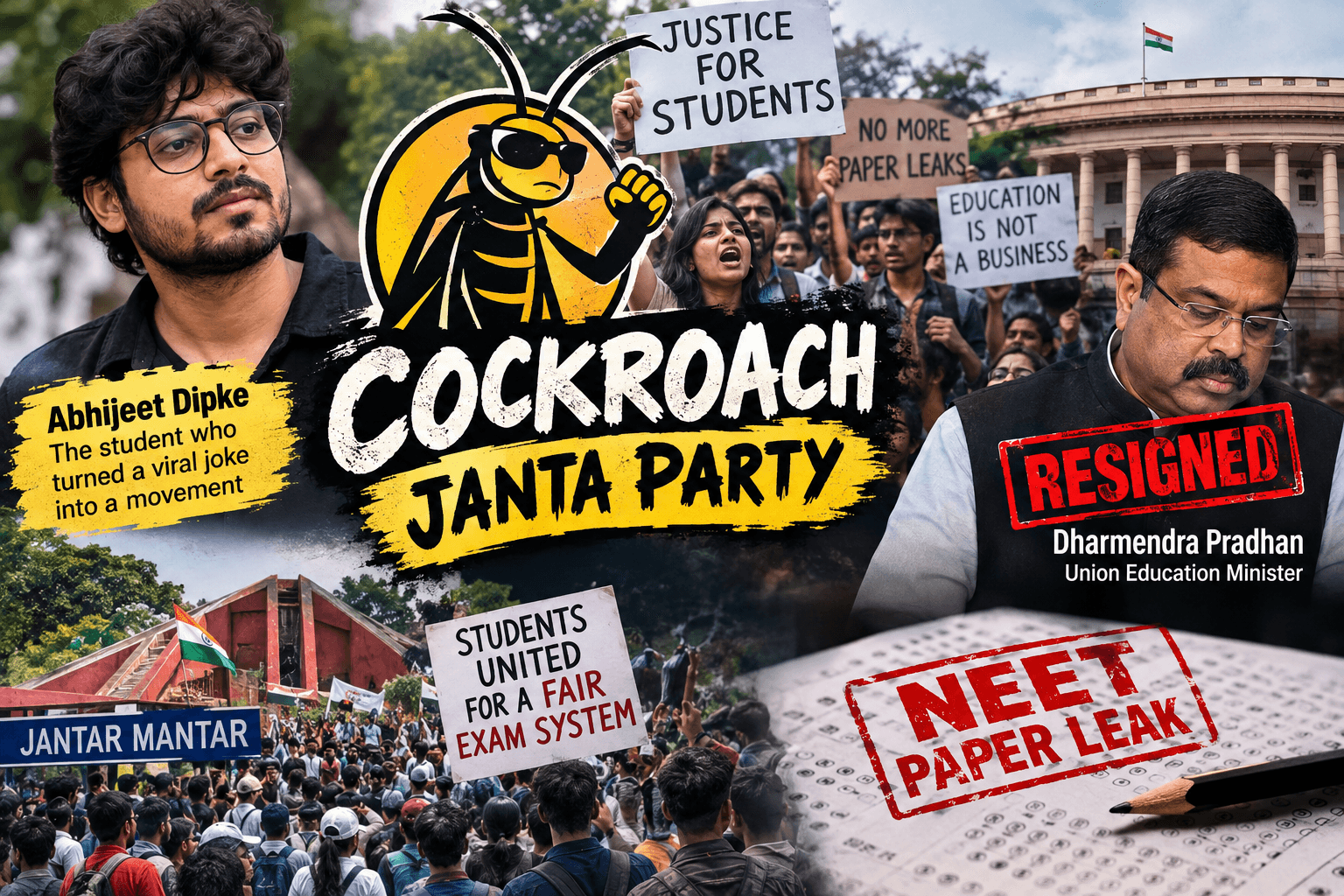
Its biggest political moment came on July 25, 2026, when Union Education Minister Dharmendra Pradhan resigned after weeks of protests demanding accountability over alleged examination irregularities and the NEET-UG controversy. The resignation was widely described as a major victory for the youth movement.
At the centre of this extraordinary story was Abhijeet Dipke, a young communications strategist and student whose understanding of social media helped turn an insult into a political identity.
But the story is much bigger than one individual.
It is about India’s students, the pressure of competitive examinations, the power of digital mobilisation and the growing willingness of young citizens to challenge institutions they believe have failed them.
How the “Cockroach” Name Was Born
The story began in May 2026, following remarks made during a Supreme Court hearing.
According to reports, Chief Justice of India Surya Kant referred to unemployed young people as “cockroaches” while discussing online criticism and young people associated with fake law degrees. The remark generated significant public criticism.
For many young Indians, the comparison was deeply offensive.
Instead of simply rejecting the word, however, Abhijeet Dipke decided to turn it around.
The response was satirical.
The name Cockroach Janta Party was deliberately provocative. Rather than allowing the word to remain an insult, the movement adopted it as a symbol.
The basic message was simple: if young people were going to be dismissed as “cockroaches,” they would organise themselves and make their presence impossible to ignore.
Dipke launched the movement online in May. What initially looked like an internet joke quickly attracted enormous attention.
Within a remarkably short period, the CJP became a recognisable youth brand.
And then another issue transformed the movement completely.
Who Is Abhijeet Dipke?
Abhijeet Dipke became the public face and founder of the Cockroach Janta Party.
Public reports describe him as a 30-year-old political communications strategist from Maharashtra with an academic background in journalism and public relations. He studied public relations at Boston University and had previously worked with the digital team associated with the Aam Aadmi Party.
His background is significant because the movement’s initial success depended heavily on communication.
CJP did not begin with a traditional political organisation.
There was no large network of established politicians.
There was no conventional election campaign.
Instead, the movement used social media, memes, short videos, slogans and highly shareable political messaging to reach young Indians.
Dipke understood something that traditional political organisations sometimes struggle to appreciate: young people may not always participate in conventional politics, but they are highly engaged with digital culture.
A slogan can travel across India within hours.
A meme can reach millions before a formal press conference has even begun.
And a protest movement can be built online before people ever meet each other physically.
That communication strategy became one of CJP’s biggest strengths.
From Satire to Serious Political Campaign
The early CJP campaign was largely satirical.
The organisation used humour to discuss unemployment, youth frustration and political accountability.
But the situation changed when examination-related controversies began dominating public discussion.
For millions of Indian students, competitive examinations are not merely tests.
They determine access to colleges, professional careers and, in many cases, the economic future of entire families.
That makes allegations of paper leaks, irregularities or unfair evaluation particularly explosive.
The controversy surrounding the NEET-UG examination provided the issue around which CJP could build a much broader campaign.
The movement’s message became increasingly serious:
Students wanted accountability.
The campaign began demanding responsibility from the Education Ministry and eventually focused on Dharmendra Pradhan’s resignation.
The transition was remarkable.
A movement that had begun with satire was now addressing one of the most politically sensitive issues in Indian education.
Why Examination Controversies Hit So Hard
To understand the strength of the protests, it is important to understand the emotional pressure surrounding India’s examination system.
Every year, millions of students prepare for competitive examinations.
Families spend years saving money for coaching.
Students sacrifice social lives and often study for 10 to 15 hours a day.
Some move from small towns to major cities.
Others study in cramped paying guest accommodations.
Many students repeat examinations for multiple years.
For them, an examination is not simply a question paper.
It represents years of preparation and enormous financial and emotional investment.
Therefore, allegations that an examination has been compromised can create an extraordinary sense of injustice.
Students may feel that their effort has been wasted.
Parents may fear that their children’s futures are being destroyed.
And when such concerns continue without what protesters consider adequate accountability, frustration can become political.
This is where CJP found its strongest support.
Jantar Mantar Becomes the Centre of the Movement
Delhi’s Jantar Mantar became the physical headquarters of the protest.
Students and supporters began gathering there for sit-ins, demonstrations and hunger strikes.
The protest lasted for weeks.
According to reports, the movement continued for more than a month and became increasingly visible nationally.
The protests eventually expanded beyond the original issue.
Participants raised concerns about:
- Examination paper leaks
- Competitive examination reforms
- Student suicides
- Accountability within educational institutions
- Youth unemployment
- Government transparency
- Safety of student protesters
- Treatment of young people by authorities
The movement’s unusual branding helped it stand out.
Posters featuring cockroach imagery appeared at demonstrations.
The slogan that had begun as satire became a badge of resistance.
Young people were effectively saying: we are not invisible.
The Moment the Movement Changed
One of the most important developments was the transition from online activism to mass mobilisation.
Digital campaigns can sometimes remain limited to social media.
CJP crossed that boundary.
Students physically gathered at protest sites.
The movement organised demonstrations and marches.
At one stage, protesters attempted a “Chalo Sansad” march toward Parliament.
The confrontation with authorities became another turning point.
Reports said police used force to control protesters during the demonstrations, with injuries reported among protesters and security personnel.
Instead of immediately ending the movement, the crackdown appeared to increase attention.
Images and videos circulated online.
More young people became aware of the protests.
And the central demand became even clearer:
The Education Minister should resign.
Why Dharmendra Pradhan Became the Focus
Dharmendra Pradhan was serving as India’s Union Education Minister when the protests intensified.
The protesters argued that political accountability was necessary for the examination controversies.
Their demand was not simply for technical reforms.
They wanted someone at the political level to accept responsibility.
That is a familiar pattern in democratic politics.
When a government department faces a major controversy, public pressure frequently centres on the minister responsible for the department.
In this case, the CJP made Pradhan’s resignation its central demand.
For weeks, that demand appeared difficult to achieve.
But the protests continued.
Eventually, on July 25, Pradhan announced his resignation.
The CJP declared victory and ended its immediate protest campaign.
A Rare Political Victory for Protesters
The resignation carried significance beyond the education portfolio.
The National University of Singapore’s Institute of South Asian Studies described the episode as the first instance of a cabinet minister in the Narendra Modi government resigning because of intense public pressure.
That made the event particularly important.
India has a long history of student movements.
Students have played significant roles in political campaigns, social movements and democratic protests.
But the CJP episode demonstrated something different:
digital-native political mobilisation can quickly become a real-world force.
The movement did not need decades of institutional infrastructure.
It needed a message that resonated with young people.
It needed organisers.
And it needed an issue capable of connecting millions of personal experiences.
The examination controversy provided exactly that.
The Power of Gen Z Politics
Perhaps the most interesting part of the CJP story is what it says about India’s younger generation.
Gen Z has grown up with smartphones, social media and instant access to information.
Their political communication is different from previous generations.
Traditional political speeches may not be enough.
Young audiences increasingly consume politics through:
- Instagram videos
- YouTube clips
- Memes
- X posts
- Short-form videos
- Livestreams
- Digital posters
- Viral hashtags
CJP understood this language.
The organisation did not attempt to look like a conventional political party.
Its name itself sounded like satire.
Its visual identity was unconventional.
Its communication was direct and sometimes humorous.
But beneath the humour was a serious message.
That combination helped it connect with students who may otherwise have remained politically disengaged.
The Student Who Became Part of a Bigger Story
The movement also brought many individual students into the spotlight.
One example is Anshil Khan, a 19-year-old student at Delhi Skill and Entrepreneurship University who spent weeks participating in the protest. According to an IPS report, Khan said he had been injured during police action but returned to the protest afterwards.
His story illustrates an important feature of the movement.
CJP was not simply about its founder.
Hundreds and eventually thousands of students gave the campaign its energy.
Some came to Jantar Mantar after seeing videos online.
Others arrived because they had personally experienced examination-related difficulties.
Some joined because they believed the government should be more accountable.
The movement became a collection of individual grievances.
The Role of Satire
Satire was perhaps CJP’s most powerful weapon.
Political protest is traditionally associated with angry slogans, serious speeches and formal organisations.
CJP added humour.
The word “cockroach” itself became part of the political performance.
Instead of hiding from the insult, protesters embraced it.
This is a classic tactic in social movements: reclaiming language that was intended to demean.
Once a community adopts an insult as its own identity, the original power of the insult can disappear.
The word becomes a symbol of solidarity.
That appears to have happened with CJP.
The cockroach was no longer merely an insult.
It became shorthand for a generation that felt ignored, dismissed and frustrated.
The Movement Faced Criticism Too
No major protest movement exists without controversy.
Critics questioned the CJP’s political character and whether a satirical organisation could sustain itself as a serious political force.
Others questioned the personalities involved and their previous political connections.
Some commentators also wondered whether the movement’s enormous online following translated into long-term political support.
These questions remain relevant.
Winning a protest is different from governing.
Winning a resignation is different from fixing an education system.
And creating a viral movement is different from building a durable political institution.
The resignation of a minister solved one immediate demand.
It did not automatically solve India’s examination problems.
What Happens After the Protest?
The biggest question now is what comes next.
The movement has already indicated ambitions beyond the original protest.
Its leaders have continued speaking about youth issues, examination reforms and political accountability.
The CJP has also started expanding its presence beyond the original Delhi protest.
Recent reports indicate that the organisation is attempting to build a wider political footprint, including activities in states such as Jharkhand.
This raises an important question:
Can a protest movement become a political organisation?
History provides mixed answers.
Some movements disappear after achieving their immediate goal.
Others evolve into political parties.
Some lose momentum because their supporters disagree about the next objective.
For CJP, the resignation of Pradhan could therefore be either the end of a chapter or the beginning of something much larger.
The Legal Battle Did Not End With the Protest
Even after the resignation, controversy surrounding the movement continued.
Students involved in CJP demonstrations have faced questions and notices from authorities.
One recent case involved a second-year law student from Gautam Buddha University who received a show-cause notice over alleged participation in a CJP protest. The notice was subsequently revoked following public attention.
Another student, Akshat Tripathi, received a legal notice connected to his participation in the protests. The matter later became part of a wider legal dispute involving the rights of protesters.
The Supreme Court has also taken an interest in complaints concerning participants in the protests.
That is significant because it moves the story beyond politics.
It becomes a question of constitutional rights.
How much freedom should students have to participate in peaceful demonstrations?
Can educational institutions punish students for political participation?
When does government action against protesters become excessive?
These questions will continue to shape the legacy of the movement.
A Troubling Development Involving a Minor Protester
The post-protest period has also highlighted the risks faced by young activists.
The Supreme Court recently expressed concern about alleged intimidation of a 14-year-old girl who had participated in the CJP demonstrations.
The court was informed about allegations involving threats and harassment and directed attention toward the safety of the girl and her family.
The episode demonstrates the darker side of viral political movements.
When young people become highly visible online, they can attract both support and hostility.
Social media can amplify a student’s voice.
But it can also expose that student to harassment.
That makes protection of young protesters an increasingly important part of the discussion.
Beyond NEET: A Wider Crisis of Trust
The CJP protests were triggered by examination controversies, but their appeal went beyond NEET.
They reflected a broader concern among India’s youth about fairness.
Students want to believe that effort matters.
They want examinations to be transparent.
They want mistakes to be acknowledged.
They want institutions to respond quickly when something goes wrong.
Most importantly, they want to feel that their futures are not being decided by systems they cannot trust.
That is why examination controversies can become politically explosive.
For a student who has spent two years preparing for a medical entrance examination, the difference between success and failure can determine an entire career.
If that examination is suspected of being compromised, the emotional impact can be enormous.
The Economic Pressure Behind Student Anger
There is also an economic dimension.
Competitive examination preparation has created a massive coaching industry.
Families frequently spend large amounts of money on coaching, accommodation, books, test series and travel.
Students from poorer backgrounds often struggle to compete with candidates who can afford expensive preparation.
This creates another layer of frustration.
A student may feel that the system is unequal even before an examination begins.
If allegations of paper leaks or irregularities are added to that inequality, public anger becomes stronger.
CJP’s language resonated because it connected examination controversies with a much larger feeling:
young Indians are tired of being told to wait.
Why the Story Matters for Indian Democracy
The CJP episode is important not simply because a minister resigned.
Its larger significance lies in how power was challenged.
The movement began with a student and a social-media idea.
It expanded through online networks.
It attracted young people who had never previously participated in organised politics.
It reached the streets.
It created national headlines.
And eventually, its central demand was met.
That is a powerful demonstration of democratic participation.
It also shows that political power in the digital age can move in unexpected directions.
A movement does not necessarily need traditional party structures to influence government decisions.
Sometimes a hashtag can become a march.
A meme can become a slogan.
A joke can become an organisation.
And an insult can become a political identity.
The Limits of Protest Politics
However, there is an important lesson on the other side.
A successful protest must eventually become a policy conversation.
Removing a minister does not automatically repair an examination system.
The government still needs to answer difficult questions about:
- How examination papers are protected
- How leaks are detected
- How digital examination systems are secured
- How students are compensated after major failures
- How examination authorities are held accountable
- How quickly disputed results are reviewed
- How student grievances are handled
- How mental-health support is provided to affected students
If those issues remain unresolved, the underlying frustration that created the movement will remain.
That is why the next phase may be more difficult than the protest itself.
A New Generation Finds Its Political Voice
The most lasting legacy of the movement may ultimately be psychological rather than institutional.
For many young Indians, the protests delivered a simple message:
You do not have to remain silent.
The students who gathered at Jantar Mantar saw that their voices could attract national attention.
They saw that political leaders could be pressured.
They saw that social media could translate individual frustration into collective action.
And they saw that young people could become political actors rather than simply political spectators.
That lesson may continue long after the original protest disappears from the headlines.
What Abhijeet Dipke’s Story Really Represents
It would be easy to reduce the entire episode to the story of one young founder.
But that would miss the larger point.
Dipke provided the spark and communication strategy.
Other organisers helped build the movement.
Students supplied the numbers.
Activists brought credibility.
Social media provided distribution.
And examination controversies supplied the emotional fuel.
The resignation of Dharmendra Pradhan was therefore not the result of one person’s actions alone.
It was the culmination of thousands of people turning individual frustration into collective pressure.
Dipke’s significance lies in his ability to recognise that frustration and give it a name.
The name happened to be Cockroach Janta Party.
The Road Ahead
The CJP movement has already demonstrated that youth politics in India is changing.
The next challenge will be maintaining momentum without losing focus.
If the movement becomes primarily electoral, it will have to develop policies across areas far beyond education.
If it remains an activist organisation, it will need to continue pressuring governments while maintaining credibility.
If it returns mainly to digital activism, it will need to keep its audience engaged.
Each path carries risks.
But whatever happens next, the events of 2026 have already changed the conversation.
A movement that began as a satirical response to one controversial phrase eventually became a national campaign demanding accountability from India’s education establishment.
Conclusion: When a Joke Became a Movement
The story behind the “cockroach” protests is ultimately a story about transformation.
A controversial remark became a meme.
The meme became a movement.
The movement became a protest.
The protest became a national political issue.
And the political pressure eventually contributed to the resignation of Union Education Minister Dharmendra Pradhan on July 25, 2026.
But the deeper story is about India’s students.
They are facing enormous competition, rising educational costs, employment uncertainty and intense pressure to succeed.
When they believe institutions have failed them, they are increasingly willing to speak out.
The Cockroach Janta Party gave that frustration a strange but memorable identity.
Whether CJP eventually becomes a lasting political force or remains remembered primarily as one of India’s most unusual protest movements, its impact is already significant.
It demonstrated the political power of a generation that communicates differently, organises differently and increasingly refuses to accept that young voices should remain on the sidelines.
The cockroach was supposed to be an insult.
In 2026, Indian students turned it into a symbol of resistance.
And that may be the most important lesson of the entire episode: sometimes the most unexpected political movements begin when ordinary people decide to reclaim the words used to dismiss them.
[…] https://thehommyblogger.com/cockroach/news/daily-news/09/2026/ […]