Table of Contents
The US Department of Homeland Security (DHS) has proposed a major change to the rules governing several categories of foreign workers who lose their jobs in the country. The proposal would remove the discretionary grace period of up to 60 days that currently gives certain employment-based visa holders time to find a new employer, change their immigration status, or prepare to leave the US.
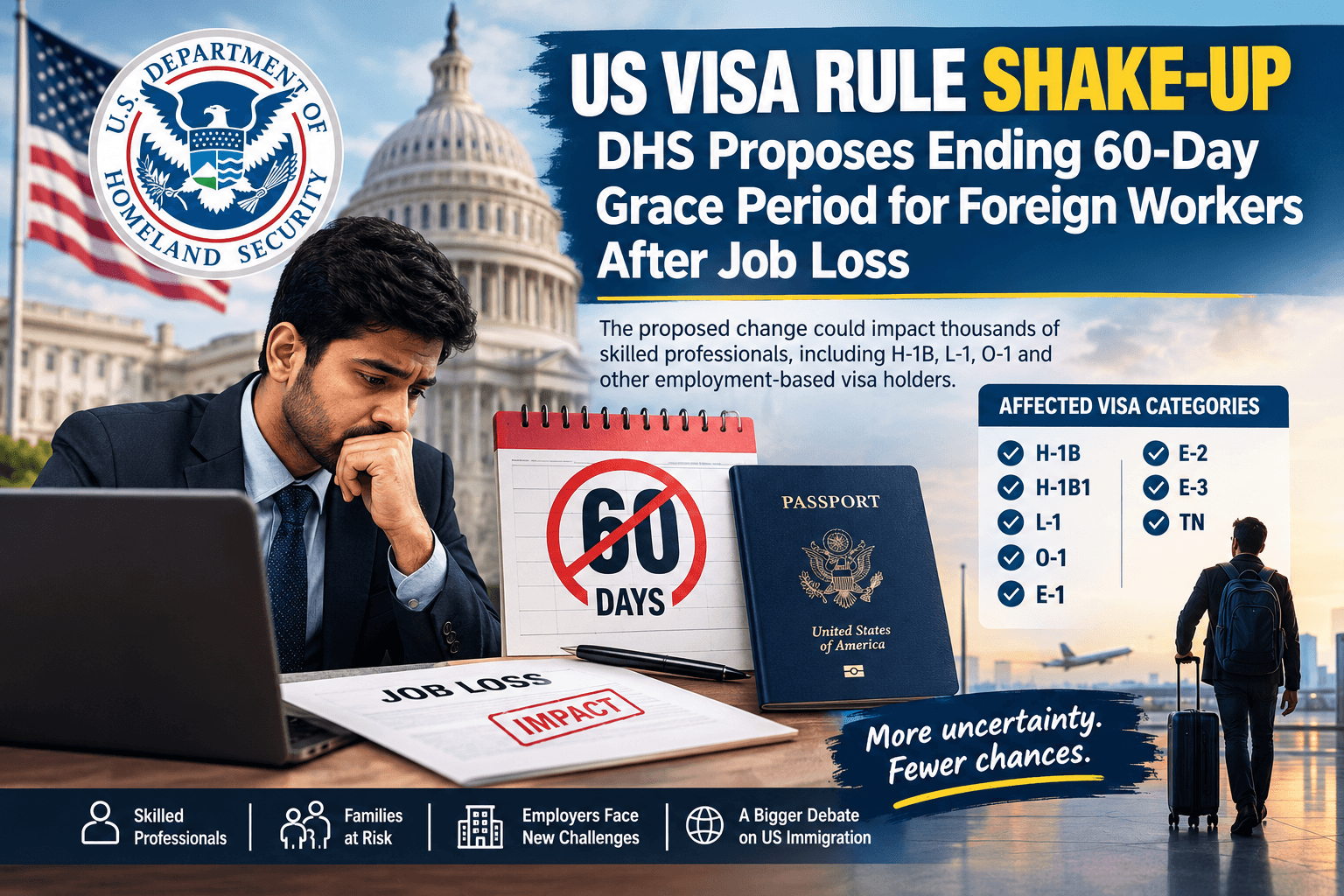
The proposal is particularly significant for workers on H-1B visas, a category widely used by technology companies and other businesses to employ highly skilled professionals. It could also affect people holding E-1, E-2, E-3, H-1B1, L-1, O-1 and TN classifications, as well as eligible dependents whose status is connected to the principal worker.
The DHS proposal does not mean the 60-day grace period has already disappeared. It is a proposed regulatory change and must go through the federal rulemaking process, including a period for public comments, before a final rule could take effect. The Federal Register proposal says DHS wants to remove the provision found at 8 CFR 214.1(l)(2), which currently allows an employment-related grace period of up to 60 days in qualifying circumstances.
For foreign professionals, employers, and families, however, the proposal represents a potentially important shift in how quickly immigration consequences could follow the loss of a job.
What Is the Current 60-Day Grace Period?
The 60-day grace period was introduced in 2017 as a way to provide certain nonimmigrant workers with a limited amount of time after their employment ends.
Under the current framework, eligible workers can generally remain in the United States for up to 60 days following the end of employment, or until the end of their authorized validity period if that comes sooner. During that window, workers may have an opportunity to look for another employer, arrange a new immigration filing, change status where legally possible, or prepare to depart the country.
The policy became particularly important for workers in industries where layoffs can occur unexpectedly.
A foreign employee on an H-1B visa, for example, does not simply need to find another job. The next employer generally has to take immigration-related steps to employ the worker in H-1B status. That means the employee’s search for a new position is closely connected to immigration procedures and employer sponsorship.
The grace period therefore provides something that ordinary employees may take for granted: time.
Without such a window, a sudden termination could create an immediate immigration problem even for a highly qualified professional who has spent years working and living in America.
DHS now argues that the grace period disconnects lawful immigration status from the employment or activity that forms the basis for certain employment-based classifications. The agency’s proposal seeks to restore a system under which employment-linked status is more directly tied to continued qualifying employment.
What Exactly Is DHS Proposing?
The proposed regulation would eliminate the availability of the discretionary grace period of up to 60 days for several employment-based nonimmigrant categories.
According to the DHS proposal, the affected classifications include:
- H-1B
- H-1B1
- L-1
- O-1
- E-1
- E-2
- E-3
- TN
These categories cover a broad range of foreign professionals, executives, managers, specialized workers and other skilled individuals.
The proposal is based on DHS’s argument that the underlying immigration classifications are connected to specific employment or qualifying activities. If that employment ends, DHS says the legal basis for the individual’s status may no longer exist.
The proposed change would therefore remove the regulatory grace period rather than allowing workers to automatically rely on a two-month buffer after employment ends.
It is important to emphasize that the proposal is not yet a final rule.
That distinction matters because proposed regulations can change during the public-comment and finalization process. Until a final rule takes effect, eligible workers continue to be governed by the existing rules.
Why H-1B Workers Are at the Center of the Debate
The H-1B program is one of the most important employment-based immigration pathways for skilled professionals in the United States.
Technology companies, consulting firms, financial institutions, healthcare organizations, research companies and other businesses use H-1B workers for specialized positions.
Indian professionals are particularly prominent in the H-1B system. Large technology and consulting companies have historically been major sponsors of H-1B employees, making changes to the program especially relevant to Indian workers and the broader Indian-American professional community. Reuters reported that companies including Deloitte, PwC, EY, Tata Consultancy Services, Infosys, HCLTech and LTIMindtree are among prominent H-1B sponsors.
The proposed policy could create a more challenging situation for an H-1B worker who suddenly loses employment.
Consider a hypothetical software engineer who has worked in the United States for several years.
The worker may have:
- A home or apartment lease
- Children attending local schools
- A spouse with employment or dependent status
- A car or other property
- Retirement and financial accounts
- A professional network
- A mortgage
- Ongoing medical or family commitments
A job loss could therefore become much more than an employment issue.
It could become an immigration deadline.
Under the current framework, the worker may have a limited period to find a new sponsoring employer or make other arrangements. Eliminating that window could significantly compress the time available to make those decisions.
The Impact on Indian Professionals Could Be Significant
The proposed change has attracted particular attention in India because Indian professionals make up a substantial share of the H-1B workforce.
For many Indian technology professionals, the United States is not a temporary destination in the conventional sense. Some workers spend many years building careers and families in the country.
That makes sudden immigration uncertainty particularly difficult.
An employee who loses a job could potentially need to coordinate several processes at once: finding a new employer, understanding the immigration implications of the new position, completing required filings and preparing for the possibility of departure.
The problem becomes even more complicated when a worker has dependents.
A spouse and children may hold derivative immigration status connected to the principal worker. The Federal Register proposal specifically discusses the treatment of dependents under the existing grace-period framework.
For a family that has lived in the United States for years, a job termination could therefore affect housing, schooling, finances and family planning.
Technology Companies Could Also Feel the Pressure
The policy debate is not limited to foreign workers.
US employers that depend on skilled international talent could also face operational challenges.
Companies routinely restructure their workforces in response to economic conditions, changes in demand, mergers, acquisitions and technological shifts. Layoffs can sometimes happen quickly.
When a worker is on an employment-based visa, however, the employer must consider immigration requirements in addition to standard human-resources procedures.
Removing the 60-day window could force companies to make immigration considerations part of termination planning much earlier.
Immigration lawyers quoted by Reuters have warned that the proposal could sharply compress the timeline available to human-resources teams dealing with layoffs and foreign-national employees.
For employers, this could mean:
- Faster coordination with immigration counsel
- More urgent communication with affected employees
- Greater pressure to identify potential immigration alternatives
- More complicated offboarding procedures
- Increased uncertainty during workforce restructuring
The effects could be particularly noticeable at companies with large numbers of H-1B, L-1 or other employment-based visa holders.
Could the Rule Encourage More Hiring of US Workers?
DHS has presented the proposed change partly within a broader policy argument about the relationship between foreign workers and the American workforce.
The agency’s proposal indicates that employers could offer positions to qualified US workers or use the applicable petition process if they still need the foreign employee. Reuters reported that DHS believes companies could replace departing foreign workers with equally qualified US workers in some situations.
Supporters of a stricter approach may argue that employment-based immigration should remain closely connected to an actual qualifying job.
From this perspective, if a foreign worker is no longer employed in the position supporting the visa classification, the worker should not have an extended period of authorized stay based solely on the former employment.
Critics, however, argue that the labor market does not operate instantly.
Finding a qualified employee can take weeks or months, especially for highly specialized roles. Similarly, finding a new employer willing and able to sponsor a foreign worker can take time.
That tension lies at the heart of the debate.
What Happens When a Worker Loses a Job?
Under the current system, an eligible worker may have up to 60 days to seek another qualifying opportunity or make other immigration arrangements, subject to the existing rules and individual circumstances.
If the proposed rule becomes final, that cushion could disappear.
That does not necessarily mean every worker would be physically removed from the country on the same day employment ends. Immigration cases can involve different legal circumstances, existing validity periods, petitions, applications and other factors.
Instead, the central issue is that the regulatory protection that currently allows the up-to-60-day grace period would no longer be available.
Individual cases could therefore depend heavily on the person’s immigration status, the timing of filings, the validity of existing documents and whether another lawful basis for staying exists.
This is one reason immigration attorneys are likely to become even more important for workers affected by layoffs.
Other Visa Categories Could Be Affected
Although H-1B is receiving most of the attention, the proposal is broader.
L-1 Visa Holders
L-1 visas are commonly used for executives, managers and specialized-knowledge employees transferring within multinational companies.
An L-1 worker who loses employment could face similar concerns under the proposed framework.
O-1 Visa Holders
O-1 visas are designed for individuals with extraordinary ability or achievement in fields such as science, education, business, athletics and the arts.
These workers are highly specialized, and their immigration status is also connected to qualifying employment or activities.
TN Professionals
The TN category facilitates professional employment for qualifying citizens of Canada and Mexico under the USMCA framework.
The proposed changes could also affect TN workers when their qualifying employment ends.
E-1 and E-2 Workers
E-1 and E-2 classifications relate to treaty traders and treaty investors.
These categories have different eligibility requirements from H-1B, but they are also included in DHS’s proposed changes.
H-1B1 and E-3
H-1B1 applies to qualifying professionals from Singapore and Chile, while E-3 is a professional visa category specifically for Australians.
The proposed rule would therefore reach beyond the much larger H-1B population.
Families Could Face Additional Uncertainty
One of the most sensitive aspects of the proposal involves families.
A foreign worker may have lived in the United States for years, while their spouse and children have built their own lives there.
A sudden loss of employment can affect:
- Children’s education
- Housing arrangements
- Health insurance
- Household income
- Spousal employment
- Travel plans
- Community ties
- Financial commitments
The existing grace period provides a limited opportunity to organize these issues.
Removing it could make family planning considerably more difficult.
A worker might have to make decisions about whether to pursue another employer, explore another immigration category, or prepare to leave the United States with little room for delay.
Immigration experts have warned that many foreign workers have deep community and family ties in the United States, making an abrupt departure particularly disruptive.
What About Workers Who Quit Voluntarily?
The proposed regulation concerns the cessation of employment or qualifying activity, so its potential application is broader than layoffs alone.
That means workers considering resignation may also need to pay close attention to how the final rule is written.
The precise consequences would depend on the final regulatory language and the individual’s immigration circumstances.
This is another reason workers should not assume that the proposed change is only about corporate layoffs.
The Proposal Is Part of a Broader Immigration Debate
The DHS proposal arrives amid a broader debate in the United States over legal immigration, skilled-worker programs and the role of foreign professionals in the American economy.
The Trump administration has pursued several immigration-related measures affecting foreign workers, visa processing and employment-based immigration. Reuters described the grace-period proposal as another step in the administration’s broader effort to tighten immigration rules.
The debate reflects two competing objectives.
One side emphasizes the protection of American workers and argues that immigration programs should not create an unfair advantage for foreign labor.
The other side emphasizes the importance of international talent and argues that American businesses rely on skilled professionals from around the world.
The H-1B system sits directly in the middle of this argument.
Why the 60-Day Period Matters So Much
Sixty days may sound like a long time.
In an immigration case, it is not.
A worker who loses employment may need to update a résumé, contact recruiters, complete interviews, negotiate an offer and wait for a company to complete immigration procedures.
For senior or highly specialized positions, hiring can take much longer.
There may also be delays related to legal filings, employer compliance and government processing.
That is why removing the grace period could create a major practical difference even though the proposal technically concerns only a 60-day window.
The change could transform a difficult employment problem into a much more urgent immigration problem.
What Employers May Need to Do
If the proposal ultimately becomes final, employers with foreign workers could need to rethink their immigration and HR policies.
Companies may need to:
- Identify visa-dependent employees before workforce changes.
- Coordinate layoffs with immigration counsel.
- Communicate termination dates clearly.
- Explain immigration-related consequences to affected workers.
- Review whether alternative employment or immigration options exist.
- Update internal offboarding procedures.
- Consider the timing of immigration filings when making employment decisions.
The proposal could therefore have an impact even on companies that are not themselves seeking to restrict immigration.
What Foreign Workers Should Watch
Foreign professionals should avoid treating the proposal as though it were already law.
The existing grace period remains relevant unless and until a final rule changes the applicable regulations.
Workers should instead monitor the federal rulemaking process and seek qualified immigration advice if their employment situation changes.
People facing an actual termination should also avoid relying solely on social-media posts or general news articles for legal decisions.
Immigration status is highly fact-specific.
The correct course can vary depending on visa category, petition status, authorized stay, employment dates, dependents and other circumstances.
Public Comments Will Be Important
Because the proposal is a regulatory change, the public-comment process will be an important part of what happens next.
Once the proposal is formally published, individuals, companies, immigration lawyers, professional associations and advocacy organizations can provide comments.
Those comments can raise concerns about:
- Economic effects
- Employer compliance
- Family disruption
- Workforce shortages
- Administrative burdens
- Treatment of specialized workers
- Practical implementation
- Effects on American businesses
The proposal’s publication begins a process rather than immediately changing the law.
Reuters reported that the measure is subject to a public-comment period of roughly two months before it can be finalized.
Could the Proposal Be Changed?
Yes.
A proposed rule is not necessarily identical to the final rule.
After reviewing public comments and other considerations, DHS could maintain the proposal, modify it, withdraw it or adopt a different approach.
That means foreign workers and employers should distinguish carefully between:
Current law: The existing rules remain applicable.
Proposed rule: DHS is seeking to change those rules.
Final rule: Only after the regulatory process is completed and a final rule becomes effective would the new requirements govern eligible cases.
This distinction is essential when discussing the future of the H-1B grace period.
What It Could Mean for the US Talent Market
The long-term impact is difficult to predict.
If the grace period disappears, some foreign professionals may become more cautious about moving to the United States.
Workers may consider countries with more predictable employment-linked immigration policies.
Employers could also face greater difficulty retaining international employees who know that losing a job could create immediate immigration pressure.
On the other hand, supporters may argue that tighter rules could encourage employers to prioritize American workers and reduce dependence on temporary foreign labor.
The outcome may depend on how businesses, workers and the wider labor market respond.
A Major Change in Risk for Foreign Professionals
At its core, the proposal is about more than 60 days.
It is about the relationship between employment and immigration status.
For many foreign professionals, a job is not simply a source of income. It is also the foundation of their ability to remain legally in the United States.
The current grace period creates a small buffer between the end of employment and the loss of that foundation.
DHS is now proposing to remove that buffer.
For an H-1B worker who has spent years building a career in America, that could represent a substantial increase in uncertainty.
For employers, it could mean a faster and more complicated response when foreign-national employees leave or are laid off.
For families, it could turn an unexpected job loss into a much larger life decision.
And for policymakers, it raises a fundamental question: how should the United States balance immigration enforcement and workforce priorities with the economic reality that American businesses increasingly compete for talent in a global market?
Final Takeaway
The Department of Homeland Security’s proposal to eliminate the discretionary 60-day grace period for certain employment-based foreign workers marks a potentially significant change in the US immigration system.
The affected categories extend beyond H-1B and include L-1, O-1, TN, E-1, E-2, E-3 and H-1B1 workers. The proposal would remove the regulatory provision that currently allows eligible workers and dependents a period of up to 60 days after employment ends, subject to the existing rules and individual circumstances.
For Indian professionals, the issue deserves particular attention because of India’s prominent role in the H-1B workforce.
However, it is equally important not to confuse a proposal with a final policy.
The rulemaking process still matters. Public comments can influence the final version, and the effective date and precise implementation requirements will depend on what DHS ultimately decides.
Until then, foreign workers should continue to follow the existing immigration rules while closely monitoring official announcements.
The bigger story is that the proposed change could make employment-linked immigration in America more immediate, less flexible and potentially more consequential for workers who experience an unexpected job loss.
For thousands of professionals and their families, the difference between having 60 days to find a solution and having no comparable regulatory grace period could be enormous.
[…] https://thehommyblogger.com/us-visa-rule/news/daily-news/09/2026/ […]