Table of Contents
The relationship between India and China is entering a potentially important new phase. Chinese President Xi Jinping is expected to visit New Delhi this week for the BRICS summit, marking his first visit to India in seven years. His arrival comes at a time when both countries appear willing to move away from the intense confrontation that followed the deadly 2020 border clashes, even though deep strategic and
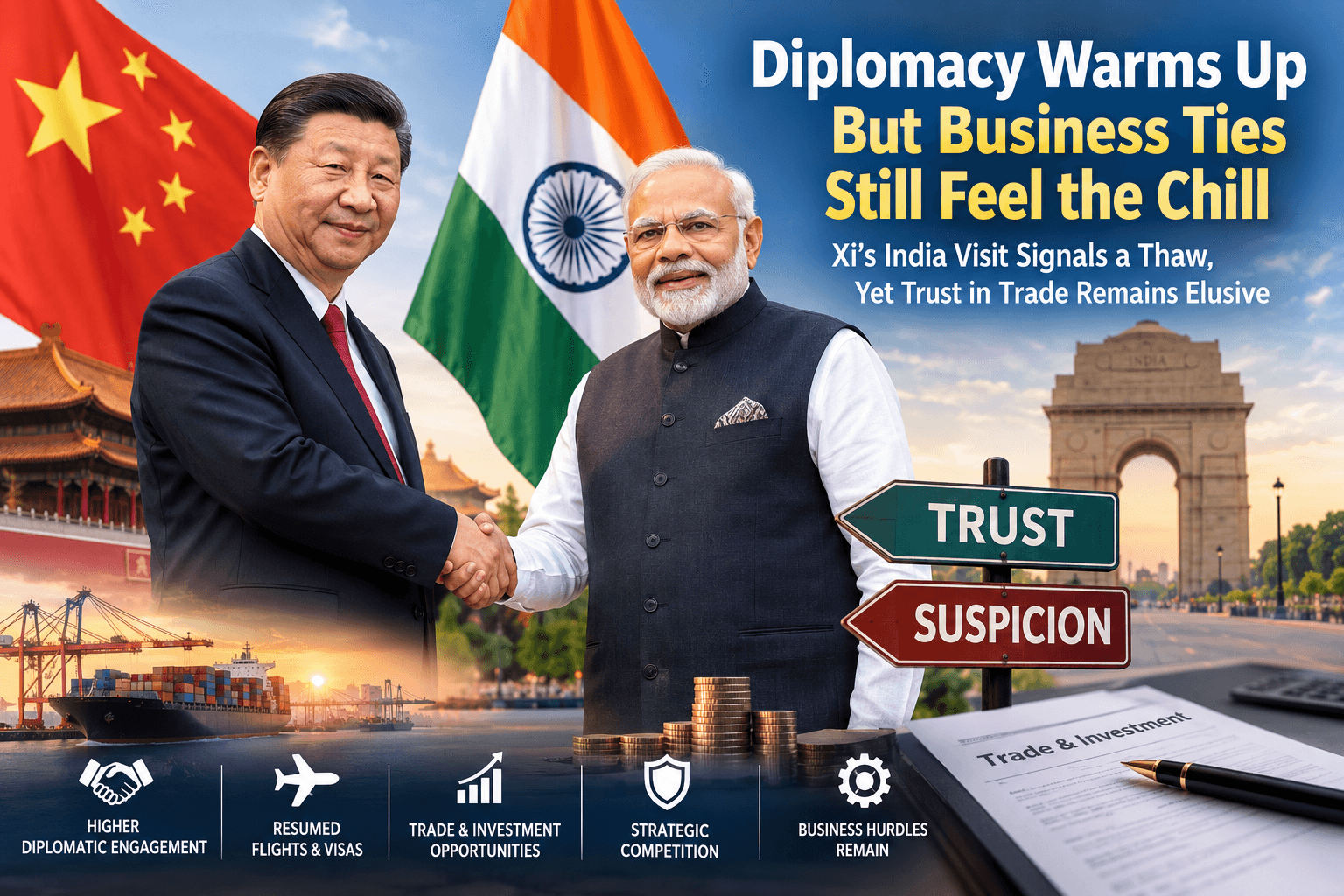
economic mistrust remains.The relationship between India and China is entering a potentially important new phase. Chinese President Xi Jinping is expected to visit New Delhi this week for the BRICS summit, marking his first visit to India in seven years. His arrival comes at a time when both countries appear willing to move away from the intense confrontation that followed the deadly 2020 border clashes, even though deep strategic and economic mistrust remains.
For New Delhi and Beijing, the significance of the visit goes well beyond ceremonial diplomacy. A meeting between Xi and Prime Minister Narendra Modi could help consolidate the gradual improvement in political relations and establish a framework for managing disagreements. Yet restoring confidence in business and investment will be much harder.
The central paradox in India-China relations today is clear: diplomacy may be warming faster than commerce.
Direct flights have resumed, some visa procedures have been eased, border arrangements have improve,d and senior leaders have again been engaging through multilateral forums. At the same time, companies continue to encounter regulatory uncertainty, scrutiny of investments, visa difficulties, technology restrictions and delays involving industrial equipment.
That gap between political engagement and commercial confidence could define the next chapter of the India-China relationship.
A Visit Seven Years in the Making
Xi’s expected trip is significant simply because of how long it has been since a Chinese president visited India.
The relationship between the two Asian powers deteriorated dramatically after the 2020 border clashes in eastern Ladakh. The violence resulted in the deaths of Indian and Chinese troops and produced one of the deepest crises in bilateral relations in decades. Political dialogue weakened, military tensions increased and economic engagement became subject to much greater scrutiny.
For years, the two governments struggled to create the conditions necessary for a meaningful reset.
That situation has gradually changed.
India and China have resumed diplomatic engagement at multiple levels, while their leaders have met on the sidelines of international gatherings. Border arrangements have also improved compared with the immediate aftermath of 2020. Direct air links have resumed, and there has been movement on cross-border exchanges and pilgrimage.
Xi’s visit therefore represents the latest and most visible stage of a cautious rapprochement.
It does not mean that the underlying disagreements have disappeared.
Instead, both sides appear to be searching for a way to manage competition without allowing every disagreement to become a crisis.
The Modi-Xi Equation Matters
Any India-China reset ultimately depends on political leadership.
The personal equation between Modi and Xi cannot resolve every structural disagreement, but communication between the two leaders can create political space for officials to negotiate difficult issues.
A bilateral conversation during the BRICS summit could therefore be closely watched for signals about the future direction of the relationship.
The immediate questions will include the border, trade, investment, technology, visas and people-to-people exchanges.
But the larger question will be whether India and China can move from crisis management toward what could be called competitive coexistence.
That would not mean that India and China suddenly become strategic partners.
Their interests remain different across the Indo-Pacific, the Indian Ocean, South Asia, technology, supply chains and global institutions.
Instead, the objective would be to establish enough stability for competition to continue without damaging essential economic relationships.
This distinction is important.
A diplomatic thaw does not necessarily produce trust. It can simply produce mechanisms for managing distrust.
Why Business Is Still Nervous
The most difficult part of the relationship may be economic.
At first glance, India-China trade looks like a powerful argument for deeper cooperation. Bilateral trade has reached very large levels, demonstrating that political disagreements have not eliminated economic interdependence.
Yet trade itself does not necessarily create strategic confidence.
Indian policymakers remain concerned about dependence on Chinese manufacturing in important sectors, while Chinese businesses face increasing scrutiny when attempting to invest in India.
The result is an unusual relationship in which the two countries can simultaneously be major trading partners and strategic competitors.
Recent reporting indicates that businesses continue to face hurdles involving regulations, visas and industrial equipment. Some Indian companies with interests in China have experienced difficulties obtaining visas, while Chinese-made equipment and components needed by Indian industries have reportedly faced delays.
These problems matter because modern investment decisions depend heavily on predictability.
A multinational company can tolerate regulation.
It can tolerate competition.
What businesses struggle with is uncertainty.
If an investor does not know whether an application will receive approval, whether equipment will arrive on time, whether personnel will obtain visas or whether a new security rule will alter the commercial environment, investment decisions become more difficult.
This is where diplomatic improvement must eventually translate into practical economic action.
The Shadow of National Security
India’s caution toward Chinese investment is not simply an economic issue.
It is closely connected to national security.
The 2020 border crisis fundamentally changed how New Delhi evaluates Chinese economic participation. Investments, telecommunications, digital infrastructure, technology and industrial supply chains are now viewed through a broader strategic lens.
From India’s perspective, economic dependence can become a vulnerability if relations deteriorate.
That lesson has influenced India’s approach to foreign investment and supply-chain diversification.
At the same time, India cannot completely remove China from its economic ecosystem overnight.
China remains a major source of components, machinery, electronics inputs, solar equipment and other industrial goods.
This creates a difficult balancing act.
New Delhi wants to reduce excessive dependence while ensuring that Indian manufacturers remain competitive.
The government therefore faces two competing objectives:
First, protect strategic and national-security interests.
Second, maintain access to competitively priced industrial inputs.
A successful China policy must somehow accomplish both.
Chinese Companies Face a Different India
Chinese businesses, meanwhile, are looking at India with a mixture of opportunity and caution.
India is one of the world’s fastest-growing major economies and has a huge consumer market. Its electronics, renewable-energy, automobile, infrastructure and manufacturing sectors offer enormous potential.
But Chinese companies have discovered that market access is not determined by commercial demand alone.
Regulatory and political considerations have become increasingly important.
Several prominent Chinese companies have faced challenges in expanding their Indian operations. Some proposed investments have struggled to move forward, while others have encountered increased scrutiny.
That uncertainty can discourage long-term capital commitments.
A company considering a factory investment does not only calculate labour costs and market demand. It also assesses regulatory stability, access to technology, taxation, supply-chain security, geopolitical risk and the possibility of future restrictions.
India’s challenge is therefore to create a framework where strategic concerns can be addressed without making legitimate business activity unpredictable.
India Is Opening Some Doors — But Carefully
The relationship is not entirely frozen.
India has recently shown signs of selectively easing restrictions on Chinese participation in certain areas, particularly sectors such as electronics and solar energy. Reports indicate that New Delhi has explored mechanisms allowing greater Chinese investment under controlled conditions, especially where such capital can support manufacturing without creating unacceptable strategic risks.
This is an important development.
It suggests that India’s policy is evolving from outright caution toward managed engagement.
The distinction is crucial.
India does not appear to be choosing between complete economic separation and unrestricted Chinese investment.
Instead, it is attempting to identify sectors where Chinese capital, technology or supply-chain participation could provide economic benefits while keeping sensitive areas under tighter scrutiny.
Such a model could become the foundation of future India-China commercial relations.
The Technology Problem
Technology may prove to be one of the biggest obstacles to economic normalisation.
India wants to develop domestic manufacturing capacity in electronics, telecommunications, renewable energy, semiconductors and advanced industrial technology.
China already possesses enormous manufacturing capabilities in many of these areas.
This creates both opportunity and competition.
India needs Chinese components and machinery in some sectors, but it also wants Indian companies to move up the value chain.
Beijing, meanwhile, has its own concerns about technology transfers, market access and India’s increasing alignment with other major economies.
The result is a complicated technological relationship.
Cooperation can accelerate India’s industrial development.
But excessive dependence can create strategic vulnerability.
That is why technology policy will remain one of the most sensitive areas of bilateral economic negotiations.
The Border Still Matters to Business
It may be tempting to separate the border dispute from trade.
In reality, the two are deeply connected.
Businesses pay attention to geopolitics because geopolitical tensions can quickly alter commercial conditions.
The 2020 crisis demonstrated this vividly.
A deterioration in border relations can affect public sentiment, regulatory policy, investment approvals, technology partnerships and consumer attitudes.
Therefore, even if the two countries agree on economic cooperation, investors will continue watching the Himalayan frontier.
For business confidence to return fully, companies need evidence that border tensions are being managed through stable mechanisms.
The resumption of patrol arrangements and other confidence-building measures is therefore not only a security development.
It is also an economic development.
Every step that reduces the possibility of another border crisis makes long-term commercial planning easier.
Why Both Countries Need Each Other
Despite all the suspicion, there are powerful economic reasons for India and China to maintain engagement.
India needs investment, manufacturing technology, industrial equipment and competitive supply chains as it attempts to expand its manufacturing base.
China, meanwhile, faces a changing global economic environment.
Western trade restrictions, geopolitical tensions and efforts by multinational companies to diversify production are encouraging Chinese businesses to search for new markets and investment opportunities.
India is simply too large to ignore.
Its population, expanding middle class, infrastructure requirements and digital economy make it an important market.
For China, deeper engagement with India could also reduce the risk of India moving too far into strategic economic partnerships with competing powers.
For India, maintaining a working economic relationship with China can provide access to important manufacturing capabilities while India builds domestic alternatives.
That creates an incentive for both sides to keep the economic relationship alive even when political trust remains limited.
BRICS Provides the Diplomatic Platform
The BRICS summit gives Xi and Modi an especially useful setting for dialogue.
Unlike a purely bilateral visit, a BRICS gathering allows India and China to engage within a broader multilateral framework.
Both countries have an interest in strengthening the voice of emerging economies and increasing the influence of institutions representing the Global South.
However, even within BRICS, India and China do not always share identical objectives.
India’s relationship with the United States and other Indo-Pacific partners remains important.
China is simultaneously dealing with its own strategic competition with Washington.
The changing global environment therefore creates both opportunities and complications.
For India and China, BRICS can serve as a diplomatic bridge even when bilateral trust remains incomplete.
A Possible New Investment Framework
There are signs that both countries are considering ways to improve business exchanges.
Recent reports have suggested that India and China have been exploring a framework for facilitating business-to-business engagement and Chinese investment in selected areas. Discussions have reportedly focused on accelerating capital flows while maintaining safeguards for sensitive sectors.
If such a framework develops, it could become one of the most significant economic outcomes of the diplomatic thaw.
The key will be transparency.
Businesses need clear rules.
Indian companies operating in China need predictable access.
Chinese companies operating in India need predictable approval procedures.
Both sides need reliable visa arrangements for legitimate business travel.
And industrial supply chains need to function without arbitrary disruption.
A new framework will only work if it addresses these practical concerns.
Trade Is Not the Same as Trust
One of the biggest misconceptions about India-China relations is that growing trade automatically means growing trust.
History shows otherwise.
Countries can trade extensively while remaining geopolitical competitors.
In fact, economic interdependence can sometimes increase strategic anxiety because each side becomes concerned about dependence on the other.
India’s concern about Chinese dominance in particular manufacturing sectors is an example.
China’s concerns about India’s economic policies and strategic partnerships provide another.
The challenge is therefore not simply to increase trade.
It is to make trade resilient to political shocks.
That requires institutions, communication channels and clearly defined rules.
Without them, a diplomatic crisis can rapidly become an economic crisis.
What Businesses Will Be Watching
For corporate leaders, Xi’s visit will be judged less by speeches and more by practical changes.
Businesses will likely watch several areas closely.
1. Visa Processing
Business travel is essential for investment, technical support, factory operations and negotiations.
Simpler and more predictable visa procedures would be an immediate confidence-building measure.
2. Investment Approvals
Investors need to understand what sectors are open, what ownership structures are permitted and how national-security reviews operate.
3. Industrial Equipment
Indian infrastructure and manufacturing projects depend on timely delivery of machinery and components.
Delays can increase costs and disrupt construction schedules.
4. Technology Access
Companies need clarity over which technologies can be imported, transferred or jointly developed.
5. Border Stability
A stable border reduces the probability of sudden political disruption.
6. Government-to-Business Communication
Regular dialogue between policymakers and business groups can help identify problems before they become diplomatic disputes.
These issues may appear technical, but they will determine whether the diplomatic thaw reaches factories, boardrooms and investment committees.
Can Trust Be Rebuilt?
Trust is probably the hardest commodity in the India-China relationship.
It cannot be announced at a summit.
It cannot be created through one handshake.
And it cannot be restored simply because trade numbers increase.
Trust develops through repeated evidence.
If border agreements continue to hold, confidence increases.
If visas are issued smoothly, confidence increases.
If investments are approved according to transparent rules, confidence increases.
If industrial supplies arrive on schedule, confidence increases.
If both governments respond to disputes through dialogue rather than escalation, confidence increases.
In other words, trust is likely to return through thousands of smaller decisions rather than one major diplomatic breakthrough.
India Will Not Abandon Strategic Diversification
Even if relations improve substantially, India is unlikely to return to the pre-2020 model of economic engagement.
The geopolitical environment has changed.
India has developed stronger relationships with the United States, Japan, Europe, Australia and other partners.
It has also invested heavily in domestic manufacturing and supply-chain diversification.
Therefore, even a successful Xi-Modi meeting should not be interpreted as a return to unrestricted Chinese economic participation.
Instead, the likely future is selective engagement.
India will cooperate where cooperation produces clear economic benefits.
It will remain cautious in sensitive sectors.
It will continue developing alternatives to excessive Chinese dependence.
And it will preserve strategic relationships with other major powers.
China Also Has Reasons to Reassess India
Beijing, too, has reasons to rethink its approach.
India is not a marginal economic player.
Its growing economy, large consumer base and role in global supply chains give it increasing bargaining power.
As multinational companies expand manufacturing outside China, India is positioning itself as one of the world’s major alternative production centres.
China therefore faces a choice.
It can treat India primarily as a strategic competitor, or it can identify areas where economic cooperation remains mutually beneficial.
The second approach does not require Beijing to abandon its strategic interests.
It requires recognising that stable economic relations can coexist with geopolitical competition.
What a Successful Visit Would Look Like
The most successful outcome of Xi’s visit may not be a dramatic announcement.
It could be something much more practical.
A successful summit might produce stronger communication mechanisms, continued border stability, improved business visas, faster movement of industrial goods and a clearer framework for investment.
These measures would not solve every disagreement.
But they would reduce friction.
And reducing friction may be the most realistic goal at this stage.
India and China do not need to agree on everything to develop a functioning relationship.
They need to prevent disagreements from destroying areas where cooperation remains possible.
The Road Ahead
The India-China relationship is unlikely to return to the easy optimism that characterised some earlier periods.
The memories of 2020 remain powerful.
Strategic competition will continue.
The United States factor will remain important.
Technology will remain sensitive.
Trade imbalances will continue to generate political debate.
And both countries will continue trying to strengthen their own manufacturing and strategic capabilities.
But rivalry does not have to mean permanent confrontation.
The emerging model appears to be one of cautious engagement: cooperate where interests overlap, compete where interests diverge and maintain enough communication to prevent disagreements from escalating.
Xi Jinping’s return to India could become an important milestone in that process.
The visit offers an opportunity to transform a fragile diplomatic thaw into a more durable framework.
But diplomacy can only take the relationship so far.
The real test will come after the motorcades leave Delhi.
Will companies find it easier to obtain visas?
Will investment approvals become more predictable?
Will industrial equipment move more smoothly?
Will technology cooperation become possible in selected sectors?
Will both countries continue building mechanisms to manage border tensions?
The answers to those questions will determine whether the current thaw becomes a genuine reset or remains a temporary pause in a complicated rivalry.
Conclusion: From Suspicion to Managed Competition
Xi Jinping’s expected India visit comes at a moment when New Delhi and Beijing have begun cautiously stepping away from the confrontation of recent years.
The political relationship is showing signs of improvement. Border arrangements have stabilised compared with the immediate post-2020 period, direct flights have resumed and diplomatic engagement has become more regular.
But economic confidence has not recovered at the same speed.
Businesses still encounter regulatory uncertainty, visa difficulties, technology restrictions and concerns surrounding investment. These obstacles demonstrate that political reconciliation and commercial trust are two different processes.
For India, the priority will be to protect national security while keeping the door open to economically useful engagement.
For China, the challenge will be to convince Indian policymakers and businesses that economic cooperation can be dependable even when strategic disagreements remain.
The likely future is therefore neither friendship nor complete separation.
It is managed competition with selective cooperation.
That may sound less dramatic than a grand diplomatic reset, but it could be far more realistic.
If Xi and Modi can establish stronger guardrails around the relationship, the two countries may gradually create an environment in which political disagreements no longer automatically translate into economic disruption.
For two neighbouring powers representing enormous populations and increasingly important shares of the global economy, that would be a significant achievement.
The real measure of the thaw will not be the warmth of a handshake in Delhi.
It will be whether, months after the summit, Indian and Chinese businesses feel that the ground beneath them has become a little more predictable.
And that is where the future of India-China relations will ultimately be decided.