Table of Contents
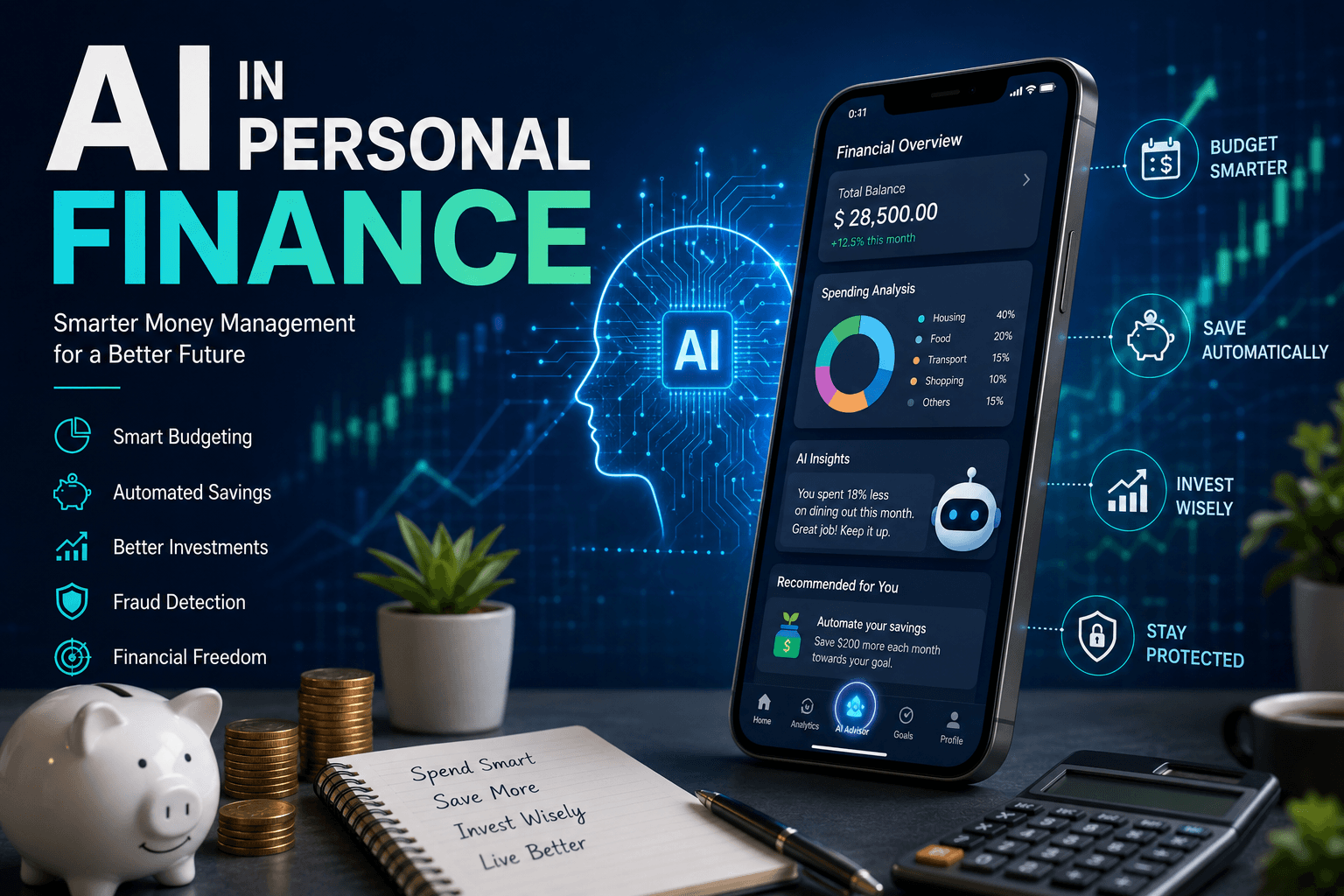
Artificial Intelligence (AI) is no longer just a futuristic concept—it has become an essential part of everyday life. From voice assistants to self-driving cars, AI is changing how we interact with technology. One of the biggest areas experiencing this transformation is personal finance. In 2026, AI is helping millions of people budget smarter, invest wisely, save automatically, and make better financial decisions.
Whether you’re trying to reduce debt, build wealth, or simply manage your monthly expenses, AI-powered financial tools can simplify the process. Instead of spending hours tracking your income and expenses, AI applications analyze your financial behavior, identify patterns, and provide personalized recommendations.
This guide explores how AI is revolutionizing personal finance, its benefits, challenges, and the best AI-powered tools available today.
What Is AI in Personal Finance?
AI in personal finance refers to the use of artificial intelligence technologies—such as machine learning, predictive analytics, and natural language processing—to help individuals manage their money more efficiently.
Unlike traditional budgeting software, AI doesn’t just record financial transactions. It learns from your spending habits and continuously improves its recommendations.
For example, AI can:
- Categorize your expenses automatically
- Predict future bills
- Suggest better saving strategies
- Detect suspicious transactions
- Recommend investment opportunities
- Provide personalized budgeting advice
This makes financial planning easier, faster, and more accurate.
Why AI Is Becoming Essential in 2026
The financial world is becoming increasingly digital. Online banking, mobile payments, digital wallets, and investment apps generate massive amounts of financial data every day.
AI helps process this data within seconds.
Instead of manually reviewing bank statements, AI instantly identifies:
- Unnecessary subscriptions
- Overspending categories
- Upcoming bills
- Savings opportunities
- Better financial products
As inflation and economic uncertainty continue to affect households worldwide, AI provides people with smarter ways to control their finances.
How AI Works in Personal Finance
AI systems analyze thousands of financial data points, including:
- Income
- Monthly expenses
- Credit card usage
- Loan payments
- Investment performance
- Spending habits
- Saving patterns
Machine learning algorithms then identify trends and create personalized financial recommendations.
For example:
If you frequently overspend on food delivery, AI may recommend:
- Setting a weekly spending limit
- Cooking more meals at home
- Redirecting the saved money into an investment account
The more you use AI-powered finance apps, the more accurate their recommendations become.
Benefits of AI in Personal Finance
1. Smarter Budgeting
Traditional budgeting requires manual effort.
AI budgeting apps automatically:
- Track every transaction
- Categorize expenses
- Create monthly reports
- Alert you before overspending
This saves time while improving financial discipline.
2. Automated Savings
One of AI’s biggest advantages is automatic saving.
AI can analyze your cash flow and determine how much money you can safely save each week without affecting your daily expenses.
Some apps even transfer small amounts automatically into savings accounts.
Over time, these small savings grow into substantial emergency funds.
3. Better Investment Decisions
Investing can feel overwhelming for beginners.
AI simplifies investing by:
- Assessing risk tolerance
- Recommending diversified portfolios
- Monitoring market changes
- Automatically rebalancing investments
Robo-advisors powered by AI make investing accessible even for people with little financial knowledge.
4. Fraud Detection
Banks increasingly rely on AI to detect suspicious activity.
AI monitors millions of transactions in real time.
If it detects unusual behavior—such as purchases made from another country or unusually large withdrawals—it can immediately:
- Freeze transactions
- Notify customers
- Prevent fraud
This provides greater financial security.
5. Personalized Financial Advice
Traditional financial advisors can be expensive.
AI-powered assistants provide personalized recommendations 24/7.
Examples include:
- Paying off debt faster
- Improving credit scores
- Building emergency funds
- Choosing better investment options
- Managing retirement savings
Many AI assistants continually update their advice as your financial situation changes.
Popular AI Applications in Personal Finance
AI is already integrated into many financial services.
Popular examples include:
AI Budgeting Apps
These automatically:
- Track expenses
- Analyze spending
- Suggest savings goals
- Monitor subscriptions
AI Investment Platforms
These platforms:
- Build portfolios
- Optimize investments
- Reduce emotional investing
- Monitor market conditions
AI Banking Assistants
Many banks now offer AI chatbots that help customers:
- Check balances
- Pay bills
- Transfer money
- Answer financial questions
- Detect fraud
Credit Score Monitoring
AI constantly monitors credit reports and provides suggestions to improve scores.
Users receive alerts when:
- Credit utilization increases
- Payments are overdue
- Identity theft risks appear
AI and Financial Planning
Financial planning used to require professional advisors.
Today, AI helps users create personalized financial plans based on:
- Income
- Expenses
- Age
- Retirement goals
- Risk tolerance
- Investment preferences
These plans automatically adjust as financial situations change.
Can AI Replace Financial Advisors?
Not completely.
AI is excellent at:
- Data analysis
- Automation
- Risk assessment
- Budgeting
- Investment recommendations
However, human advisors still provide valuable guidance during major life events like:
- Retirement planning
- Estate planning
- Tax optimization
- Business ownership
- Complex investments
The future will likely combine AI technology with human expertise.
Best AI Tools for Personal Finance in 2026
The rapid growth of AI has led to a wide range of financial tools that help users manage money more efficiently. Here are some of the most popular categories:
1. AI Budgeting Apps
AI budgeting apps analyze your income and spending automatically. They can:
- Categorize expenses in real time
- Create monthly spending reports
- Alert you before exceeding your budget
- Identify unnecessary subscriptions
- Suggest ways to save more money
These tools eliminate manual budgeting and help users stay financially disciplined.
2. AI Robo-Advisors
Robo-advisors are investment platforms powered by AI. They help users build diversified portfolios based on their financial goals and risk tolerance.
Benefits include:
- Low investment fees
- Automatic portfolio rebalancing
- Tax-efficient investing
- Personalized investment recommendations
- 24/7 portfolio monitoring
They are especially useful for beginner investors who want professional-level guidance at a lower cost.
3. AI Debt Management Tools
Debt can become overwhelming without a proper repayment strategy.
AI-powered debt management tools help by:
- Prioritizing high-interest debt
- Recommending repayment schedules
- Predicting payoff dates
- Suggesting refinancing opportunities
- Tracking progress automatically
This makes becoming debt-free more achievable.
4. AI Expense Trackers
Expense tracking apps automatically sync with bank accounts and credit cards to monitor spending.
They can identify:
- Spending habits
- Seasonal expenses
- Areas of overspending
- Potential monthly savings
Users receive personalized reports that make financial planning much easier.
AI and Credit Score Improvement
A good credit score can lead to lower loan interest rates and better financial opportunities.
AI helps improve credit scores by:
- Monitoring payment history
- Sending bill reminders
- Tracking credit utilization
- Detecting reporting errors
- Suggesting actions to increase your score
Some AI tools even simulate how financial decisions could affect your credit score before you make them.
AI for Tax Planning
Tax preparation can be stressful, but AI simplifies the process.
AI can:
- Organize financial records
- Identify eligible deductions
- Estimate tax liabilities
- Reduce filing errors
- Generate financial reports
This saves time and helps maximize potential tax savings.
AI and Fraud Prevention
Financial fraud continues to evolve, but AI is becoming one of the strongest defenses against it.
AI systems analyze millions of transactions every second and detect unusual activity almost instantly.
Examples include:
- Unexpected international purchases
- Large withdrawals
- Multiple failed login attempts
- Suspicious payment locations
- Identity theft indicators
When suspicious activity is detected, banks can immediately notify customers or temporarily block transactions.
Advantages of AI in Personal Finance
AI offers several important benefits:
Saves Time
Tasks like budgeting, expense tracking, and financial reporting become almost completely automated.
Better Financial Decisions
AI uses data instead of emotions, helping users make more objective financial choices.
Personalized Recommendations
Every person’s financial situation is unique. AI provides customized advice based on spending habits, income, and goals.
Improved Accuracy
Automation reduces manual errors in budgeting, investing, and financial planning.
Available 24/7
Unlike traditional financial advisors, AI tools are always available to answer questions and provide guidance.
Challenges of AI in Personal Finance
Despite its advantages, AI also has limitations.
Privacy Concerns
AI applications often require access to sensitive financial information. Users should choose trusted platforms with strong security measures.
Data Security
Financial data can become a target for cybercriminals if not properly protected.
Algorithm Bias
AI recommendations depend on the quality of the data used to train the system. Poor data can lead to inaccurate advice.
Over-Reliance on Automation
While AI is powerful, users should still review important financial decisions themselves, especially those involving major investments or long-term planning.
The Future of AI in Personal Finance
The role of AI in finance is expected to grow rapidly over the next decade. Future developments may include:
- Hyper-personalized financial coaching
- Predictive financial planning
- Voice-controlled banking
- Smarter investment strategies
- Advanced fraud prevention
- AI-powered retirement planning
- Automated tax optimization
- Integration with smart home devices and digital assistants
As technology continues to improve, managing money will become more efficient and accessible for people around the world.
Tips for Using AI in Personal Finance
To get the most out of AI financial tools:
- Choose reputable apps with strong security features.
- Review AI recommendations before making major financial decisions.
- Regularly monitor your accounts for unusual activity.
- Combine AI insights with your own financial goals.
- Keep your financial information updated for more accurate recommendations.
- Continue learning about personal finance to make informed decisions.
AI is a valuable assistant, but informed users will always make the best financial choices.
Frequently Asked Questions (FAQs)
1. What is AI in personal finance?
AI in personal finance refers to the use of artificial intelligence to help individuals manage their money. It can automate budgeting, track expenses, recommend investments, detect fraud, and provide personalized financial advice.
2. Is AI safe for managing personal finances?
Yes, AI can be safe when you use trusted financial platforms that offer encryption, two-factor authentication (2FA), and strong privacy policies. Always choose reputable providers and monitor your accounts regularly.
3. Can AI replace a financial advisor?
AI can handle routine tasks such as budgeting, saving, and basic investment management. However, for complex decisions involving retirement, taxes, estate planning, or business finances, a qualified human financial advisor is still valuable.
4. What are the benefits of AI in personal finance?
Some major benefits include:
- Automated budgeting
- Smart savings recommendations
- Personalized financial insights
- Better investment management
- Real-time fraud detection
- Time-saving automation
- Improved financial decision-making
5. What are the risks of using AI in finance?
Potential risks include:
- Data privacy concerns
- Cybersecurity threats
- Incorrect recommendations due to poor data
- Overdependence on automation
- Limited understanding of unique personal situations
Always verify major financial decisions before acting on AI-generated advice.
6. Can AI help improve my credit score?
Yes. Many AI-powered finance apps monitor your credit usage, payment history, and financial habits. They can send reminders, recommend strategies to lower debt, and suggest ways to improve your credit score over time.
7. Are AI budgeting apps free?
Many AI budgeting apps offer free versions with essential features. Premium plans often include advanced tools such as investment tracking, debt management, financial forecasting, and personalized coaching.
8. How does AI detect fraud?
AI analyzes spending patterns in real time. If it notices unusual activity—such as unexpected purchases, large withdrawals, or transactions from unfamiliar locations—it can alert you or help your bank respond quickly.
9. Is AI useful for beginners?
Absolutely. AI simplifies financial management by providing easy-to-understand insights, automatic budgeting, savings recommendations, and investment guidance, making it ideal for people who are new to personal finance.
10. What is the future of AI in personal finance?
The future includes smarter financial assistants, predictive budgeting, voice-controlled banking, advanced fraud prevention, personalized investment strategies, and AI-driven financial coaching tailored to each individual’s goals.
Final Thoughts
Artificial Intelligence is reshaping personal finance by making money management more efficient, accessible, and personalized. Whether you are creating a budget, building an emergency fund, investing for retirement, or tracking your daily expenses, AI-powered tools can simplify the process and help you make more informed financial decisions.
Despite its advantages, AI should be viewed as a support system rather than a replacement for financial knowledge. Understanding the basics of budgeting, saving, investing, and responsible borrowing remains essential. The most successful financial strategy combines AI-powered insights with your own judgment and long-term financial goals.
As AI technology continues to evolve, it will become an even more important part of everyday financial life. By embracing these innovations responsibly, individuals can improve financial security, reduce stress, and work toward lasting financial success.
Editor’s Note (Approx. 300 Words)
Artificial Intelligence has moved beyond being a buzzword—it is now a practical tool that is transforming how people manage their personal finances. From automating budgets and tracking expenses to improving investment decisions and detecting fraud, AI is making financial management smarter and more accessible than ever before.
However, while AI offers remarkable convenience, it should not replace financial education or careful decision-making. Every person’s financial goals, risk tolerance, and circumstances are unique. AI can analyze data and identify patterns, but it cannot fully understand personal priorities, emotions, or life-changing events. This is why users should treat AI as a trusted assistant rather than the sole decision-maker.
When selecting AI-powered financial tools, prioritize platforms with strong security, transparent privacy policies, and a proven reputation. Regularly review your financial information, verify AI-generated recommendations, and stay informed about changes in technology and financial regulations.
As we move through 2026 and beyond, AI is expected to become even more sophisticated. Innovations such as predictive financial planning, personalized financial coaching, and advanced fraud detection will continue to improve how individuals save, invest, and build wealth. Those who combine AI technology with sound financial habits will be better positioned to achieve long-term financial stability.
Whether you are just beginning your financial journey or looking to optimize your existing financial strategy, AI can provide valuable insights that simplify complex decisions. By using these tools wisely and maintaining control over your financial choices, you can confidently navigate the future of personal finance.
Thank you for reading! Stay informed, embrace innovation responsibly, and let AI help you build a stronger financial future.
Creator’s Note
Thank you for taking the time to read “AI in Personal Finance: How Artificial Intelligence Is Transforming Money Management in 2026.” This article was created to help readers understand how artificial intelligence is changing the way we budget, save, invest, and make financial decisions in today’s digital world.
AI is no longer a technology reserved for large corporations or financial institutions. It has become a practical tool that everyday people can use to improve their financial habits. From smart budgeting apps and automated savings to robo-advisors and fraud detection systems, AI is making personal finance more accessible and efficient than ever before. The purpose of this guide is to explain these innovations in a simple, easy-to-understand way so that readers of all experience levels can benefit.
While researching and writing this article, the focus was on providing balanced, practical, and educational information rather than promoting any specific financial product or service. Financial technology continues to evolve rapidly, so some AI tools and features may change over time. Readers are encouraged to verify the latest information before making important financial decisions.
It is also important to remember that AI should support your financial journey—not replace your own judgment. Every individual’s financial goals, income, risk tolerance, and life circumstances are unique. Whenever major investment, tax, or retirement decisions are involved, consulting a qualified financial professional is always recommended.
I hope this article has helped you better understand the growing role of AI in personal finance and inspired you to explore technology that can simplify money management. If you found this guide useful, consider sharing it with friends, family, or colleagues who are interested in smarter financial planning. Stay curious, continue learning, and use AI responsibly to build a more secure and successful financial future.