Table of Contents
The Indian stock market witnessed a sharp decline on Thursday, September 24, 2026, as a combination of rising crude oil prices, elevated US bond yields, geopolitical uncertainty, and pressure on financial stocks weighed heavily on investor sentiment.
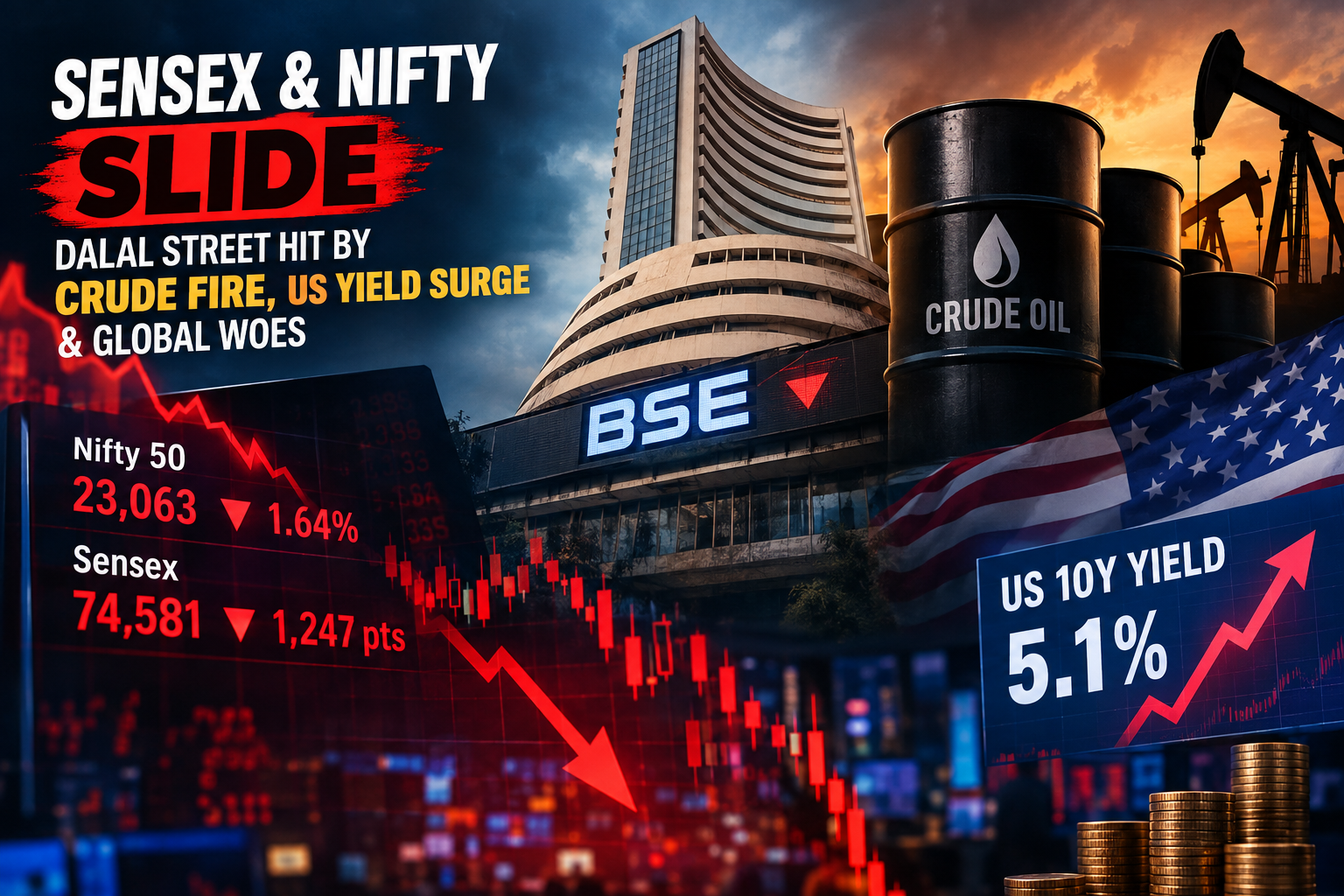
The Nifty 50 ended the session around the 23,063 level, registering a decline of about 1.64%, while the Sensex lost roughly 1,247 points. The sell-off extended beyond large-cap stocks, with mid-cap and small-cap indices also facing pressure. The broader market decline reflected concerns that higher global borrowing costs and expensive crude could create additional challenges for India’s economy and corporate earnings.
The day’s fall came after Indian equities had shown some resilience in the previous session. On Wednesday, the Sensex had gained 299.17 points to close at 74,828.25, while the Nifty 50 rose 117.80 points to 23,446.80. However, global cues deteriorated sharply overnight.
At the heart of Thursday’s market weakness were two major global variables: crude oil and US Treasury yields.
Brent crude moved back above the $100-per-barrel mark, while the US 10-year Treasury yield climbed to levels not seen since 2007. Those developments increased concerns over inflation, interest rates, India’s import bill and the direction of foreign investment flows.
What Happened in the Indian Stock Market Today?
The selling pressure was visible from the opening bell.
The Sensex dropped hundreds of points in early trading, while the Nifty slipped below the 23,250 level. By mid-morning, the Sensex was down more than 700 points and the Nifty was lower by more than 1%.
As the session progressed, selling intensified.
The market decline was broad-based rather than restricted to a handful of stocks. Financial companies, banks and several other heavyweight constituents came under pressure. The weakness also spread to mid-cap and small-cap shares.
The sharp fall represented a significant change in sentiment from Wednesday, when lower crude prices and buying in metals and capital-market stocks had supported the benchmarks.
The latest decline also pushed the major indices toward three-month lows, highlighting how quickly global macroeconomic developments can change the direction of Indian equities. NDTV Profit reported that investors lost about ₹3.93 lakh crore in market value during the session as the Sensex and Nifty moved to three-month lows.
Nifty 50 Ends Around 23,063
The Nifty 50 finished Thursday around the 23,063 level, down approximately 1.64%.
The decline was significant because the index had closed at 23,446.80 on Wednesday. The move therefore represented a substantial one-day reversal after the previous session’s recovery.
The index’s fall reflected weakness across multiple sectors, with financial stocks among the important contributors to the decline.
Earlier in the session, the Nifty had fallen below 23,200, with selling pressure becoming increasingly broad-based. At one stage, the index was down more than 1.5%.
The decline also showed that investors were not simply reacting to company-specific developments. Instead, the market was responding to a broader change in the global risk environment.
Sensex Loses Around 1,247 Points
The BSE Sensex also suffered a steep decline.
The index had started the day under pressure and fell more than 700 points during the morning session. By the afternoon, losses had widened considerably as investors continued reducing exposure to equities.
The benchmark ultimately lost roughly 1,247 points, marking one of the sharper single-session declines for the index in recent trading.
The previous day’s closing level of 74,828.25 made Thursday’s decline particularly notable.
The fall was accompanied by weakness in several major Sensex constituents, including financial stocks.
Bajaj Finance was among the notable losers, falling more than 5% during trading, while Axis Bank and Bajaj Finserv also recorded substantial declines. HDFC Bank and other large companies were under pressure as well.
Crude Oil Becomes a Major Concern
One of the biggest reasons behind Thursday’s sell-off was the renewed rise in crude oil prices.
Brent crude moved above $102 per barrel after having fallen below $99 during the previous session. The move was linked to continuing uncertainty surrounding the US-Iran situation and concerns about future oil supplies.
For India, crude oil is particularly important because the country imports a large proportion of its energy requirements.
When crude prices rise sharply, several economic effects can emerge.
First, India’s oil import bill can increase.
Second, higher energy costs can add to inflationary pressure.
Third, a larger import bill can put pressure on the rupee.
Fourth, companies that depend heavily on fuel, transportation or petrochemical inputs can see their costs increase.
Finally, higher inflation can complicate the monetary-policy environment.
This explains why investors closely track Brent crude whenever prices approach or cross psychologically important levels such as $100 per barrel.
Why Rising Oil Prices Matter for Indian Companies
The impact of expensive crude is not uniform across the stock market.
Oil producers can experience different effects from companies that consume petroleum products as inputs.
Airlines, logistics companies, transportation businesses and other fuel-intensive sectors can face higher operating costs when crude prices rise.
Manufacturing companies may also experience pressure if transportation, packaging or energy expenses increase.
At the macroeconomic level, expensive oil can potentially affect consumer purchasing power because households may spend more on transportation and other energy-related expenses.
That can influence demand across the economy.
For investors, therefore, crude oil is not merely a commodity-market issue. It can influence inflation, currencies, interest rates, government finances, corporate margins and ultimately equity valuations.
US Treasury Yield Surge Adds to Market Pressure
The second major trigger was the sharp rise in US Treasury yields.
The US 10-year Treasury yield climbed to around 5.1%, reaching its highest level since 2007. The increase followed data suggesting that US business activity had accelerated to its strongest level in more than five years.
The move was significant because Treasury yields influence borrowing costs and valuations throughout global financial markets.
US government bonds are considered a major benchmark for global interest rates.
When their yields rise substantially, investors reassess the relative attractiveness of equities, emerging-market assets and other riskier investments.
The higher yield environment can also put pressure on technology and other growth-oriented companies because the present value of their future earnings becomes less attractive when discount rates rise.
That relationship can contribute to volatility in stock markets around the world.
Fed Rate Hike Expectations Rise
The increase in Treasury yields was accompanied by changing expectations about US Federal Reserve policy.
According to market reports, traders increased the probability assigned to another US rate hike in October following stronger-than-expected US business activity data.
This matters for emerging markets such as India because higher US interest rates can influence global capital flows.
When US yields become more attractive, international investors may reconsider allocations to emerging-market equities.
The result can be greater volatility in currencies and stock markets.
The combination of higher crude prices and rising US yields is therefore particularly uncomfortable for Indian equities.
One factor increases inflationary pressure while the other raises global borrowing costs.
Impact on Foreign Investors
Foreign investor activity has been another important feature of the Indian market in September.
Foreign portfolio investors had withdrawn substantial amounts from Indian equities during the month amid concerns about global uncertainty, elevated interest rates, crude prices and the rupee.
The Times of India reported that foreign investors had withdrawn nearly ₹21,000 crore from Indian equities in September as of September 21.
However, Thursday’s market weakness should not be interpreted as evidence that every foreign investor was selling that day.
In fact, NSE data showed that foreign institutional investors bought shares worth ₹1,617.45 crore on Wednesday, while domestic institutional investors purchased ₹2,341.46 crore.
This distinction is important.
Daily buying or selling can change from session to session, while the broader monthly trend can remain different.
Therefore, investors often examine both short-term flows and longer-term capital-flow trends.
The Rupee Also Faces Pressure
The Indian rupee was another part of the market’s macroeconomic story.
Early Thursday trading saw the rupee weaken to around ₹95.87 against the US dollar, according to market reports.
A weaker rupee can become a concern when crude oil prices are rising because India has to spend more rupees to purchase dollar-denominated energy imports.
This can increase pressure on the import bill.
At the same time, foreign investors monitoring currency movements may become more cautious if currency depreciation affects their returns when converted back into their home currencies.
The relationship between oil, the rupee and foreign flows therefore becomes particularly important during periods of geopolitical uncertainty.
Financial Stocks Among the Biggest Pressure Points
Financial stocks were among the major areas of weakness on Thursday.
Bajaj Finance fell more than 5%, while Axis Bank and Bajaj Finserv also recorded declines of several percentage points. Other financial names were under pressure as well.
Another domestic factor affecting financial stocks was a proposal from the insurance regulator concerning commissions and distribution payouts.
Reports indicated that the proposed changes raised concerns about revenue streams linked to insurance distribution for certain banks, non-bank financial companies and other financial intermediaries.
This created an additional source of selling pressure on top of the global macroeconomic concerns.
As a result, the financial-services segment faced pressure from both domestic regulatory developments and the broader risk-off environment.
Broader Market Also Turns Weak
The sell-off was not restricted to the Sensex and Nifty.
Mid-cap and small-cap stocks also declined.
Earlier in the session, the Nifty Midcap 50 was down around 1.41%, while the Nifty Midcap 100 had fallen roughly 1.19%. The Nifty Smallcap 100 was also lower.
This broad participation in the decline indicated that investors were reducing risk across market segments.
The market breadth was also weak.
At one point, the NSE recorded substantially more declining stocks than advancing stocks, showing that the selling pressure extended well beyond the benchmark constituents.
When both large-cap and broader-market indices fall together, investors typically pay closer attention to liquidity, valuation and macroeconomic factors rather than focusing only on individual company news.
India VIX Climbs
Market volatility also increased.
The India VIX, which measures expected volatility in the Indian equity market, jumped during Thursday’s trading session. India Today reported that the index rose nearly 10% during morning trading.
A rise in volatility indicates that investors are pricing in greater uncertainty.
It does not necessarily predict the direction of the next market move.
However, a rising volatility index alongside falling equity prices generally indicates a more cautious trading environment.
This can lead to larger intraday price movements as traders react quickly to developments in crude oil, global markets, currencies and interest-rate expectations.
Global Markets Send Weak Signals
Indian markets were also influenced by weakness in global equities.
US stocks had declined sharply on Wednesday as higher Treasury yields and concerns about tighter monetary policy weighed on sentiment.
The Dow Jones Industrial Average fell 0.7%, the S&P 500 declined 0.75% and the Nasdaq dropped 1.13%.
Asian markets also traded lower on Thursday.
Shanghai and Hong Kong benchmarks declined, while investors reacted to the combination of rising oil prices and elevated US bond yields.
For Indian investors, such global signals matter because international institutional investors operate across multiple markets.
A synchronized risk-off move can therefore create additional selling pressure in emerging markets.
Geopolitical Uncertainty Remains a Key Variable
The US-Iran situation remains closely linked to the crude oil market.
Investors are particularly concerned about the possibility of disruptions to energy supplies and shipping routes in the region.
The Strait of Hormuz is especially important because it is a major route for global oil shipments.
Any prolonged disruption could potentially have significant implications for international energy prices.
The market is therefore closely watching diplomatic developments alongside military and political statements.
A reduction in tensions could help ease some of the pressure on crude prices, while further escalation could create renewed concerns about supply.
For India, the oil-price channel is particularly important because of the country’s dependence on imported crude.
NSE Listing Adds Another Market Event
Thursday also marked an important event for India’s capital markets: the stock-market debut of the National Stock Exchange.
The NSE’s initial public offering had been subscribed 5.71 times, with the issue priced at ₹1,785 at the upper end of its price band.
The listing attracted considerable attention because the exchange itself is one of the central institutions of India’s equity-market infrastructure.
However, the broader market sell-off created a complicated backdrop for the debut.
Investors were simultaneously watching a major new listing while dealing with sharp declines in benchmark indices.
The performance of the NSE shares could therefore attract significant attention from investors, analysts and market participants during the session.
Why Today’s Fall Is Important
Thursday’s decline is important for several reasons.
First, it demonstrates the sensitivity of Indian equities to global interest-rate movements.
Second, it highlights the importance of crude oil for the Indian economy.
Third, it shows how geopolitical developments can quickly affect financial markets.
Fourth, the decline demonstrates that strong domestic liquidity does not necessarily eliminate global-market risks.
Finally, the simultaneous weakness in large-, mid- and small-cap stocks indicates that the selling pressure was broad rather than concentrated in a single segment.
The previous weeks had already been challenging for Indian equities. Reuters reported earlier this week that the Nifty and Sensex had experienced six consecutive weekly declines, their longest such losing streak in six years.
Thursday’s fall therefore occurred against an already cautious market backdrop.
What Investors Will Watch Next
The next few trading sessions are likely to remain focused on several key variables.
1. Crude oil prices
The first major factor will be whether Brent crude remains above $100.
A sustained rise could keep inflation and import-cost concerns elevated.
A meaningful decline could reduce some pressure on Indian equities.
2. US Treasury yields
Investors will closely monitor whether the US 10-year Treasury yield remains around the 5% area or retreats.
Any major move could influence global equity valuations and emerging-market capital flows.
3. Federal Reserve expectations
Changes in expectations for US interest rates will remain important.
Stronger economic data could keep rate-hike concerns alive, while weaker data could potentially reduce pressure on yields.
4. Foreign fund flows
Investors will watch whether foreign investors resume sustained buying or continue reducing exposure to Indian equities.
Domestic institutional flows will also remain important as a source of market liquidity.
5. Geopolitical developments
Any breakthrough in US-Iran discussions could affect oil prices and global risk sentiment.
Conversely, escalation could create additional uncertainty.
6. Corporate earnings and valuations
Even when global factors dominate the headlines, company fundamentals remain important.
Investors will continue assessing earnings growth, margins, debt levels and valuations when deciding how individual stocks respond to market volatility.
What the Market Decline Means for Retail Investors
A sharp fall in the Sensex or Nifty can create anxiety, particularly for investors who have entered the market recently.
However, a one-day index movement does not by itself determine the long-term performance of an investment.
The impact depends on an investor’s portfolio composition, investment horizon, valuation paid and financial objectives.
A diversified portfolio can behave differently from the headline index.
For example, a portfolio concentrated in banks will respond differently from one concentrated in technology, consumer companies or energy producers.
Investors should therefore distinguish between a market-wide decline and the fundamentals of individual investments.
Avoid Looking at the Index in Isolation
Thursday’s market action demonstrates why investors should not examine only the Sensex.
The Nifty, mid-cap indices, small-cap indices, sectoral indices, volatility indicators, crude oil, bond yields and the rupee all provide different pieces of information.
A market decline accompanied by falling crude prices may have a different economic meaning from a decline accompanied by surging crude.
Similarly, falling stocks alongside declining Treasury yields can represent a different environment from falling stocks alongside sharply rising yields.
The context surrounding a market move is therefore crucial.
The Bigger Picture for Indian Equities
The Indian equity market is currently dealing with a combination of domestic and international factors.
India’s economic growth story remains an important part of the long-term investment narrative, but equity markets can still experience periods of significant volatility.
Global interest rates, commodity prices, currency movements and geopolitical developments can affect valuations even when domestic economic conditions remain comparatively stable.
The September 24 sell-off is a clear example.
The immediate pressure came from rising crude prices and US yields, but the market reaction also reflected existing concerns around foreign flows, financial-sector developments and geopolitical uncertainty.
That combination amplified the decline.
Conclusion
Indian equities experienced a sharp sell-off on September 24, 2026, with the Nifty 50 closing around 23,063 after falling roughly 1.64%, while the Sensex lost about 1,247 points.
The decline was driven by a combination of factors rather than one isolated event.
The most important external pressures were the rise in Brent crude above $100 per barrel and the sharp increase in the US 10-year Treasury yield toward 5.1%. Both developments have important implications for India through inflation, borrowing costs, the rupee and foreign capital flows.
Domestic factors also contributed, particularly weakness in financial stocks and concerns surrounding proposed changes to insurance distribution and commission rules.
The sell-off extended into mid-cap and small-cap stocks, while India VIX rose, reflecting increased market uncertainty.
The immediate direction of the market will depend heavily on what happens next with crude oil, US Treasury yields, Federal Reserve expectations, foreign investment flows and geopolitical developments.
For investors, Thursday’s session serves as a reminder that Indian equities are closely connected to the global financial system. Movements in oil markets and US bond yields can rapidly influence domestic stocks, currencies and investor sentiment.
As markets navigate this uncertain environment, investors will continue to monitor macroeconomic developments alongside company-specific fundamentals. The coming sessions could provide further clues about whether the current pressure remains a short-term risk-off episode or develops into a more prolonged period of volatility.
Market data and news referenced above relate to September 24, 2026. Stock-market investments are subject to market risks; this article is for informational purposes and is not investment advice.
[…] https://thehommyblogger.com/market-sell-off/news/daily-news/09/2026/ […]