Delhi Traffic
Table of Contents
New Delhi is preparing for one of the year’s biggest international diplomatic events as India hosts the 18th BRICS Leaders’ Summit from September 11 to 13, 2026. The summit will be held at Bharat Mandapam in Pragati Maidan, bringing together leaders and senior delegations from BRICS member and partner countries.
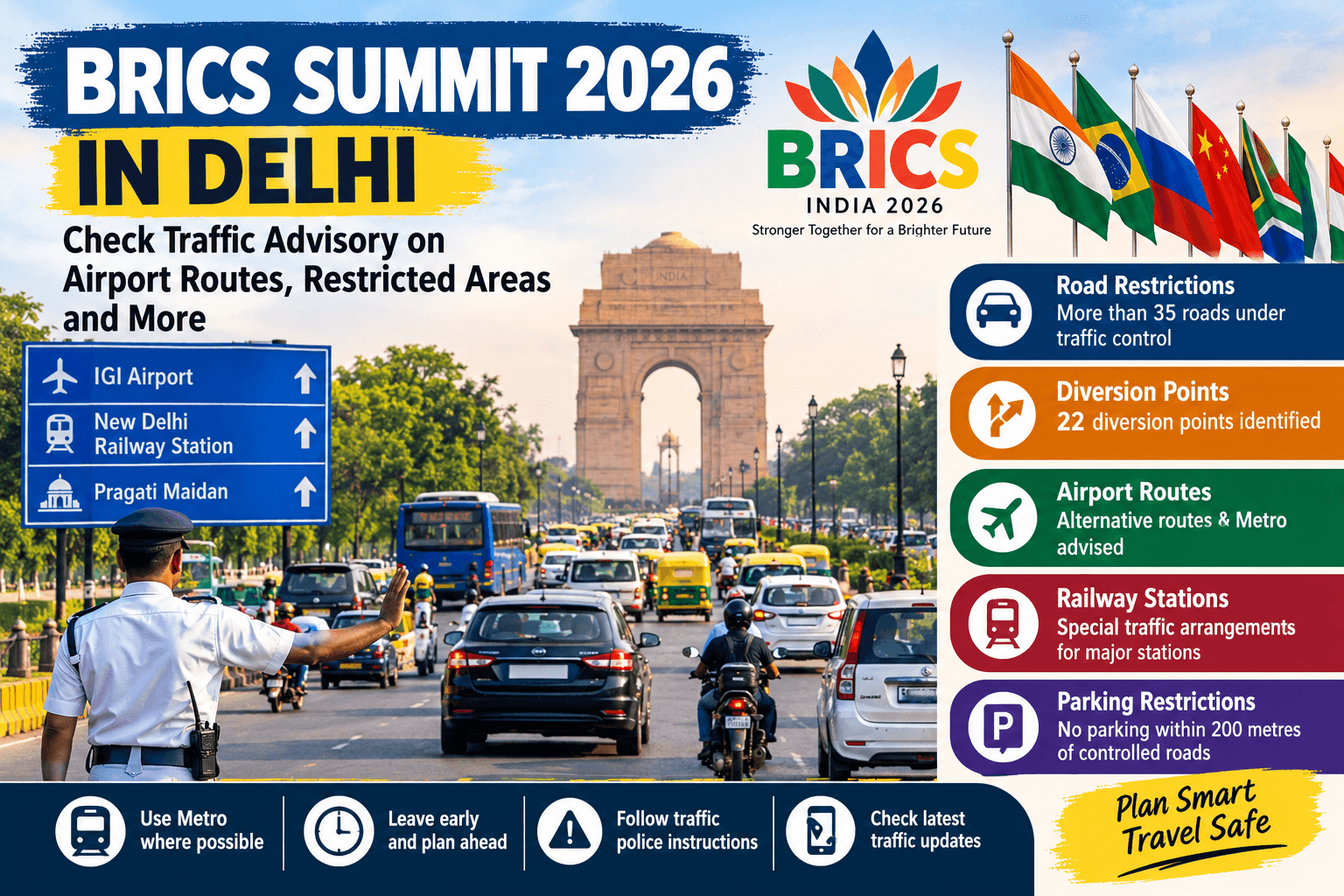
While the summit is expected to put India’s diplomatic and economic priorities in the global spotlight, it will also have a major impact on everyday life in the capital. From airport journeys and railway-station access to office commutes, taxis, buses and private vehicles, Delhi residents are likely to experience traffic diversions and temporary restrictions during the summit period.
Delhi Traffic Police has prepared an extensive traffic-management plan. More than 35 roads are expected to come under controlled traffic arrangements, while 22 diversion points have been identified across important parts of the city. The restrictions are designed primarily to facilitate the movement of visiting heads of state, government delegations and security convoys.
For ordinary commuters, the message is straightforward: plan ahead, allow extra time and check the traffic situation before leaving home.
The airport is one of the biggest concerns because thousands of passengers will continue to travel through Indira Gandhi International Airport while VIP movements take place across Delhi and the National Capital Region. Authorities have specifically advised airport passengers to consider the Delhi Metro wherever possible.
Here is a detailed guide to what commuters should know.
When Is the BRICS Summit Taking Place?
The 18th BRICS Leaders’ Summit is scheduled in New Delhi from September 11 to September 13, 2026.
The principal venue is Bharat Mandapam at Pragati Maidan, one of the capital’s major convention and exhibition complexes.
The presence of international leaders means that security arrangements will be significantly tighter than during an ordinary weekend. VIP motorcades can require temporary traffic holds, and routes may change depending on the movement of individual delegations.
Delhi has therefore prepared special traffic corridors and diversion arrangements to prevent congestion from affecting summit-related movements.
The summit comes at a time when BRICS itself has expanded considerably, making the gathering particularly significant for India’s diplomacy. The event is expected to include leaders and senior representatives from the expanded BRICS grouping and partner countries, alongside bilateral meetings involving key participating leaders.
Why Will Delhi Traffic Be Affected?
A major international summit requires the movement of several categories of vehicles simultaneously.
These include:
- Motorcades carrying heads of government and heads of state
- Security vehicles
- Delegation vehicles
- Emergency-response teams
- Police and paramilitary vehicles
- Airport-to-hotel convoys
- Hotel-to-summit-venue movements
- Other official and diplomatic vehicles
Many of these movements have to take place within tightly controlled time windows.
As a result, traffic police may temporarily stop or divert normal traffic when a VIP convoy passes through a particular corridor.
This means that a road that appears open at one moment could experience a short-term restriction later.
Delhi Traffic Police has therefore warned commuters that traffic arrangements can change according to the movement of VIP convoys.
More Than 35 Roads Under Traffic Control
One of the most important features of the BRICS traffic plan is the regulation of more than 35 roads across Delhi.
The affected network includes roads around central Delhi, diplomatic areas, important government corridors and routes connecting hotels, the summit venue and the airport.
Among the roads identified in the advisory are:
- Mathura Road
- Subramaniam Bharti Marg
- Tees January Marg
- Firoze Shah Road
- Tughlak Road
- Panchsheel Marg
- Mother Teresa Crescent
- Africa Avenue
- Purana Quila Road
- Nyaya Marg
- Brigadier Hoshiar Singh Marg
- Shanti Path
- Sher Shah Suri Marg
- San Martin Marg
- Tilak Marg
- Dr Zakir Hussain Marg
- Rajesh Pilot Marg
- Akbar Road
- Sardar Patel Marg
- APJ Abdul Kalam Road
- Kautilya Marg
- Bhagwan Das Road
- Kemal Ataturk Marg
- Kartavya Path
- Safdarjung Road
The complete operational situation can vary according to security requirements, so commuters should not assume that every road will be continuously closed. Instead, traffic can be regulated, diverted or temporarily stopped depending on the movement of VIP convoys.
22 Diversion Points Across Delhi
To manage the expected pressure, authorities have identified 22 diversion points.
Some of the important locations include:
- Dr Dinesh Nandini Dalmia Chowk
- Ram Charan Aggarwal Chowk
- Mir Dard Chowk
- Kasturba Gandhi Marg/Outer Circle
- Janpath/Connaught Place
- Patel Chowk
- Roundabout near RML Hospital
- Vande Mataram Marg/Bolivar Marg
- Dhaula Kuan Flyover
- Moti Bagh Flyover
- Brigadier Hoshiar Singh Marg roundabout
- Madarsa T-Point
- Lodhi Road/Maharishi Valmiki Marg
- Lodhi Road/Max Mueller Marg
- Lodhi Road/Raman Marg
- Lodhi Road/Archbishop Marg
- Lodhi Road/Mathura Road underpass
- Neela Gumbad
- Under Oberoi Flyover
- U-turn opposite DPS on Mathura Road
- Ring Road/Barapullah Road
- Mandi House
These points are intended to redirect traffic before vehicles enter sensitive or heavily controlled corridors.
For commuters, the important point is that a diversion does not necessarily mean the destination itself is inaccessible. In many cases, traffic will be moved onto another arterial road.
Airport Travellers Need to Plan Carefully
Perhaps the biggest concern for ordinary residents is reaching Indira Gandhi International Airport on time.
Delhi Traffic Police has specifically recommended the Metro for airport travel during the summit period because road traffic may be unpredictable.
Passengers travelling to or from the airport should therefore consider adding substantial buffer time to their journey.
This is particularly important for people travelling during periods of major VIP movement.
A missed flight is much harder to recover from than a delayed commute.
The traffic advisory provides alternative road routes depending on where the passenger is starting their journey.
Airport Route From Gurugram
For travellers coming from Gurugram towards Terminals 3, 4 and 2, the suggested route includes:
NH-48 → Rao Gajraj Singh Marg → Old Delhi-Gurugram Road → UER-II → Service Road → T3 Terminal Road.
For Terminal 1, commuters have been advised to use routes involving NH-48, the Mahipalpur area and Ulaanbaatar Marg towards the terminal.
However, airport passengers should remember that road conditions can change quickly during VIP movements.
If public transport is practical, the Metro remains the preferred option recommended by authorities.
Airport Route From Dwarka
Travellers from Dwarka have been provided an alternative route using:
Sector 22, Dwarka Road → UER-II
The advisory also refers to the new tunnel connection towards Terminal 3.
For people living in Dwarka, this route can help avoid some of the heavily regulated central and South Delhi corridors.
Nevertheless, passengers should still leave early because traffic conditions around connecting roads may change.
Airport Route From New Delhi and South Delhi
Travellers from central and South Delhi heading towards Terminal 3 have been advised to use routes involving:
Ring Road → AIIMS Chowk → Moti Bagh Chowk → RTR Marg → Shankar Vihar Flyover → Sanjay T-Point → NH-48 → Mahipalpur/Rangpuri → T3 Road.
Another suggested corridor connects AIIMS, Ring Road, Moti Bagh, RTR Marg, Shankar Vihar Flyover and Ulaanbaatar Marg for access to the airport terminals.
The exact route a passenger should take will depend on their starting point and the prevailing traffic restrictions.
Why Metro May Be the Best Choice
During a major summit, road traffic has one major disadvantage: it is vulnerable to sudden changes.
A private car can become stuck behind a temporary convoy restriction.
A taxi can be rerouted.
A bus may have to change its route.
The Metro, by comparison, is less exposed to road-level VIP movements.
This is why Delhi Traffic Police has repeatedly encouraged commuters, particularly airport passengers, to use Metro services where practical.
People travelling to the airport should still check their terminal and allow enough time to transfer between the Metro system and airport facilities.
What About Railway Stations?
Airport passengers are not the only travellers who need to be careful.
Delhi’s major railway stations could also see difficulties because some important approaches are located near controlled corridors.
The traffic advisory covers travel arrangements for stations including:
- New Delhi Railway Station
- Old Delhi Railway Station
- Hazrat Nizamuddin Railway Station
Passengers are advised to leave earlier than normal and use alternative routes where required.
For New Delhi Railway Station, authorities have suggested routes involving Ring Road, Ashram Chowk and Mathura Road, as well as alternative approaches from the northern side through ISBT Kashmere Gate and Raj Ghat.
If you have an important train to catch, arriving early is strongly recommended.
What Will Happen to Buses, Taxis and Autos?
Public transport will continue to operate, but road-based services can experience delays or route changes.
Buses may be diverted around controlled roads.
Taxis and app-based cabs could also take longer because drivers may need to use alternative corridors.
Auto-rickshaws can face similar restrictions.
For commuters, this means that an estimated 30-minute journey could take significantly longer during periods of heavy security movement.
People should avoid scheduling important appointments with extremely tight travel windows.
Parking Restrictions
Parking is another area where commuters need to exercise caution.
Authorities are expected to enforce stricter parking regulations around controlled corridors. Parking may be restricted in areas close to important routes and security zones.
Reports on the traffic plan indicate that parking within 200 metres of controlled roads is restricted, with parking permitted only at designated locations.
This is particularly important for office workers, shoppers, residents and visitors in central Delhi.
A vehicle parked in a restricted area can create a security problem and may be removed or subjected to enforcement action.
The safest approach is simple: do not park along controlled roads unless parking is clearly permitted.
Commercial Vehicles May Also Face Restrictions
Commercial traffic is another area that could be affected.
Non-destination commercial vehicles may face restrictions from entering certain areas of Delhi during the summit period.
This could affect trucks, goods carriers and other commercial vehicles attempting to cross sensitive areas without a specific destination.
Businesses that depend on deliveries should therefore plan their logistics in advance.
Late deliveries, rerouting and additional travel time are possible.
What Should Office Commuters Do?
People working in central Delhi, diplomatic areas and surrounding business districts should consider adjusting their travel plans.
If your office permits remote work, working from home during the most affected periods could reduce unnecessary travel.
If you must travel:
- Leave earlier than usual.
- Use Metro services where practical.
- Check the latest traffic advisory before starting.
- Keep alternative routes in mind.
- Avoid controlled roads unless necessary.
- Do not depend entirely on navigation apps during sudden convoy restrictions.
- Follow instructions from traffic police on the ground.
- Avoid unnecessary trips through central Delhi.
The key is flexibility.
Will Delhi Be Completely Shut Down?
No.
The traffic restrictions do not mean that Delhi will come to a complete standstill.
Most roads and public services will continue operating.
The purpose of the traffic plan is to create controlled corridors for summit-related movements while keeping civilian traffic moving through alternative routes.
However, temporary stoppages can occur when VIP convoys pass.
That distinction is important.
A road may be accessible for most of the day but temporarily restricted for several minutes or longer.
Therefore, commuters should think of the situation as dynamic traffic management rather than a blanket citywide closure.
Security Is Behind the Extensive Arrangements
The traffic restrictions are part of a much wider security operation.
Reports indicate that thousands of security personnel have been deployed for the summit, including Delhi Police and central security forces. Anti-drone measures, hotel security and dedicated movement corridors are also part of the preparations.
Several hotels and diplomatic locations are being secured because visiting leaders and delegations need protected accommodation and transportation.
The resulting security perimeter naturally affects traffic.
For residents, this may be inconvenient, but authorities are attempting to balance security requirements with normal city movement.
Delhi Airport Also Preparing for International Traffic
The impact of the summit is not limited to roads outside the airport.
Delhi’s airport operator has made operational preparations for the expected increase in international traffic associated with the event.
Terminal 3’s Pier C has been repurposed from domestic to international operations to increase international passenger-handling capacity during the summit period.
For passengers, this means it is particularly important to check their airline information, terminal and departure instructions before leaving home.
International travellers should avoid arriving at the last minute.
What Should Passengers Do Before Leaving for the Airport?
A simple checklist can prevent a lot of stress.
1. Check your flight status
Do this before leaving home.
2. Confirm your terminal
Delhi airport has multiple terminals, and the correct terminal matters.
3. Prefer Metro where practical
Traffic police has specifically recommended Metro travel for airport passengers during the summit.
4. Leave early
Do not calculate your journey using normal Delhi traffic conditions.
5. Keep your travel documents ready
Avoid unnecessary delays at the airport.
6. Follow traffic police instructions
If police redirect you, do not attempt to bypass the restriction.
7. Check live traffic updates
The situation may change during VIP movements.
Traffic Restrictions May Change at Short Notice
One of the most important things to understand about a high-security international summit is that the traffic plan is not necessarily static.
VIP schedules can change.
Arrival times can change.
Bilateral meetings can be rescheduled.
Motorcade routes can be adjusted for security reasons.
As a result, traffic police can impose temporary restrictions beyond what commuters expect from a normal road closure.
This is why authorities are asking residents to check updates before travelling.
What Should Tourists and Visitors Do?
Tourists planning to visit central Delhi during September 11–13 should also take precautions.
Popular areas around India Gate, Kartavya Path, Connaught Place, museums and other central locations could be affected by traffic-control arrangements.
Visitors should avoid building itineraries that require crossing multiple controlled corridors.
Instead, group destinations by geographical area.
Using Metro stations can also make sightseeing easier during periods of road congestion.
What About Emergency Vehicles?
Emergency and essential services are given priority within the traffic-management system.
Ambulances, fire services and other emergency vehicles need uninterrupted movement.
Residents should therefore never block designated corridors or attempt to drive around police barricades.
If an emergency occurs, follow the instructions of police and emergency personnel.
How Can Residents Stay Updated?
The Delhi Traffic Police has asked commuters to check traffic updates before leaving.
Official traffic channels should be treated as the primary source for real-time changes.
The Delhi Traffic Police website also lists its BRICS-related traffic advisory and contact information.
The traffic police helpline is 1095, while the advisory also lists WhatsApp contact details for traffic-related communication.
Commuters should avoid relying solely on old social-media posts or messages circulating in WhatsApp groups because traffic conditions can change quickly.
A Practical Travel Strategy for the BRICS Weekend
The best strategy for Delhi residents during the summit is to think ahead.
If your journey is optional, consider postponing it.
If your journey is essential, leave early.
If your destination is connected by Metro, consider using it.
If you need to drive, identify an alternative route before starting.
If you are travelling to the airport or railway station, build a significant time buffer into your schedule.
And if you encounter a police diversion, follow the alternative route rather than trying to find a shortcut through restricted areas.
Why the Summit Matters Beyond Traffic
Although the traffic restrictions will be the most visible impact for ordinary Delhi residents, the BRICS Summit is much larger than a city-management exercise.
The meeting brings together some of the world’s major emerging economies at a time of significant geopolitical uncertainty.
For India, hosting the summit provides an opportunity to promote its priorities on trade, technology, development finance, energy security, multilateral cooperation and reform of international institutions.
The summit is also important because BRICS has expanded beyond its original five-member structure.
The presence of countries with different strategic interests means that consensus will not always be easy.
Issues such as energy, the global economy, international conflicts and trade could test the group’s ability to produce common positions.
The Delhi summit therefore has both diplomatic and economic importance.
Delhi Residents Can Help Keep Traffic Moving
Traffic management during a summit is not only the responsibility of the police.
Commuters also play an important role.
Avoiding unnecessary journeys reduces congestion.
Using public transport reduces the number of vehicles on the roads.
Following diversions prevents bottlenecks.
Not parking illegally keeps emergency and security corridors clear.
And checking official updates reduces confusion.
Small changes in commuter behaviour can have a large effect when millions of people are moving through the city.
Final Takeaway
The BRICS Summit 2026 in New Delhi will bring global leaders, diplomats and senior officials to the capital from September 11 to 13. The event will also bring temporary changes to the way Delhi’s roads operate.
More than 35 roads are expected to be regulated, with 22 diversion points identified as part of the traffic-management plan. Key roads around central Delhi, diplomatic areas, Pragati Maidan and airport-linked corridors may experience restrictions or temporary diversions.
For airport passengers, the most important advice is to leave early and consider the Metro. Travellers from Gurugram, Dwarka, South Delhi, West Delhi and other parts of the NCR have been given alternative road corridors, but these routes can still be affected by temporary VIP movements.
Railway passengers should also allow additional time, particularly when travelling towards New Delhi, Old Delhi or Hazrat Nizamuddin railway stations.
The best approach for everyone is preparation.
Check the route before leaving. Keep extra time. Follow official traffic instructions. Avoid unnecessary travel through controlled areas. And remember that the traffic situation can change at short notice.
For a city accustomed to heavy traffic, the BRICS weekend may be challenging—but with advance planning, commuters can avoid the worst disruptions and keep their journeys as smooth as possible.
As Delhi welcomes world leaders, the city’s traffic system will be under exceptional pressure. For residents and visitors, a little preparation could make the difference between a manageable journey and a missed flight, train or important appointment.
[…] https://thehommyblogger.com/delhi-traffic-alert/news/daily-news/09/2026/ […]