Table of Contents
Introduction
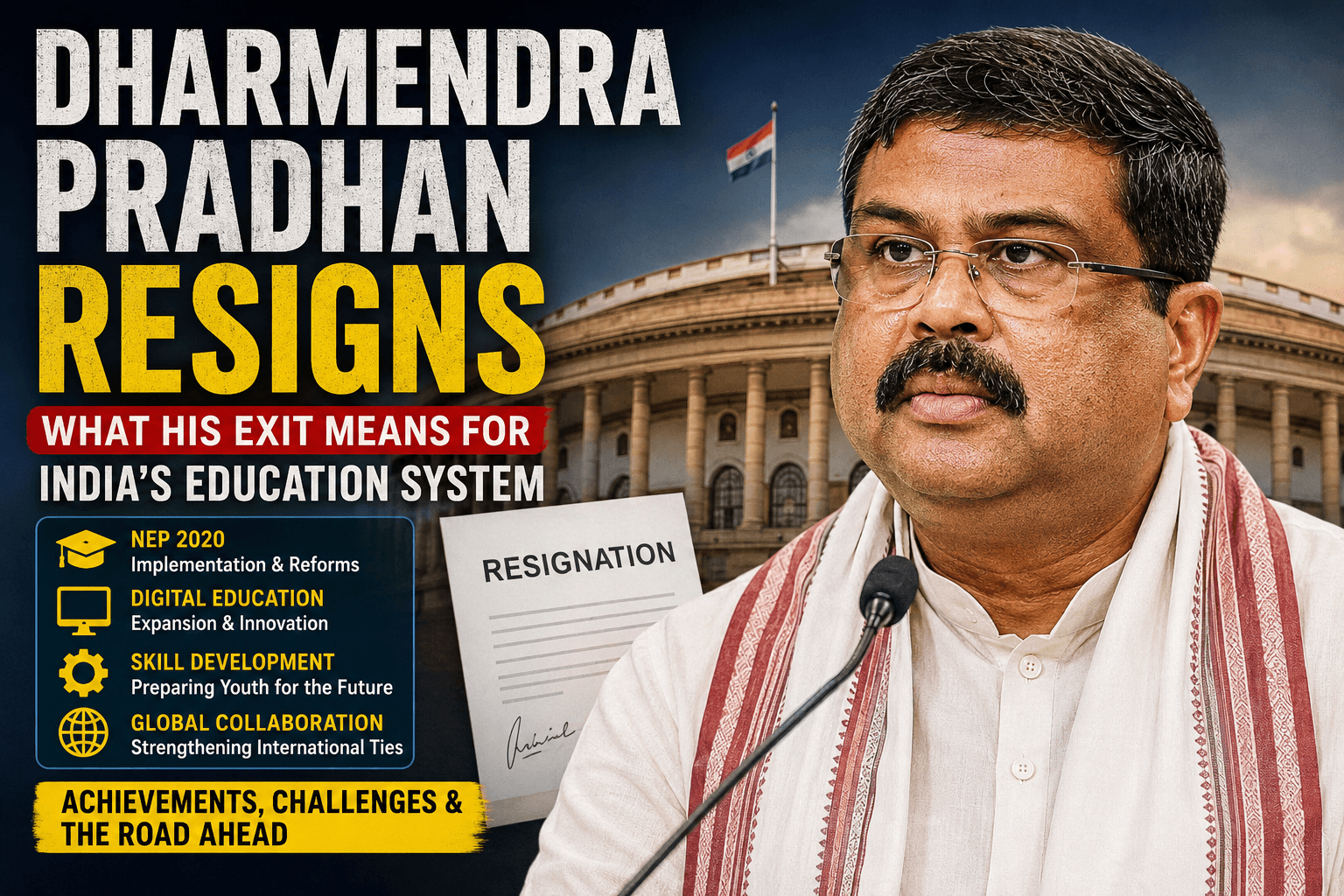
The resignation of Union Education Minister Dharmendra Pradhan has become one of the biggest political developments in India. As the face of the country’s education reforms over the past few years, Pradhan played a major role in implementing the National Education Policy (NEP) 2020, promoting digital learning, expanding skill development, and introducing several changes to higher education.
His sudden resignation has raised several questions among students, teachers, parents, education experts, and political analysts. Why did he resign? What happens next? Will the reforms continue? How will this affect India’s education system?
In this article, we explore everything you need to know about Dharmendra Pradhan’s resignation, the reasons behind it, his achievements, the reactions from across the country, and what this leadership change could mean for the future of Indian education.
Who Is Dharmendra Pradhan?
Dharmendra Pradhan is a senior leader of the Bharatiya Janata Party (BJP) and has held several important positions in the Government of India. Before becoming the Union Education Minister, he served as the Minister of Petroleum and Natural Gas, where he gained recognition for expanding access to clean cooking fuel through government welfare schemes.
In July 2021, he took charge as India’s Education Minister. During his tenure, he focused on transforming the education system by implementing long-term reforms aimed at improving quality, accessibility, innovation, and skill-based learning.
His leadership was closely associated with the rollout of the National Education Policy 2020, one of the most ambitious education reforms introduced in independent India.
Dharmendra Pradhan’s Resignation
Dharmendra Pradhan officially resigned from the post of Union Education Minister, marking the end of a significant chapter in India’s education sector. The resignation quickly became national news, with political parties, educators, and students reacting across social media and television debates.
Although leadership changes are common in politics, Pradhan’s resignation attracted widespread attention because he was overseeing several major educational reforms that are still in progress.
The central government has stated that the transition of leadership will ensure continuity in educational reforms while preparing for the next phase of policy implementation.
Why Did Dharmendra Pradhan Resign?
The resignation comes amid growing political developments and changing priorities within the government. Political analysts believe that cabinet reshuffles often occur to strengthen governance, improve administrative efficiency, and prepare for future policy goals.
Several factors have been discussed in public conversations:
- Ongoing political restructuring within the Union Cabinet.
- Administrative changes aimed at improving governance.
- The need for new leadership during the next phase of education reforms.
- Broader political strategy ahead of upcoming policy priorities.
While speculation continues, official statements emphasize that government reforms in education will continue without interruption.
His Biggest Achievements as Education Minister
During his tenure, Dharmendra Pradhan introduced or accelerated several major reforms that reshaped India’s education landscape.
1. Implementation of the National Education Policy (NEP) 2020
One of his biggest responsibilities was implementing the National Education Policy.
Key initiatives included:
- Flexible learning pathways.
- Multiple entry and exit options in higher education.
- Greater focus on skill development.
- Promotion of regional languages.
- Multidisciplinary education.
- Digital learning initiatives.
The NEP remains one of the largest education reform projects in India.
2. Digital Education Expansion
Pradhan strongly promoted technology in education.
Major initiatives included:
- Expansion of online learning platforms.
- Increased use of digital classrooms.
- Development of e-learning resources.
- Support for hybrid education models after the pandemic.
These initiatives helped improve access to education for millions of students.
3. Focus on Skill Development
Recognizing changing job market demands, Pradhan emphasized practical skills alongside traditional education.
His ministry encouraged:
- Vocational education.
- Industry partnerships.
- Internship opportunities.
- Entrepreneurship programs.
- Career-oriented learning.
The objective was to make Indian graduates more employable in both domestic and global markets.
4. International Collaboration
India also expanded academic cooperation with several international universities during his tenure.
The government encouraged:
- Student exchange programs.
- Global research partnerships.
- International campuses.
- Higher education reforms aligned with global standards.
These efforts aimed to strengthen India’s position as an emerging global education hub.
Challenges During His Tenure
Despite several achievements, Pradhan’s tenure was not without criticism.
Some major challenges included:
Competitive Examinations
Several entrance examinations faced logistical issues, delays, and public criticism, leading to debates over examination management and transparency.
NEP Implementation
Although the National Education Policy received widespread attention, implementing reforms across India’s diverse education system remained a significant challenge.
Different states adopted reforms at varying speeds, creating uneven progress.
Digital Divide
While online education expanded rapidly, unequal internet access and limited digital infrastructure continued to affect many students in rural and economically weaker regions.
Higher Education Reforms
Universities faced the complex task of adapting to new academic structures, curriculum changes, and administrative reforms, requiring considerable time and resources.
Public Reaction
Dharmendra Pradhan’s resignation triggered mixed reactions.
Supporters praised his commitment to modernizing Indian education and implementing long-term reforms.
Critics argued that several education challenges remained unresolved and expected stronger execution of policy reforms.
Students, teachers, education experts, and political leaders shared diverse opinions, making the resignation one of the most discussed education-related developments in recent years.
Regardless of political views, most observers agree that his tenure significantly influenced the direction of India’s education system.
Political Reactions to the Resignation
Dharmendra Pradhan’s resignation immediately sparked political debate across India. Leaders from both the ruling party and the opposition expressed their views on the development, with each side interpreting the move differently.
Supporters of the government described the resignation as part of a broader administrative strategy aimed at strengthening governance and ensuring fresh leadership in key ministries. They emphasized that cabinet reshuffles are a normal feature of parliamentary democracy and do not necessarily signal a change in policy direction.
Opposition parties, however, questioned the timing of the resignation and linked it to ongoing controversies surrounding the education sector. Several opposition leaders argued that issues related to competitive examinations, implementation of reforms, and public dissatisfaction had increased pressure on the ministry.
Regardless of political opinion, the resignation became one of the most discussed national issues, dominating television debates, newspaper headlines, and social media conversations.
Reaction from Students and Teachers
Students across the country responded with mixed emotions. Many appreciated the reforms introduced during Pradhan’s tenure, especially the emphasis on digital learning, skill development, and flexibility in higher education.
Others expressed concerns over examination-related challenges and hoped that the new leadership would focus on making entrance exams more transparent, efficient, and student-friendly.
Teachers and academic institutions also reacted differently. Some educators praised the National Education Policy (NEP) for encouraging innovation, multidisciplinary education, and research. Others pointed out that implementing these reforms required greater financial support, teacher training, and infrastructure improvements.
Education experts noted that meaningful reforms often take years to produce measurable results and that continuity would be essential regardless of who leads the ministry.
The Future of the National Education Policy (NEP)
One of the biggest questions following Dharmendra Pradhan’s resignation is whether the National Education Policy (NEP) 2020 will continue at the same pace.
Most policy analysts believe that the NEP will remain the foundation of India’s education reforms because it represents a long-term national vision rather than the agenda of a single minister.
The policy aims to:
- Improve foundational literacy and numeracy.
- Promote critical thinking and creativity.
- Increase flexibility in school and higher education.
- Strengthen vocational and skill-based learning.
- Expand digital education across India.
- Encourage multidisciplinary universities.
- Improve research and innovation.
Since many of these initiatives are already underway, experts expect the implementation process to continue under the next education minister.
Key Challenges Awaiting the New Education Minister
The incoming Education Minister will inherit several important responsibilities that will shape the future of Indian education.
1. Restoring Confidence in Competitive Examinations
Competitive examinations remain one of the biggest concerns for students. Ensuring fairness, transparency, security, and timely conduct of national-level exams will be among the ministry’s top priorities.
2. Completing NEP Implementation
Many schools, colleges, and universities are still adapting to the new education framework. The government will need to work closely with state governments, universities, and educational boards to ensure smooth implementation.
3. Bridging the Digital Divide
Although digital education has expanded rapidly, millions of students still lack reliable internet access, digital devices, and modern learning facilities. Closing this gap will remain essential for achieving educational equality.
4. Improving Teacher Training
Teachers play a central role in implementing educational reforms. Continuous professional development, updated teaching methods, and digital literacy programs will be necessary to ensure long-term success.
5. Increasing Research and Innovation
India aims to become a global knowledge economy. Achieving this goal will require greater investment in research institutions, innovation centers, startups, and international academic collaboration.
Economic Impact of Education Reforms
Education is closely linked to economic development. A skilled workforce attracts investment, encourages innovation, and improves national productivity.
The reforms introduced during Pradhan’s tenure sought to align education with industry needs by promoting practical skills, entrepreneurship, and vocational training.
If these initiatives continue successfully, India could strengthen its position in sectors such as:
- Information Technology
- Artificial Intelligence
- Manufacturing
- Healthcare
- Renewable Energy
- Digital Services
- Research and Development
Many economists believe that long-term education reforms contribute directly to economic growth and employment generation.
International Perspective
India’s education reforms have attracted attention from universities, researchers, and policymakers around the world.
International institutions have shown increasing interest in collaborating with Indian universities through research partnerships, faculty exchanges, and student mobility programs.
The introduction of multidisciplinary education, flexible academic structures, and greater emphasis on innovation has positioned India as an emerging destination for global higher education.
The next Education Minister will likely continue efforts to strengthen India’s international academic partnerships while maintaining the country’s focus on quality education.
Public Expectations from the Next Education Minister
With a leadership transition underway, expectations are naturally high. Students, parents, teachers, and education experts hope the next minister will focus on both continuity and improvement.
Some of the key expectations include:
- Transparent and secure examination systems.
- Faster implementation of pending education reforms.
- Better infrastructure in government schools.
- Increased funding for higher education and research.
- Affordable and accessible education for all.
- Stronger support for digital learning in rural areas.
- Closer collaboration with states and educational institutions.
Whoever assumes the role will face the important task of balancing ambitious reforms with practical implementation across India’s vast and diverse education system.
Dharmendra Pradhan’s Legacy as Education Minister
Dharmendra Pradhan leaves office after a tenure marked by ambitious reforms and significant changes to India’s education landscape. Whether viewed positively or critically, his time as Union Education Minister will be remembered for pushing structural reforms that aimed to modernize learning in the country.
His leadership was closely associated with the implementation of the National Education Policy (NEP) 2020, which introduced a new vision for school and higher education. The policy sought to move away from rote learning and encourage critical thinking, flexibility, multidisciplinary education, and skill development.
Beyond policy, Pradhan also emphasized digital education, vocational training, and global collaboration. These initiatives reflected the government’s long-term goal of preparing Indian students for a rapidly changing global economy.
At the same time, his tenure faced criticism over challenges in examination management, uneven implementation of reforms, and concerns raised by students and educators. These debates have become an important part of his legacy and will continue to shape discussions on education policy.
What Happens Next?
The resignation of an Education Minister does not stop the functioning of the Ministry of Education. Ongoing projects, policy implementation, and administrative work continue under the leadership of the new minister and senior officials.
Some of the key priorities in the coming months are expected to include:
- Continuing the rollout of NEP 2020.
- Improving the administration of national entrance examinations.
- Expanding digital education infrastructure.
- Strengthening government schools and higher education institutions.
- Encouraging research, innovation, and international partnerships.
- Supporting skill development and employability programs.
The direction taken by the new leadership will play a major role in determining how quickly these goals are achieved.
Why Education Leadership Matters
Education is one of the most important sectors for any nation. Decisions made by the Education Ministry influence millions of students, teachers, universities, and educational institutions.
Effective leadership can help:
- Improve learning outcomes.
- Create better employment opportunities.
- Promote scientific research and innovation.
- Reduce educational inequality.
- Strengthen India’s global competitiveness.
- Build a skilled workforce for future industries.
Because of this, every change in educational leadership attracts nationwide attention and public interest.
Frequently Asked Questions (FAQs)
1. Why did Dharmendra Pradhan resign?
According to official announcements, the resignation was part of a broader change in the Union Cabinet. Political observers have also linked it to ongoing developments in the education sector, though opinions differ on the primary reason.
2. What were Dharmendra Pradhan’s biggest achievements?
His tenure is best known for advancing the implementation of the National Education Policy (NEP) 2020, expanding digital education, promoting skill development, and encouraging reforms in higher education.
3. Will the National Education Policy continue?
Yes. The NEP is a long-term national education policy, and experts expect its implementation to continue under the new Education Minister.
4. How does this resignation affect students?
In the short term, there is no immediate change for students. Schools, colleges, universities, and examination bodies continue to function normally. Future policy decisions will depend on the priorities of the new leadership.
5. What challenges remain for India’s education system?
Some of the biggest challenges include improving examination systems, reducing the digital divide, increasing research funding, enhancing teacher training, and ensuring equal access to quality education across the country.
Final Thoughts
The resignation of Dharmendra Pradhan marks an important political and administrative transition for India’s education sector. During his tenure, he led several ambitious reforms that aimed to transform the country’s education system for the 21st century.
While supporters credit him with introducing long-term structural changes, critics argue that several challenges remain unresolved. Like many major public policies, the success of these reforms will ultimately depend on effective implementation, cooperation between the central and state governments, and sustained investment in education.
As India continues its journey toward becoming a global knowledge economy, the Ministry of Education will remain central to shaping the nation’s future. The next Education Minister will inherit both opportunities and responsibilities—continuing ongoing reforms while addressing the concerns of students, teachers, parents, and educational institutions.
The coming years will reveal how this leadership transition influences India’s educational progress. Regardless of political perspectives, one thing is clear: education will continue to be one of the most important pillars of India’s development, and every policy decision made today will have a lasting impact on future generations.
Editor’s Note
The resignation of Union Education Minister Dharmendra Pradhan has generated significant discussion across India. This article provides an overview of the political development, his contributions, the challenges during his tenure, and the possible implications for the country’s education system. As education policies continue to evolve, readers are encouraged to follow official government announcements and verified news sources for the latest updates. Leadership changes are a natural part of democratic governance, but the long-term success of India’s education system will depend on consistent policy implementation, transparency, and a continued focus on improving learning opportunities for every student.
https://thehommyblogger.com/